

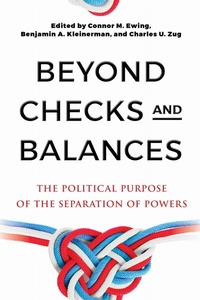
Beyond Checks and Balances
The Political Purpose of the Separation of Powers
Will be published approx. on 28. July 2026
Book
Hardback
304 pages
978-1-5128-2958-7 (ISBN)
Description
An argument for understanding the separation of powers as a political arrangement designed to pursue the common democratic good
Beyond Checks and Balances seeks to rescue the democratic concept of the separation of powers from a popular caricature of it: that checks and balances exist between branches of government to frustrate, slow, and inhibit change. Long regarded as a legal doctrine that must be adjudicated by the federal courts, political scientists Connor M. Ewing, Benjamin A. Kleinerman, and Charles U. Zug have gathered leading scholars' analyses into a volume that argues that the separation of powers is instead best understood politically. When cast as a configuration of powers, incentives, and institutions designed to pursue the foundational ends of politics, it becomes clear that separation of powers does not exist to stymie collective action, though it certainly is capable of doing so.
The book is divided into two sections: the first examines the foundations of statement-of-powers doctrine and thought. The second set of chapters analyzes the application of the doctrine and addresses more specific topics, such as the power to declare war, the scope of executive powers, and the impeachment of federal judges. The contributors spotlight the substantive constitutional goodsthat the arrangement commonly referred to as the separation of powers is designed to achieve.
The collection shows that-as a concept dedicated to creating collaborative, good democratic government-the separation of powers includes, but cannot be reduced to, constraints on governmental power. By incentivizing conflict and negotiation between different constitutional offices, the separation of powers brings diverse governmental perspectives to bear on the basic problems of politics, promoting political values like deliberation, decisiveness, and inclusion across branches.
Contributors: Sotirios A. Barber, Thomas R. Bell, Paul Carrese, Connor M. Ewing, Brigid Flaherty Staab, Benjamin A. Kleinerman, David J. Siemers, George Thomas, Kathleen Tipler, Jeffrey K. Tulis, Keith E. Whittington, Mariah Zeisberg, Charles U. Zug.
Beyond Checks and Balances seeks to rescue the democratic concept of the separation of powers from a popular caricature of it: that checks and balances exist between branches of government to frustrate, slow, and inhibit change. Long regarded as a legal doctrine that must be adjudicated by the federal courts, political scientists Connor M. Ewing, Benjamin A. Kleinerman, and Charles U. Zug have gathered leading scholars' analyses into a volume that argues that the separation of powers is instead best understood politically. When cast as a configuration of powers, incentives, and institutions designed to pursue the foundational ends of politics, it becomes clear that separation of powers does not exist to stymie collective action, though it certainly is capable of doing so.
The book is divided into two sections: the first examines the foundations of statement-of-powers doctrine and thought. The second set of chapters analyzes the application of the doctrine and addresses more specific topics, such as the power to declare war, the scope of executive powers, and the impeachment of federal judges. The contributors spotlight the substantive constitutional goodsthat the arrangement commonly referred to as the separation of powers is designed to achieve.
The collection shows that-as a concept dedicated to creating collaborative, good democratic government-the separation of powers includes, but cannot be reduced to, constraints on governmental power. By incentivizing conflict and negotiation between different constitutional offices, the separation of powers brings diverse governmental perspectives to bear on the basic problems of politics, promoting political values like deliberation, decisiveness, and inclusion across branches.
Contributors: Sotirios A. Barber, Thomas R. Bell, Paul Carrese, Connor M. Ewing, Brigid Flaherty Staab, Benjamin A. Kleinerman, David J. Siemers, George Thomas, Kathleen Tipler, Jeffrey K. Tulis, Keith E. Whittington, Mariah Zeisberg, Charles U. Zug.
Reviews / Votes
"The contributions in this provocative volume add up to nothing less than a wholesale reevaluation of the foundations of the American national separation of powers. It belongs on every constitutional scholar's bookshelf." - Josh Chafetz, Georgetown UniversityMore details
Series
Language
English
Place of publication
Pennsylvania
United States
Target group
Professional and scholarly
Product notice
Paper over boards
Illustrations
N/A
Dimensions
Height: 229 mm
Width: 152 mm
ISBN-13
978-1-5128-2958-7 (9781512829587)
Copyright in bibliographic data and cover images is held by Nielsen Book Services Limited or by the publishers or by their respective licensors: all rights reserved.
Schweitzer Classification
Persons
Connor M. Ewing is Assistant Professor in the Department of Political Science and Fellow of Trinity College at the University of Toronto. He has published with the International Journal of Constitutional Law.
Benjamin A. Kleinerman is R.W. Morrison Professor of Political Science at Baylor University. He has previously published articles in Perspectives on Politics (APSA) and American Political Science Review. He has served as a co-editor on Nomos and The Collected Works of Abraham Lincoln (Yale University Press, 2012).
Charles U. Zug is Assistant Professor of Political Science in the Truman School of Government and Public Affairs and Assistant Professor of Constitutional Democracy in the Kinder Institute on Constitutional Democracy. His recent publications include Dwight D. Eisenhower and the Federal Highway Act (University Press of Kansas, 2024) and Demagogues in American Politics (Oxford University Press, 2022).
Benjamin A. Kleinerman is R.W. Morrison Professor of Political Science at Baylor University. He has previously published articles in Perspectives on Politics (APSA) and American Political Science Review. He has served as a co-editor on Nomos and The Collected Works of Abraham Lincoln (Yale University Press, 2012).
Charles U. Zug is Assistant Professor of Political Science in the Truman School of Government and Public Affairs and Assistant Professor of Constitutional Democracy in the Kinder Institute on Constitutional Democracy. His recent publications include Dwight D. Eisenhower and the Federal Highway Act (University Press of Kansas, 2024) and Demagogues in American Politics (Oxford University Press, 2022).