

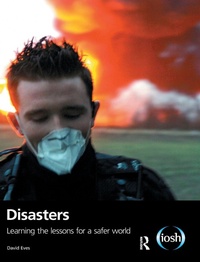
Disasters
Learning the Lessons for a Safer World
1st Edition
Published on 19. August 2016
Book
Hardback
256 pages
978-1-138-14423-1 (ISBN)
Description
This is a reprint of ISBN 978-0-901357-46-5
Disasters: learning the lessons for a safer world is both a tribute to the victims of past safety failures and a warning against complacency and cutting corners today. It also recognises the achievements of health and safety professionals and others in learning the lessons of past mistakes. As Trevor Kletz has written, "Someone has paid the 'tuition fess'. There is no need for you to pay them again."
Illustrated throughout in colour, the book looks at over 90 accidents, incidents and safety failures. Some, like Aberfan, Chernobyl and Hillsborough, are known simply by a single place name. Others have now faded from our collective consciousness but still have important lessons for us today, such as the early fires, explosions and mining disasters that paved the way for better safety management.
Disasters: learning the lessons for a safer world offers:
a description of events from 1800 to the present day
a wide range of incidents, from explosions and fires to floods, pollution and human and animal ill health
information on the background to each incident, what happened and the lessons that were learnt
an exploration of the politics of disaster and risk reduction
Disasters: learning the lessons for a safer world is both a tribute to the victims of past safety failures and a warning against complacency and cutting corners today. It also recognises the achievements of health and safety professionals and others in learning the lessons of past mistakes. As Trevor Kletz has written, "Someone has paid the 'tuition fess'. There is no need for you to pay them again."
Illustrated throughout in colour, the book looks at over 90 accidents, incidents and safety failures. Some, like Aberfan, Chernobyl and Hillsborough, are known simply by a single place name. Others have now faded from our collective consciousness but still have important lessons for us today, such as the early fires, explosions and mining disasters that paved the way for better safety management.
Disasters: learning the lessons for a safer world offers:
a description of events from 1800 to the present day
a wide range of incidents, from explosions and fires to floods, pollution and human and animal ill health
information on the background to each incident, what happened and the lessons that were learnt
an exploration of the politics of disaster and risk reduction
More details
Language
English
Place of publication
London
United Kingdom
Publishing group
Taylor & Francis Ltd
Target group
Professional and scholarly
Academic and Professional Practice & Development
Dimensions
Height: 260 mm
Width: 208 mm
Thickness: 19 mm
Weight
783 gr
ISBN-13
978-1-138-14423-1 (9781138144231)
Copyright in bibliographic data and cover images is held by Nielsen Book Services Limited or by the publishers or by their respective licensors: all rights reserved.
Schweitzer Classification
Other editions
Additional editions
E-Book
05/2016
Routledge
€69.99
Available for download
E-Book
05/2016
Routledge
€69.99
Available for download
Book
01/2015
1st Edition
Routledge
€95.60
Shipment within 10-20 days
Person
David Eves CB is a former Deputy Director-General of the Health and Safety Executive and has over 45 years' experience in the health and safety profession. He has also worked closely with DEFRA on the regulation of animal health and with the Health Protection Agency on environmental health.
He is co-author of Questioning Performance: the director's essential guide to health, safety and the environment, also published by IOSH.
He is co-author of Questioning Performance: the director's essential guide to health, safety and the environment, also published by IOSH.
Content
1. Too young to die, 2. Flixborough, Limberg and Enschede, 3. Deadly fires, 4. More conflagrations, 5. Gas explosions, 6. Ignorance is not blissful, 7. Seveso and other environmental calamities, 8. Unwelcome off-site consequences, 9. High explosives, 10. Maritime disasters, 11. Marine pollution, 12. Offshore catastrophes, 13. Aviation accidents, 14. Catastrophes in space, 15. Nuclear disasters, 16. Trouble in store, 17. Buncefield oil storage depot, 18. The price of coal, 19. Railways, 20. Crowd crushes, 21. Stadium tragedies, 22. The human factor, 23. Safety culture under strain, 24. Structural collapses, 25. Floods, 26. Silent killers at work, 27. Public health, 28. Animal catastrophes, 29. Bhopal, 30. Reducing hazards and risks, 31. The politics of disaster, 32. Establishing a culture of safety