

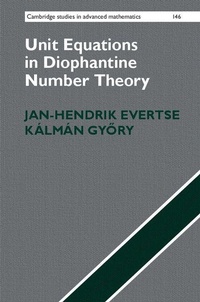
Unit Equations in Diophantine Number Theory
Published on 30. December 2015
Book
Hardback
378 pages
978-1-107-09760-5 (ISBN)
Description
Diophantine number theory is an active area that has seen tremendous growth over the past century, and in this theory unit equations play a central role. This comprehensive treatment is the first volume devoted to these equations. The authors gather together all the most important results and look at many different aspects, including effective results on unit equations over number fields, estimates on the number of solutions, analogues for function fields and effective results for unit equations over finitely generated domains. They also present a variety of applications. Introductory chapters provide the necessary background in algebraic number theory and function field theory, as well as an account of the required tools from Diophantine approximation and transcendence theory. This makes the book suitable for young researchers as well as experts who are looking for an up-to-date overview of the field.
Reviews / Votes
'The book is well written and is certain to be of use to experts and graduate students alike. Every chapter is prefaced with a nice introduction and summary, putting the material in perspective and surveying the proof techniques. The book also features an extensive bibliography and an easy-to-use glossary and index.' Lenny Fukshansky, MathSciNet 'Understanding the book requires only basic knowledge in algebra (groups, commutative rings, fields, Galois theory and elementary algebraic number theory). In particular the concepts of height, places and valuations play an important role. ... In addition to providing a survey, the authors improve both formulations and proofs of various important existing results in the literature, making their book a valuable asset for researchers in this area. ... I thank them for their fast and clear answers.' Pieter Moree, Nieuw Archief voor WiskundeMore details
Series
Language
English
Place of publication
Cambridge
United Kingdom
Target group
Professional and scholarly
Dimensions
Height: 235 mm
Width: 157 mm
Thickness: 27 mm
Weight
766 gr
ISBN-13
978-1-107-09760-5 (9781107097605)
Copyright in bibliographic data and cover images is held by Nielsen Book Services Limited or by the publishers or by their respective licensors: all rights reserved.
Schweitzer Classification
Other editions
Additional editions
Jan-Hendrik Evertse | Kalman Gyory
Unit Equations in Diophantine Number Theory
E-Book
01/2016
Cambridge University Press
€64.99
Available for download
Jan-Hendrik Evertse
Unit Equations in Diophantine Number Theory
E-Book
12/2015
Cambridge University Press
€56.99
Available for download
Persons
Jan-Hendrik Evertse is Assistant Professor in the Mathematical Institute at Leiden University. His research concentrates on Diophantine approximation and applications to Diophantine problems. In this area he has obtained some influential results, in particular on estimates for the numbers of solutions of Diophantine equations and inequalities. He has written more than 75 research papers and co-authored one book with Bas Edixhoven entitled Diophantine Approximation and Abelian Varieties (2003). Kalman Gyory is Professor Emeritus at the University of Debrecen, a member of the Hungarian Academy of Sciences and a well-known researcher in Diophantine number theory. Over his career he has obtained several significant and pioneering results, among others on unit equations, decomposable form equations, and their various applications. His results have been published in one book and 160 research papers. Gyory is also the founder and leader of the Number Theory Research Group in Debrecen, which consists of his former students and their descendants.
Content
Preface; Summary; Glossary of frequently used notation; Part I. Preliminaries: 1. Basic algebraic number theory; 2. Algebraic function fields; 3. Tools from Diophantine approximation and transcendence theory; Part II. Unit equations and applications: 4. Effective results for unit equations in two unknowns over number fields; 5. Algorithmic resolution of unit equations in two unknowns; 6. Unit equations in several unknowns; 7. Analogues over function fields; 8. Effective results for unit equations over finitely generated domains; 9. Decomposable form equations; 10. Further applications; References; Index.