

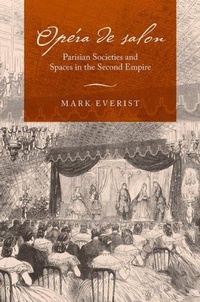
Opera de salon
Parisian Societies and Spaces in the Second Empire
Published on 30. September 2025
Book
Hardback
288 pages
978-0-19-769518-0 (ISBN)
Description
Opera de salon emerged in the early 1850s out of a much longer tradition of theatre de societe: the cultivation of performing plays in aristocratic town houses and chateaux which continued into the Second Empire of the 1850s and 1860s, and beyond. It consisted of a one-act operette with between six and nine musical compositions separated by spoken dialogue that carried the action in the same way as opera-comique or operette itself. Opera de salon was separated from operette and related genres by its performance context: never shared with the regulated theatre, opera de salon was cultivated in domestic living spaces that were repurposed in ways that ranged from simply pushing back the furniture to building a fully-fledged theatre in one's own home. Opera de salon furthermore found its way into the concert culture hosted by Parisian piano manufacturers Herz, Erard, Pleyel, and others.
In Opera de salon: Parisian Societies and Salons in the Second Empire, author Mark Everist brings to light a genre and a set of cultural practices that have long been obscured. Approximately 130 operas de salon were composed and performed up to ca. 1875, and, as Everist demonstrates, they represent a significant generic trajectory in the history of nineteenth century music and theatre. Produced by major composers and librettists of the day, these works play into questions of gender, age, and urban topography in ways unlike other musical and theatrical genres of the day. Everist's focus is on the salon--the domestic, the private--but he also shows how opera de salon moves effortlessly between intimate familial space, the more public salon, to the public and largely commercial concert hall in ways that prompt reflection on the status of all these critical categories. Ultimately, Everist challenges the hermetic discipline of 'opera studies' by opening up massive repertories that are still unknown, and by developing critical practices that go beyond traditional categories of theatres, institutions, consumers, and creators.
In Opera de salon: Parisian Societies and Salons in the Second Empire, author Mark Everist brings to light a genre and a set of cultural practices that have long been obscured. Approximately 130 operas de salon were composed and performed up to ca. 1875, and, as Everist demonstrates, they represent a significant generic trajectory in the history of nineteenth century music and theatre. Produced by major composers and librettists of the day, these works play into questions of gender, age, and urban topography in ways unlike other musical and theatrical genres of the day. Everist's focus is on the salon--the domestic, the private--but he also shows how opera de salon moves effortlessly between intimate familial space, the more public salon, to the public and largely commercial concert hall in ways that prompt reflection on the status of all these critical categories. Ultimately, Everist challenges the hermetic discipline of 'opera studies' by opening up massive repertories that are still unknown, and by developing critical practices that go beyond traditional categories of theatres, institutions, consumers, and creators.
More details
Language
English
Place of publication
New York
United States
Target group
Professional and scholarly
Product notice
sewn/stitched
Cloth over boards
Illustrations
28 illustrations, 13 tables
Dimensions
Height: 245 mm
Width: 166 mm
Thickness: 24 mm
Weight
576 gr
ISBN-13
978-0-19-769518-0 (9780197695180)
Copyright in bibliographic data and cover images is held by Nielsen Book Services Limited or by the publishers or by their respective licensors: all rights reserved.
Schweitzer Classification
Other editions
Additional editions
E-Book
06/2025
OUP eBook
€70.49
Available for download
E-Book
06/2025
OUP eBook
€70.49
Available for download
Person
Mark Everist is Professor of Music at the University of Southampton. His research focuses on the music of western Europe from 1150-1330, music for the stage in nineteenth-century France, Mozart, reception theory, and historiography. He is the author of six monographs, the most recent of which are Genealogies of Music and Memory and The Empire at the Opera, editor of three volumes of the Magnus Liber Organi, and has published over 80 articles in peer-reviewed journals and collections of essays. The recipient of the Solie (2010) and Slim (2011) awards of the American Musicological Society, he was elected a fellow of the Academia Europaea in 2012. Everist was President of the Royal Musical Association from 2011-17 and was elected a corresponding member of the American Musicological Society in 2014. He was visiting professor at the Sorbonne in 2021-22 and was elected to a fellowship at the French
Institute of Advanced Studies from 2023-24. In July 2024, Everist was named Chevalier de l'Ordre des Arts et des Lettres by the French Minister of Culture.
Institute of Advanced Studies from 2023-24. In July 2024, Everist was named Chevalier de l'Ordre des Arts et des Lettres by the French Minister of Culture.
Content
Illustrations
Music Examples
Tables
Acknowledgements
Introduction
1. Opera de salon
Opera - Salon
Opera de salon
Patterns of Publication
2. Performers and the Improvised Stage
Casts, Scoring and Instrumentation
Vocal Artists
The Improvised Stage
3. Performance and Places: The Bourgeois and the Aristocrat
Spaces and Patrons
Spaces and Patrons 1: The Medical Profession
Spaces and Patrons 2: Entrepreneurs and the Haute-Bourgeoisie
Spaces and Patrons 3: Government and Aristocracy
4. Performance and Places: Music and Letters
Spaces and Patrons 4: Artists and Men of Letters
Spaces and Patrons 5: Professional Musicians
Spaces and Patrons 6: Public Spaces
5. Contexts and cultivation
Contexts for creation
Salons - Concerts
Theatre de societe
Charade
Proverbe
Opera de salon and the Regulated Theatre
Salon, Song and Seance
6. Performance in the Parloir
Women, the Parloir and Opera de salon
Women Composers and Librettists
7. Locating Opera de salon
Time and Space
Spatialite
Geolocation
Multiplicities of Power
Opera de salon in the Provinces and Abroad
Conclusion
Appendix
Bibliography
Index
Music Examples
Tables
Acknowledgements
Introduction
1. Opera de salon
Opera - Salon
Opera de salon
Patterns of Publication
2. Performers and the Improvised Stage
Casts, Scoring and Instrumentation
Vocal Artists
The Improvised Stage
3. Performance and Places: The Bourgeois and the Aristocrat
Spaces and Patrons
Spaces and Patrons 1: The Medical Profession
Spaces and Patrons 2: Entrepreneurs and the Haute-Bourgeoisie
Spaces and Patrons 3: Government and Aristocracy
4. Performance and Places: Music and Letters
Spaces and Patrons 4: Artists and Men of Letters
Spaces and Patrons 5: Professional Musicians
Spaces and Patrons 6: Public Spaces
5. Contexts and cultivation
Contexts for creation
Salons - Concerts
Theatre de societe
Charade
Proverbe
Opera de salon and the Regulated Theatre
Salon, Song and Seance
6. Performance in the Parloir
Women, the Parloir and Opera de salon
Women Composers and Librettists
7. Locating Opera de salon
Time and Space
Spatialite
Geolocation
Multiplicities of Power
Opera de salon in the Provinces and Abroad
Conclusion
Appendix
Bibliography
Index