

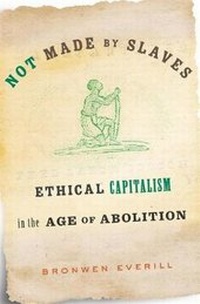
Not Made by Slaves
Ethical Capitalism in the Age of Abolition
Published on 1. September 2020
Book
Hardback
328 pages
978-0-674-24098-8 (ISBN)
Description
How abolitionist businesses marshaled intense moral outrage over slavery to shape a new ethics of international commerce.
"East India Sugar Not Made By Slaves." With these words on a sugar bowl, consumers of the early nineteenth century declared their power to change the global economy. Bronwen Everill examines how abolitionists from Europe to the United States to West Africa used new ideas of supply and demand, consumer credit, and branding to shape an argument for ethical capitalism.
Everill focuses on the everyday economy of the Atlantic world. Antislavery affected business operations, as companies in West Africa, including the British firm Macaulay & Babington and the American partnership of Brown & Ives, developed new tactics in order to make "legitimate" commerce pay. Everill explores how the dilemmas of conducting ethical commerce reshaped the larger moral discourse surrounding production and consumption, influencing how slavery and freedom came to be defined in the market economy. But ethical commerce was not without its ironies; the search for supplies of goods "not made by slaves"-including East India sugar-expanded the reach of colonial empires in the relentless pursuit of cheap but "free" labor.
Not Made by Slaves illuminates the early years of global consumer society, while placing the politics of antislavery firmly in the history of capitalism. It is also a stark reminder that the struggle to ensure fair trade and labor conditions continues.
"East India Sugar Not Made By Slaves." With these words on a sugar bowl, consumers of the early nineteenth century declared their power to change the global economy. Bronwen Everill examines how abolitionists from Europe to the United States to West Africa used new ideas of supply and demand, consumer credit, and branding to shape an argument for ethical capitalism.
Everill focuses on the everyday economy of the Atlantic world. Antislavery affected business operations, as companies in West Africa, including the British firm Macaulay & Babington and the American partnership of Brown & Ives, developed new tactics in order to make "legitimate" commerce pay. Everill explores how the dilemmas of conducting ethical commerce reshaped the larger moral discourse surrounding production and consumption, influencing how slavery and freedom came to be defined in the market economy. But ethical commerce was not without its ironies; the search for supplies of goods "not made by slaves"-including East India sugar-expanded the reach of colonial empires in the relentless pursuit of cheap but "free" labor.
Not Made by Slaves illuminates the early years of global consumer society, while placing the politics of antislavery firmly in the history of capitalism. It is also a stark reminder that the struggle to ensure fair trade and labor conditions continues.
Reviews / Votes
Impressive scholarship...[Readers] will be rewarded with greater understanding of historical developments that changed the relationship between consumers and producers in a global economy in ways that reverberate to this day. -- Marc M. Arkin * Wall Street Journal * Everill repositions West Africa as central to the broader Atlantic story of 18th and 19th century economic morality, its relationship with commercial ethics, and the expansion of capitalism. -- Kofi Adjepong-Boateng * Financial Times * An exceptional interpretation of how the Atlantic world envisioned social responsibility and how some people faced questions about ethical capitalism that still vex us today. -- Alessandra McLoughlin * Origins * Offers a penetrating new perspective on abolition in the British Empire by spotlighting a particular cast of characters: the commercial abolitionists in West Africa who fashioned a consumer-focused, business-friendly antislavery ethics. These figures sought to prove the moral and economic superiority of non-slave labor while profiting from the transition away from slavery...Impressive. -- Dale Kretz * Jacobin * [A] brisk jaunt through decades of history...This is a book that intervenes masterfully in various fields...[and] can be read profitably alongside the burgeoning scholarship that seeks to understand the rise and evolution of capitalism itself. -- Gerald Horne * S-USIH: Society for U.S. Intellectual History * [An] incisive history of political economy. -- Michael Taylor * London Review of Books * Intriguing...Armed with fresh insights from the new history of slavery and capitalism, Everill argues that scholars must launch a renewed investigation into the origins of abolitionism in the Atlantic World. If-as the new history contends-slavery was itself capitalist, then we can no longer assume that the triumph of capitalism made abolitionism inevitable...Not Made by Slaves successfully knits together U.S. and West African history in novel ways that will make it especially useful and exciting for early Americanists looking to expand their transnational reach. -- Samantha Payne * Business History Review * A fascinating, well-written book about abolitionists' efforts to construct an antislavery economic island in a global capitalism system shaped by slavery-generated profit. -- Edward E. Baptist, author of <i>The Half Has Never Been Told</i> In this deeply researched and elegantly written book, Everill follows the merchants and activists in West Africa, Europe, and the Americas who hoped to purify capitalism. Not Made by Slaves is a surprising, searching, and thoughtful examination of an overlooked but essential problem in the history of slavery and emancipation in the Atlantic world. -- Padraic X. Scanlan, author of <i>Freedom's Debtors</i> Where did fair trade come from? As we learn in this innovative book, it emerged in multiple parts of the nineteenth-century Atlantic world as activists, merchants, and producers grappled with the complications of ending and replacing slavery. This is an important, truly transnational history of the fraught development of capitalism and the politics of ethical consumption that are still with us today. -- Lisa A. Lindsay, author of <i>Atlantic Bonds</i> A rich, exciting, and thought-provoking examination of how a global system was constructed from the bottom up. Everill demonstrates how abolitionists turned consumers into the moral compass of capitalism, a shift that obscured the other ethical dilemmas capitalism posed, from poorly paid labor to the sale of ethically dubious goods-a framework of justification whose legacies continue to this day. -- Joanna Cohen, author of <i>Luxurious Citizens</i> In an insightful and important book, Everill offers a fresh perspective on abolition by examining how abolitionists used free trade to undermine slavery and the slave trade. A real strength of the work is her focus on the central role that West African trade and radical experiments in Sierra Leone and Liberia played in shaping both Atlantic abolition and commercial reform. -- Randy J. Sparks, author of <i>Where the Negroes Are Masters</i> In this groundbreaking exploration of ethical capitalism in the age of Atlantic empire and slavery, Everill digs down into the efforts aimed at making an immoral trade just. Giving equal attention to North America, Europe, and West Africa, she carefully documents the struggle to buy, sell, and consume according to ideas of free and fair trade. With the morality of global capitalism under the microscope today, this is a book for our times. -- Emma Hart, author of <i>Trading Spaces</i>More details
Language
English
Place of publication
Cambridge, Mass
United States
Target group
Professional and scholarly
Illustrations
1 Karte
1 Maps
Dimensions
Height: 235 mm
Width: 156 mm
ISBN-13
978-0-674-24098-8 (9780674240988)
Copyright in bibliographic data and cover images is held by Nielsen Book Services Limited or by the publishers or by their respective licensors: all rights reserved.
Schweitzer Classification
Person
Bronwen Everill is the 1973 College Lecturer in History at Gonville & Caius College and Director of the Centre of African Studies at the University of Cambridge. She is the author of Abolition and Empire in Sierra Leone and Liberia and is a Fellow of the Royal Historical Society.