

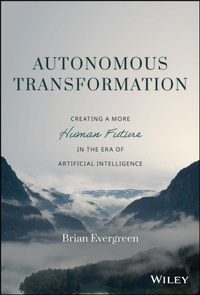
Autonomous Transformation
Description
Social good initiatives are incompatible with the current network of systems that make up and support the private and public sectors. Millions of dollars have been invested in bringing leaders together from organizations around the world to design solutions for global challenges such as the climate crisis, child labor, racism, war, and many more. Despite executive buy-in, alignment of core capabilities and resources, passionate leadership, and well-designed strategies, these initiatives inevitably fail (with a few, notable exceptions).
The dawn of the Internet ignited a global redesign and rebuild of the interlocking systems that make up and support the private and public sectors today. The era of Digital Transformation extended this further through the adoption of cloud technologies and distributed computing.
With a recent wave of technological advancements, organizations have arrived at another global redesign and rebuilding of the network of systems that make up society: Autonomous Transformation, revealing an opportunity for leaders to create Profitable Good through systemic design in combination with emerging autonomous technologies and surprising and remarkable partnerships.
Autonomous Transformation provides a blueprint for leaders and managers who have aspired or attempted to harness artificial intelligence and its adjacent technologies for the betterment of their organization and the world, weaving strategy, business, economics, systemic design, and philosophy into four actionable steps with accompanying frameworks:
Clear the Digital Fog
See the Systems
Choose a Problem Future
Design Inevitability
<b>From technologist and strategist Brian Evergreen, a bold new agenda for the role of organizational leaders in creating a more human future with technology</b>
Social good initiatives are incompatible with the current network of systems that make up and support the private and public sectors. Millions of dollars have been invested in bringing leaders together from organizations around the world to design solutions for global challenges such as the climate crisis, child labor, racism, war, and many more. Despite executive buy-in, alignment of core capabilities and resources, passionate leadership, and well-designed strategies, these initiatives inevitably fail (with a few, notable exceptions).
The dawn of the Internet ignited a global redesign and rebuild of the interlocking systems that make up and support the private and public sectors today. The era of Digital Transformation extended this further through the adoption of cloud technologies and distributed computing.
With a recent wave of technological advancements, organizations have arrived at another global redesign and rebuilding of the network of systems that make up society:<b> Autonomous Transformation</b>, revealing an opportunity for leaders to create<b> Profitable Good </b>through systemic design in combination with emerging autonomous technologies and surprising and remarkable partnerships.<b> </b>
<b><i>Autonomous Transformation</i></b> provides a blueprint for leaders and managers who have aspired or attempted to harness artificial intelligence and its adjacent technologies for the betterment of their organization and the world, weaving strategy, business, economics, systemic design, and philosophy into four actionable steps with accompanying frameworks:
<ol><li><b></b></li><li><b>Clear the Digital Fog</b></li><li><b><b></b></b></li><li><b><b>See the Systems</b></b></li><li><b><b><b></b></b></b></li><li><b><b><b>Choose a Problem Future</b></b></b></li><li><b><b><b><b></b></b></b></b></li><li><b><b><b><b>Design Inevitability</b></b></b></b></li></ol>More details
Other editions
Additional editions


Content
Introduction: We Can Create a More Human Future
<b>Part One: The Fundamentals</b>
1. Reformation, Transformation, and Creation: Defining Autonomous Transformation
2. What Does It Mean to Be Human in the Era of Artificial Intelligence?
<b>Part Two: The Art of the Impossible</b>
3. Our Inheritance
4. Maintenance Mode
<b>Part Three: Envision Your Future</b>
5. Requiem for the Industrial Revolution: Rehumanizing Work
6. The Problem with Solving Problems: Introducing Future Solving
7. Developing the Skill of Envisioning
<b>Part Four: Discover and Rediscover</b>
8. Systemic Design and the Lost Art of Synthesis
9. The Organization as a Chessboard: Seeing the Pieces
10. The Organization as a System
11. A Broken System
<b>Part Five: Clear the Digital Fog</b>
12. Chaos, Noise, and Epistemology in the Era of Artificial Intelligence
13. Silicon Valley, Wall Street, and the Factory Floor
14. The Multiplication of Expertise: A Leadership Imperative
<b>Part Six: Design for Inevitability</b>
15. From Data-Driven to Reason-Driven
16. The Reformational Economics of Linear and Exponential Value
17. The Reformational Economics of Omission and Commission
18. The Ecosystem: Surprising and Remarkable Partnerships
<b>Part Seven: Create a More Human Future</b>
19. Beyond Pilot Purgatory
20. Storytelling: Leading Social Systems
21. A More Human Organization
<b>Part Eight: Autonomous Transformation Technologies</b>
22. Autonomous Transformation Technologies: A Leader's Guide
23. A Deeper Dive into Artificial Intelligence
Conclusion
What Should You Read Next?
Acknowledgments
Index