

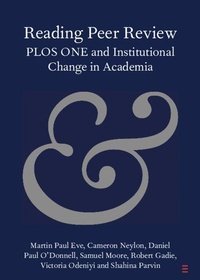
Reading Peer Review
PLOS ONE and Institutional Change in Academia
Published on 4. February 2021
Book
Paperback/Softback
126 pages
978-1-108-74270-2 (ISBN)
Description
This Element describes for the first time the database of peer review reports at PLOS ONE, the largest scientific journal in the world, to which the authors had unique access. Specifically, this Element presents the background contexts and histories of peer review, the data-handling sensitivities of this type of research, the typical properties of reports in the journal to which the authors had access, a taxonomy of the reports, and their sentiment arcs. This unique work thereby yields a compelling and unprecedented set of insights into the evolving state of peer review in the twenty-first century, at a crucial political moment for the transformation of science. It also, though, presents a study in radicalism and the ways in which PLOS's vision for science can be said to have effected change in the ultra-conservative contemporary university. This title is also available as Open Access on Cambridge Core.
More details
Series
Language
English
Place of publication
Cambridge
United Kingdom
Product notice
Paperback (trade)
Illustrations
Worked examples or Exercises
Dimensions
Height: 172 mm
Width: 122 mm
Thickness: 10 mm
Weight
118 gr
ISBN-13
978-1-108-74270-2 (9781108742702)
Copyright in bibliographic data and cover images is held by Nielsen Book Services Limited or by the publishers or by their respective licensors: all rights reserved.
Schweitzer Classification
Other editions
Additional editions

E-Book
02/2021
Cambridge University Press
€9.49
Available for download

Martin Paul Eve | Cameron Neylon | Daniel Paul O'Donnell
Reading Peer Review
PLOS ONE and Institutional Change in Academia
E-Book
01/2021
Cambridge University Press
€10.49
Available for download
Persons
Content
1. Peer Review and its discontents; 2. The radicalism of PLOS; 3. New technologies, old traditions?; 4. PLOS, institutional change, and the future of peer review.