

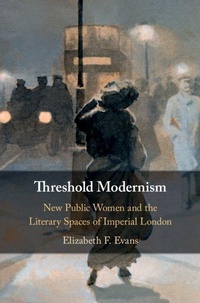
Threshold Modernism
New Public Women and the Literary Spaces of Imperial London
Published on 6. December 2018
Book
Hardback
274 pages
978-1-108-47981-3 (ISBN)
Description
Threshold Modernism reveals how changing ideas about gender and race in late nineteenth- and early twentieth-century Britain shaped - and were shaped by - London and its literature. Chapters address key sites, especially department stores, women's clubs, and city streets, that coevolved with controversial types of modern women. Interweaving cultural history, narrative theory, close reading, and spatial analysis, Threshold Modernism considers canonical figures such as George Gissing, Henry James, Dorothy Richardson, H. G. Wells, and Virginia Woolf alongside understudied British and colonial writers including Amy Levy, B. M. Malabari, A. B. C. Merriman-Labor, Duse Mohamed Ali, and Una Marson. Evans argues that these diverse authors employed the 'new public women' and their associated spaces to grapple with widespread cultural change and reflect on the struggle to describe new subjects, experiences, and ways of seeing in appropriately novel ways. For colonial writers of color, those women and spaces provided a means through which to claim their own places in imperial London.
Reviews / Votes
'The book's arguments are clear and forceful. The recovery of reverse imperial ethnography adds historical depth to treatments of race in London that too often begin with materials published after the Second World War. The book will be of interest to a wide variety of readers, from academic specialists in modernism, British literature, women's literature, and postcolonial literature and to advanced students in courses on British modernism, literature and the city, and women's writing.' Michael Thurston, Smith College, Massachusetts 'This is a well-conceived and deftly executed analysis of women's changing position in late nineteenth- and early twentieth-century London, as represented in a wide range of literary texts. It offers useful new methodologies for literary study, drawing particularly on new scholarly approaches in feminist geography and digital humanities, and is fresh and original in its insights.' Lise Sanders, Hampshire College, Massachusetts 'Everyone loves a book with maps. Evans has mapped out sites of narrative significance in Henry James' The Princess Casamassima, Amy Levy's The Romance of a Shop, George Gissing's The Odd Women, H. G. Wells' Ann Veronica and Virginia Woolf's Night and Day.' Rebecca Bowler, Times Higher Education 'Evans contributes to the ongoing debate on the nature and definition, and quantity of modernisms, revealing 'overlooked commonalities' even between H. G. Wells and Virginia Woolf. In advancing her arguments, Evans employs maps, spatial theory and work from understudied colonial writers of colour who gazed with outsiders' eyes on the teeming imperial metropolis; and she asks us to re-examine literary scholarship with fresh eyes, too.' The Times Literary SupplementMore details
Language
English
Place of publication
Cambridge
United Kingdom
Target group
Professional and scholarly
Illustrations
Worked examples or Exercises; 11 Halftones, black and white
Dimensions
Height: 235 mm
Width: 157 mm
Thickness: 19 mm
Weight
552 gr
ISBN-13
978-1-108-47981-3 (9781108479813)
Copyright in bibliographic data and cover images is held by Nielsen Book Services Limited or by the publishers or by their respective licensors: all rights reserved.
Schweitzer Classification
Other editions
Additional editions
Book
07/2021
Cambridge University Press
€48.90
Shipment within 15-20 days
E-Book
12/2018
Cambridge University Press
€18.49
Available for download
E-Book
11/2018
Cambridge University Press
€88.99
Available for download
Person
Elizabeth F. Evans teaches in the Department of English and the Program in Gender Studies at the University of Notre Dame. She specializes in British and Anglophone literature of the long twentieth century, with particular attention to modernism. She is the co-editor of Woolf and the City (2010) and has published in Modern Fiction Studies, Literature Compass, and Cultural Analytics and in edited collections on Amy Levy, George Gissing, and Virginia Woolf.
Content
Introduction: London, 1880-1940: Liminal Sites and Contested Identities; 1. Modern sites for modern types: locating the new public woman; 2. Shops and shop girls: the modern shop, 'counter-jumpers', and the shopgirl's narrative evolution; 3. Streets and the woman walker: when 'street love' meets Flanerie; 4. Women's clubs and clubwomen: 'neutral territory', feminist heterotopia, and failed 'diplomacy'; 5. New public women through colonial eyes: reverse imperial ethnography; Notes; Bibliography; Index.