

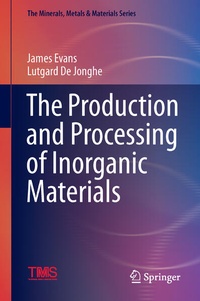
The Production and Processing of Inorganic Materials
Published on 31. December 2016
Book
Hardback
XIV, 534 pages
978-3-319-48566-9 (ISBN)
Description
Guiding readers from the significance, history, and sources of materials to advanced materials and processes, this textbook looks at the production and primary processing of inorganic materials, such as ceramics, metals, silicon, and some composite materials. The text encourages instructors to teach the production of all types of inorganic materials as one. While recognizing the differences between producing various types of materials, the authors focus on the commonality of thermodynamics, kinetics, transport phenomena, phase equilibria and transformation, process engineering, and surface chemistry to all inorganic materials. The text focuses on fundamentals and how fundamentals can be applied to understand how the major inorganic materials are produced and the initial stages of their processing. Understanding of these fundamentals will equip students for engineering future processes for producing materials or for studying the processing of the many less common materials not examined in this text. The text is intended for use in an undergraduate course at the junior or senior level, but will also serve as a useful introductory and reference work for graduate students and practicing scientists and engineers.
More details
Series
Edition
1st ed. 2016
Language
English
Place of publication
Cham
Switzerland
Publishing group
Springer International Publishing
Target group
Professional and scholarly
Illustrations
XIV, 534 p.
Dimensions
Height: 235 mm
Width: 157 mm
Thickness: 35 mm
Weight
943 gr
ISBN-13
978-3-319-48566-9 (9783319485669)
DOI
10.1007/978-3-319-48163-0
Schweitzer Classification
Other editions
Additional editions
James W. Evans | Lutgard C. De Jonghe
The Production and Processing of Inorganic Materials
Book
10/2002
The Minerals, Metals & Materials Society
€126.20
Article exhausted; check different version
Persons
The Minerals, Metals & Materials Society (TMS) is a member-driven international professional society dedicated to fostering the exchange of learning and ideas across the entire range of materials science and engineering, from minerals processing and primary metals production, to basic research and the advanced applications of materials. Included among its nearly 13,000 professional and student members are metallurgical and materials engineers, scientists, researchers, educators, and administrators from more than 70 countries on six continents. For more information on TMS, visit www.tms.org.