


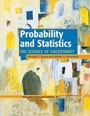
Probability and Statistics
The Science of Uncertainty
2nd Edition
Published on 30. November 2009
Book
Hardback
200 pages
978-1-4292-2462-8 (ISBN)
Description
Unlike some more traditional introductory mathematics and statistics competitors, Probability and Statistics: The Science of Uncertainty brings a modern flavour to the course, incorporating the computer and offering an integrated approach to inference that includes the frequency approach and the Bayesian inference. From the start of the book, it integrates simulations into its theoretical coverage, and emphasizes the use of computer-powered computation throughout. Maths and science students (both undergraduate and postgraduate) with just one year of calculus can use this text and experience a refreshing blend of applications and theory that goes beyond merely mastering the technicalities.
The second edition now includes a number of features designed to make the material more accessible and level-appropriate to the students taking this course today.
The second edition now includes a number of features designed to make the material more accessible and level-appropriate to the students taking this course today.
More details
Edition
2nd ed. 2010
Language
English
Place of publication
New York
United States
Publishing group
Macmillan Learning
Target group
Professional and scholarly
Edition type
Revised edition
Illustrations
200 p.
Dimensions
Height: 229 mm
Width: 178 mm
ISBN-13
978-1-4292-2462-8 (9781429224628)
Copyright in bibliographic data is held by Nielsen Book Services Limited or its licensors: all rights reserved.
Schweitzer Classification
Other editions
Additional editions
Book
03/2010
2nd Edition
WH Freeman
€26.74
Article exhausted; check different version
Previous edition
Book
07/2003
W.H.Freeman & Co Ltd
€71.98
Article exhausted; check for reprint
Persons
Michael Evans is a Professor of Statistics at the University of Toronto. He received his Ph.D. from the University of Toronto in 1977 and has been employed there ever since.
Jeffrey Rosenthal is a Professor in the Department of Statistics at the University of Toronto. He received his Ph.D. from Harvard University at the age of 24.
Jeffrey Rosenthal is a Professor in the Department of Statistics at the University of Toronto. He received his Ph.D. from Harvard University at the age of 24.
Content
1 Probability Models 1.1 Probability: A Measure of Uncertainty 1.2 Probability Models 1.3 Properties of Probability Models 1.4 Uniform Probability on Finite Spaces 1.5 Conditional Probability and Independence 1.6 Continuity of P 1.7 Further Proofs (Advanced).- 2 Random Variables and Distributions 2.1 Random Variables 2.2 Distributions of Random Variables 2.3 Discrete Distributions 2.4 Continuous Distributions 2.5 Cumulative Distribution Functions 2.6 One-Dimensional Change of Variable 2.7 Joint Distributions 2.8 Conditioning and Independence 2.9 Multidimensional Change of Variable 2.10 Simulating Probability Distributions.- 3 Expectation 3.1 The Discrete Case 3.2 The Absolutely Continuous Case 3.3 Variance, Covariance, and Correlation 3.4 Generating Functions 3.5 Conditional Expectation 3.6 Inequalities 3.7 General Expectations (Advanced) 3.8 Further Proofs (Advanced).- 4 Sampling Distributions and Limits 4.1 Sampling Distributions 4.2 Convergence in Probability 4.3 Convergence with Probability 1 4.4 Convergence in Distribution 4.5 Monte Carlo Approximations 4.6 Normal Distribution Theory 4.7 Further Proofs (Advanced).- 5 Statistical Inference 5.1 Why Do We Need Statistics? 5.2 Inference Using a Probability Model 5.3 Statistical Models 5.4 Data Collection 5.5 Some Basic Inferences.- 6 Likelihood Inference 6.1 The Likelihood Function 6.2 Maximum Likelihood Estimation 6.3 Inferences Based on the MLE6.4 Distribution-Free Methods 6.5 Asymptotics for the MLE (Advanced).- 7 Bayesian Inference 7.1 The Prior and Posterior Distributions 7.2 Inference Based on the Posterior 7.3 Bayesian Computations 7.4 Choosing Priors 7.5 Further Proofs (Advanced).- 8 Optimal Inferences 8.1 Optimal Unbiased Estimation 8.2 Optimal Hypothesis Testing 8.3 Optimal Bayesian Inferences 8.4 Decision Theory (Advanced) 8.5 Further Proofs (Advanced).- 9 Model Checking 9.1 Checking the Sampling Model
9.2 Checking for Prior-Data Conflict9.3 The Problem with Multiple Checks.- 10 Relationships Among Variables 10.1 Related Variables 10.2 Categorical Response and Predictors 10.3 Quantitative Response and Predictors 10.4 Quantitative Response and Categorical Predictors 10.5 Categorical Response and Quantitative Predictors 10.6 Further Proofs (Advanced).- 11 Advanced Topic -Stochastic Processes 11.1 Simple Random Walk 11.2 Markov Chains 11.3 Markov Chain Monte Carlo 11.4 Martingales 11.5 Brownian Motion 11.6 Poisson Processes 11.7 Further Proofs.- Appendices A Mathematical Background A.1 Derivatives A.2 Integrals A.3 Infinite Series A.4 Matrix Multiplication A.5 Partial Derivatives A.6 Multivariable Integrals B Computations B.1 Using R B.2 Using Minitab C Common Distributions C.1 Discrete Distributions C.2 Absolutely Continuous Distributions D TablesD.1 Random Numbers D.2 Standard Normal Cdf D.3 Chi-Squared Distribution Quantiles D.4 t Distribution Quantiles D.5 F Distribution Quantiles D.6 Binomial Distribution Probabilities E Answers to Odd-Numbered Exercises.
9.2 Checking for Prior-Data Conflict9.3 The Problem with Multiple Checks.- 10 Relationships Among Variables 10.1 Related Variables 10.2 Categorical Response and Predictors 10.3 Quantitative Response and Predictors 10.4 Quantitative Response and Categorical Predictors 10.5 Categorical Response and Quantitative Predictors 10.6 Further Proofs (Advanced).- 11 Advanced Topic -Stochastic Processes 11.1 Simple Random Walk 11.2 Markov Chains 11.3 Markov Chain Monte Carlo 11.4 Martingales 11.5 Brownian Motion 11.6 Poisson Processes 11.7 Further Proofs.- Appendices A Mathematical Background A.1 Derivatives A.2 Integrals A.3 Infinite Series A.4 Matrix Multiplication A.5 Partial Derivatives A.6 Multivariable Integrals B Computations B.1 Using R B.2 Using Minitab C Common Distributions C.1 Discrete Distributions C.2 Absolutely Continuous Distributions D TablesD.1 Random Numbers D.2 Standard Normal Cdf D.3 Chi-Squared Distribution Quantiles D.4 t Distribution Quantiles D.5 F Distribution Quantiles D.6 Binomial Distribution Probabilities E Answers to Odd-Numbered Exercises.