

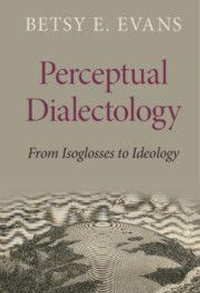
Perceptual Dialectology
From Isoglosses to Ideology
Will be published approx. on 30. November 2026
Book
Hardback
220 pages
978-1-108-83305-9 (ISBN)
Description
Perceptual Dialectology (PD) is the study of non-linguists' beliefs about language variation and its spatial distribution. This book provides a concise introduction to PD, covering the foundational assumptions and scholarly theories that inform it, such as sociolinguistics, human geography, and social psychology. It addresses the key strategies and best practices for the design, collection, analysis, and interpretation of PD research, such as the effects of bias, macro/micro social categories, use of interviews, and data analysis. It approaches the analysis of metalinguistic commentary through an exploration of the frameworks that assign meaning to language objects, and also includes a summary of the history and roots of PD, allowing readers to understand how PD intersects with both 'old' and 'new' ways of exploring sociolinguistic questions. Providing the tools to carry out their own research, it is ideal for researchers and students looking for a one-stop overview of this growing field.
More details
Other editions
Additional editions
Book
approx. 11/2026
Cambridge University Press
€31.50
Not yet published
Person
Betsy E. Evans is Professor of Linguistics in the University of Washington Department of Linguistics. She has been conducting research in perceptual dialectology and language regard for over twenty years with a focus on the function of language in marking identity, status, group solidarity, and cultural values.
Content
Preface; Acknowledgments; 1. Introduction: foundation and interdisciplinarity; 2. Considerations for PD methodology: collecting and analyzing data; 3. What does it all mean: challenges for interpreting data; 4. What can be learned from PD research?; 5. Concluding remarks; References; Index.