

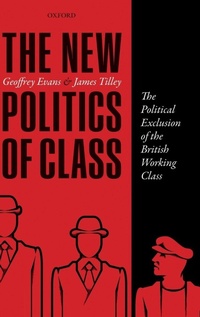
The New Politics of Class
The Political Exclusion of the British Working Class
Published on 23. February 2017
Book
Hardback
252 pages
978-0-19-875575-3 (ISBN)
Description
This book explores the new politics of class in 21st century Britain. It shows how the changing shape of the class structure since 1945 has led political parties to change, which has both reduced class voting and increased class non-voting.
This argument is developed in three stages. The first is to show that there has been enormous social continuity in class divisions. The authors demonstrate this using extensive evidence on class and educational inequality, perceptions of inequality, identity and awareness, and political attitudes over more than fifty years.
The second stage is to show that there has been enormous political change in response to changing class sizes. Party policies, politicians' rhetoric, and the social composition of political elites have radically altered. Parties offer similar policies, appeal less to specific classes, and are populated by people from more similar backgrounds. Simultaneously the mass media have stopped talking about the politics of class.
The third stage is to show that these political changes have had three major consequences. First, as Labour and the Conservatives became more similar, class differences in party preferences disappeared. Second, new parties, most notably UKIP, have taken working class voters from the mainstream parties. Third, and most importantly, the lack of choice offered by the mainstream parties has led to a huge increase in class-based abstention from voting. Working class people have become much less likely to vote. In that sense, Britain appears to have followed the US down a path of working class political exclusion, ultimately undermining the representativeness of our democracy. They conclude with a discussion of the Brexit referendum and the role that working class alienation played in its historic outcome.
This argument is developed in three stages. The first is to show that there has been enormous social continuity in class divisions. The authors demonstrate this using extensive evidence on class and educational inequality, perceptions of inequality, identity and awareness, and political attitudes over more than fifty years.
The second stage is to show that there has been enormous political change in response to changing class sizes. Party policies, politicians' rhetoric, and the social composition of political elites have radically altered. Parties offer similar policies, appeal less to specific classes, and are populated by people from more similar backgrounds. Simultaneously the mass media have stopped talking about the politics of class.
The third stage is to show that these political changes have had three major consequences. First, as Labour and the Conservatives became more similar, class differences in party preferences disappeared. Second, new parties, most notably UKIP, have taken working class voters from the mainstream parties. Third, and most importantly, the lack of choice offered by the mainstream parties has led to a huge increase in class-based abstention from voting. Working class people have become much less likely to vote. In that sense, Britain appears to have followed the US down a path of working class political exclusion, ultimately undermining the representativeness of our democracy. They conclude with a discussion of the Brexit referendum and the role that working class alienation played in its historic outcome.
Reviews / Votes
This is a book of outstanding academic and political importance. It reveals the changing relationship between social class and party support over recent decades and brings out the far-reaching implications for British political life in the post-Brexit era. * John Goldthorpe, Fellow, Nuffield College, University of Oxford. * In a masterly analysis of long-term social and political change in Britain, Evans and Tilley show that people's class position still influences their values - but that this class divide is now little reflected at the ballot box. Their findings leave us pondering whether social democratic parties like Labour can successfully adapt to a world in which the university graduate is coming to be more commonplace than the manual worker. * John Curtice, Professor of Politics, University of Strathclyde. * This book challenges the prevailing view that class politics in Britain is no more. It provides an important corrective to conventional wisdom regarding the decline of class, and a vital contribution to understanding the falling turnout of the working class. * Jan Leighley, Professor of Political Science, American University. * This book demonstrates that class politics is alive in Britain, but has taken on a new shape. The size and make-up of classes have changed, yet their distinctive preferences remain. It is the strategic reactions of office-seeking parties to these changes in class proportions, above all that of the Labour Party, that explain why classes have realigned their partisan affiliations. Splendidly captured through the lens of British politics, this book more generally illustrates the core political dynamics of post-industrial democratic capitalism. * Herbert Kitschelt, George V. Allen Professor of International Relations, Duke University. *More details
Language
English
Place of publication
Oxford
United Kingdom
Target group
College/higher education
Professional and scholarly
Dimensions
Height: 240 mm
Width: 161 mm
Thickness: 18 mm
Weight
546 gr
ISBN-13
978-0-19-875575-3 (9780198755753)
Copyright in bibliographic data and cover images is held by Nielsen Book Services Limited or by the publishers or by their respective licensors: all rights reserved.
Schweitzer Classification
Other editions
Additional editions
Geoffrey Evans | James Tilley
The New Politics of Class
The Political Exclusion of the British Working Class
E-Book
02/2017
1st Edition
OUP eBook
€25.99
Available for download
Geoffrey Evans | James Tilley
The New Politics of Class
The Political Exclusion of the British Working Class
E-Book
02/2017
1st Edition
OUP eBook
€25.99
Available for download
Persons
Geoffrey Evans is Professor of the Sociology of Politics, University of Oxford and Official Fellow in Politics, Nuffield College. He has published extensively in political science, sociology, and related disciplines on social structure, public opinion, and political behaviour. His publications include The End of Class Politics? (OUP, 1999) and Political Choice Matters: Explaining the Strength of Class and Religious Cleavages in Cross-National Perspective (OUP, 2013). He is also an editor for the journal Electoral Studies.
James Tilley is a Professor of Politics, the University of Oxford and a Fellow of Jesus College, Oxford. His research is mainly in the fields of public opinion and electoral behaviour specialising in British politics. He has published widely on various topics within these fields including the social bases of voting behaviour, generational changes in political attitudes, economic voting and the attribution of responsibility to governments, and sources of public support for the EU. His recent publications include Blaming Europe? Responsibility without Accountability in the European Union (co-authored with Sara B. Hobolt, OUP, 2014).
James Tilley is a Professor of Politics, the University of Oxford and a Fellow of Jesus College, Oxford. His research is mainly in the fields of public opinion and electoral behaviour specialising in British politics. He has published widely on various topics within these fields including the social bases of voting behaviour, generational changes in political attitudes, economic voting and the attribution of responsibility to governments, and sources of public support for the EU. His recent publications include Blaming Europe? Responsibility without Accountability in the European Union (co-authored with Sara B. Hobolt, OUP, 2014).
Content
PART 1: SOCIAL CONTINUITY; PART 2: POLITICAL CHANGE; PART 3: CONSEQUENCES