

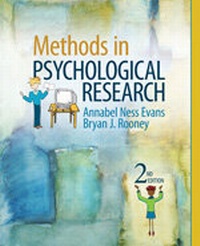
Methods in Psychological Research
2nd Edition
Published on 14. September 2010
Book
Paperback/Softback
408 pages
978-1-4129-7788-3 (ISBN)
Description
Providing an applied approach in this thoroughly updated Second Edition of Methods of Psychological Research, the authors apply findings from student feedback from their extensive classroom experience to insure both accessibility and relevance. End-of-chapter FAQs and projects complement the in-text exercises and art to develop a refreshingly realistic methodology.
Key Features include:
- Updated material and research examples incorporating reviewer suggestions
- New illustrative artwork emphasizes pertinent concepts while providing a visual foundation for today's students.
- Conceptual mini-exercises throughout the text encourage students to stop and think critically about the material they have just read.
- End-of-chapter material includes suggested answers to the conceptual exercises, a collection of chapter exercises and projects voted by students to be the most useful, and a popular FAQ section comprised of the questions asked most often by the authors' students.
- Chapter 13 is written specifically for students who are required to conduct or propose a research project, and is complete with detailed examples and basic statistical procedures.
Key Features include:
- Updated material and research examples incorporating reviewer suggestions
- New illustrative artwork emphasizes pertinent concepts while providing a visual foundation for today's students.
- Conceptual mini-exercises throughout the text encourage students to stop and think critically about the material they have just read.
- End-of-chapter material includes suggested answers to the conceptual exercises, a collection of chapter exercises and projects voted by students to be the most useful, and a popular FAQ section comprised of the questions asked most often by the authors' students.
- Chapter 13 is written specifically for students who are required to conduct or propose a research project, and is complete with detailed examples and basic statistical procedures.
More details
Edition
2nd Revised edition
Language
English
Place of publication
Thousand Oaks
United States
Target group
College/higher education
Edition type
Revised edition
Dimensions
Height: 232 mm
Width: 187 mm
Weight
680 gr
ISBN-13
978-1-4129-7788-3 (9781412977883)
Copyright in bibliographic data and cover images is held by Nielsen Book Services Limited or by the publishers or by their respective licensors: all rights reserved.
Schweitzer Classification
Other editions
New editions
Annabel Ness Evans | Bryan J. Rooney
Methods in Psychological Research
Book
08/2013
3rd Edition
SAGE Publications Inc
€117.80
Article exhausted; check for reprint
Previous edition
Annabel Ness Evans | Bryan J. Rooney
Methods in Psychological Research
Book
02/2008
1st Edition
SAGE Publications Inc
€80.65
Article exhausted; check for reprint
Persons
Annabel Ness Evans received her PhD in cognitive psychology from the University of Alberta in 1979.
She was the Chair of the Department of Psychology at Concordia University of Edmonton from 1975 until 2013, when she retired as Professor Emerita to muddle about in her garden, ski her brains out, and basically have a really good time.
She has written two previous texts. Her Using Basic Statistics in the Behavioral and Social Sciences (2014) is in its fifth edition and is available from Sage. She has coauthored a book, Principles of Behavior Analysis (1994), with Lyle Grant.
Annabel's sons, Christiaan, Marcus, and Luke, are grown and on their own so she lives with her Havanese dog, Skye, who has shown a notable lack of interest in psychological research.
Bryan J. Rooney is an Associate Professor of Psychology at Concordia University of Edmonton. He enjoys teaching research methods and finds the process of helping students design and implement their own research projects particularly rewarding. When students learn about research by developing their own projects, they experience the frustrations, excitements, and occasional disappointments that are part of the process. They also discover how fun it is to seek answers to questions that pique their curiosity. He has taught research methods for over 15 years and also teaches introductory and intermediate statistics. His research background is in visual and auditory sensation and perception, and more recent interests include quality-of-life issues for people with dementia. When he is not involved in the life of his busy family, you can find him skiing or riding his motorcycles depending on the season. He earned his PhD in psychology from Carleton University in Ottawa and his BSc and MSc from the University of Calgary.
She was the Chair of the Department of Psychology at Concordia University of Edmonton from 1975 until 2013, when she retired as Professor Emerita to muddle about in her garden, ski her brains out, and basically have a really good time.
She has written two previous texts. Her Using Basic Statistics in the Behavioral and Social Sciences (2014) is in its fifth edition and is available from Sage. She has coauthored a book, Principles of Behavior Analysis (1994), with Lyle Grant.
Annabel's sons, Christiaan, Marcus, and Luke, are grown and on their own so she lives with her Havanese dog, Skye, who has shown a notable lack of interest in psychological research.
Bryan J. Rooney is an Associate Professor of Psychology at Concordia University of Edmonton. He enjoys teaching research methods and finds the process of helping students design and implement their own research projects particularly rewarding. When students learn about research by developing their own projects, they experience the frustrations, excitements, and occasional disappointments that are part of the process. They also discover how fun it is to seek answers to questions that pique their curiosity. He has taught research methods for over 15 years and also teaches introductory and intermediate statistics. His research background is in visual and auditory sensation and perception, and more recent interests include quality-of-life issues for people with dementia. When he is not involved in the life of his busy family, you can find him skiing or riding his motorcycles depending on the season. He earned his PhD in psychology from Carleton University in Ottawa and his BSc and MSc from the University of Calgary.
Content
Preface
Acknowledgments
About the Authors
1. Introduction to Research in Psychology
2. Understanding the Research Literature
3. Research in Psychology: An Ethical Enterprise
4. Hypothesis Testing, Power, and Control: A Review of the Basics
5. Measuring Variables
6. Selecting Research Participants
7. Experimental Design: Independent Groups Designs
8. Experimental Design: Dependent Groups and Mixed Groups Designs
9. Experimental Design: Single-Participant Designs/The Operant Approach
10. Finding Relationships Among Variables: Nonexperimental Research
11. Data Collection Methods
12. Program Evaluation, Archival Research, and Meta-Analytic Designs
13. Your Research Project: Analyzing, Interpreting, and Presenting Your Research
14. Communicating in Psychology
Glossary
References
Index
Acknowledgments
About the Authors
1. Introduction to Research in Psychology
2. Understanding the Research Literature
3. Research in Psychology: An Ethical Enterprise
4. Hypothesis Testing, Power, and Control: A Review of the Basics
5. Measuring Variables
6. Selecting Research Participants
7. Experimental Design: Independent Groups Designs
8. Experimental Design: Dependent Groups and Mixed Groups Designs
9. Experimental Design: Single-Participant Designs/The Operant Approach
10. Finding Relationships Among Variables: Nonexperimental Research
11. Data Collection Methods
12. Program Evaluation, Archival Research, and Meta-Analytic Designs
13. Your Research Project: Analyzing, Interpreting, and Presenting Your Research
14. Communicating in Psychology
Glossary
References
Index