

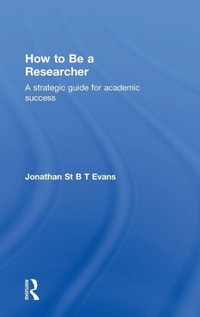
How to Be a Researcher
A strategic guide for academic success
2nd Edition
Published on 2. September 2015
Book
Hardback
162 pages
978-1-138-91730-9 (ISBN)
Description
How to be a Researcher provides a strategic guide to the conduct of a successful research career within a university environment. Based on the author's extensive personal experience, it offers down-to-earth advice, philosophical guidance, and discussions of the political context of academic research.
This is not a research methods book, and the topics it covers are rarely discussed elsewhere. The bulk of the book provides practical advice on the development of essential skills and strategic approaches, covering questions such as:
how to decide which topics to work on
how to read and review literature
how to develop theory
how to integrate research and teaching activity
how to approach research design
how to obtain and manage research funding
how to collaborate and supervise effectively
how to write up your research, and
how to secure the best sources of publication.
The final part of the book considers the philosophy and psychology of research work and includes an exploration of the cognitive biases which may affect researchers.
How to be a Researcher will be particularly useful for masters and doctoral students in the behavioral and social sciences, and also for early career academics developing research within a university career.
This is not a research methods book, and the topics it covers are rarely discussed elsewhere. The bulk of the book provides practical advice on the development of essential skills and strategic approaches, covering questions such as:
how to decide which topics to work on
how to read and review literature
how to develop theory
how to integrate research and teaching activity
how to approach research design
how to obtain and manage research funding
how to collaborate and supervise effectively
how to write up your research, and
how to secure the best sources of publication.
The final part of the book considers the philosophy and psychology of research work and includes an exploration of the cognitive biases which may affect researchers.
How to be a Researcher will be particularly useful for masters and doctoral students in the behavioral and social sciences, and also for early career academics developing research within a university career.
Reviews / Votes
I found this book eminently readable, full of advice, wise and witty. The discussions of issues like collaboration, giving talks and publication were just so helpful. I think this book will be as useful to students as to junior researchers, lecturers and assistant professors. Jonathan Evans is not only a first-rate researcher, but truly a thinker and a mentor.- Robert Sternberg, Department of Human Development, Cornell University, USASo many young researchers have to navigate the stormy waters of academia without a pilot. Here finally is a guide, a book full of practical wisdom about how to succeed as an academic researcher in psychology. Jonathan Evans, one of the most prolific psychologists around, is a fount of useful career advice stated with his usual clarity and directness.
- Steven Sloman, Cognitive, Linguistic, & Psychological Sciences, Brown University, USA Well organised, thoughtful and thought-provoking, I strongly recommend this text to postgraduates in psychology. It drips with experience and is bang up to date. - James Hartley, The Psychologist
I found this book eminently readable, full of advice, wise and witty. The discussions of issues like collaboration, giving talks and publication were just so helpful. I think this book will be as useful to students as to junior researchers, lecturers and assistant professors. Jonathan Evans is not only a first-rate researcher, but truly a thinker and a mentor.- Robert Sternberg, Department of Human Development, Cornell University, USA
So many young researchers have to navigate the stormy waters of academia without a pilot. Here finally is a guide, a book full of practical wisdom about how to succeed as an academic researcher in psychology. Jonathan Evans, one of the most prolific psychologists around, is a fount of useful career advice stated with his usual clarity and directness.
- Steven Sloman, Cognitive, Linguistic, & Psychological Sciences, Brown University, USA
Drawing examples from his 35 years of experience as an academic in the area of psychology, Evans tackles the practical aspects before moving on to the philosophy and psychology of research. The organization and execution of a creditable literature review is discussed in detail. Each chapter ends with a list of helpful hints. Filling a gap in the literature, this book is the next best thing to having a senior faculty member looking over one's shoulder while one attempts to get tenure. Summing Up: Highly recommended. Graduate students, researchers, faculty
- A. Salter, Oglethorpe University CHOICE September2016
More details
Edition
2nd edition
Language
English
Place of publication
London
United Kingdom
Publishing group
Taylor & Francis Ltd
Target group
College/higher education
Professional and scholarly
Illustrations
8 s/w Abbildungen, 8 s/w Zeichnungen, 2 s/w Tabellen
2 Tables, black and white; 8 Line drawings, black and white; 8 Illustrations, black and white
Dimensions
Height: 240 mm
Width: 161 mm
Thickness: 14 mm
Weight
435 gr
ISBN-13
978-1-138-91730-9 (9781138917309)
Copyright in bibliographic data and cover images is held by Nielsen Book Services Limited or by the publishers or by their respective licensors: all rights reserved.
Schweitzer Classification
Other editions
Additional editions
E-Book
09/2015
2nd Edition
Routledge
€54.99
Available for download
E-Book
09/2015
2nd Edition
Routledge
€55.49
Available for download
Book
09/2015
2nd Edition
Routledge
€63.20
Shipment within 10-20 days
Previous edition
Book
08/2005
Psychology Press Ltd
€141.13
Article exhausted; check for reprint
Person
Jonathan St B T Evans is Emeritus Professor of Psychology at Plymouth University. He has over 40 years' experience of experimental research and has published more than 150 journal articles. He has also authored eight books, and he served as Editor of the journal Thinking & Reasoning for 17 years.
Content
1. Foreword 2. Introduction Part One: Advice 3. Scholarship and the origin of ideas 4. Research and teaching 5. Designing empirical studies 6. Research funding 7. Developing and testing theories 8. Collaboration and supervision 9. Communication of research Part Two: Philosophy and Psychology of Research 10. Hypothesis testing and reasoning 11. Statistical inference 12. Final thoughts