

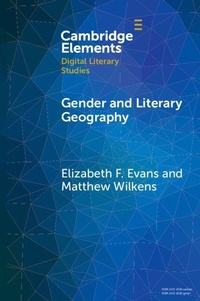
Gender and Literary Geography
Published on 22. May 2025
Book
Paperback/Softback
98 pages
978-1-009-01415-1 (ISBN)
Description
Our analysis of over 20,000 books published in Britain between 1800 and 2009 compares the geographic attention of fiction authored by women and by men; of books that focus on women and men as characters; and of works published in different eras. We find that, while there were only modest differences in geographic attention in books by men and women authors, there were dramatic geographic differences in books with highly gendered character space. Counter to expectation, the geographic differences between differently gendered characters were remarkably stable across these centuries. We also examine and complicate the power attributed to separate-sphere ideology. And we demonstrate a surprising reversal of critical expectation: in fiction, broadly natural spaces were more strongly associated with men, while urban spaces were more aligned with women. As it uncovers spatial patterns in literary history, this study casts new light on well-known texts and reimagines literature's broader engagement with gender and geography.
More details
Series
Language
English
Place of publication
Cambridge
United Kingdom
Product notice
Paperback (trade)
Illustrations
Worked examples or Exercises
Dimensions
Height: 229 mm
Width: 152 mm
Thickness: 6 mm
Weight
159 gr
ISBN-13
978-1-009-01415-1 (9781009014151)
Copyright in bibliographic data and cover images is held by Nielsen Book Services Limited or by the publishers or by their respective licensors: all rights reserved.
Schweitzer Classification
Other editions
Additional editions
Elizabeth F. Evans | Matthew Wilkens
Gender and Literary Geography
Book
05/2025
Cambridge University Press
€82.70
Shipment within 15-20 days
Persons
Content
1. Introduction: gender and literary geography; 2. Gender and language through computation; 3. Measuring literary space; 4. Measuring spatial mobility; 5. Geographic intensity and specificity; 6. The gendering of public and private spaces; 7. Gender and the city; 8. Conclusions; References.