

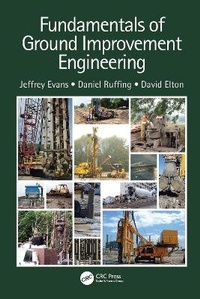
Fundamentals of Ground Improvement Engineering
Published on 31. December 2023
Book
Hardback
576 pages
978-0-415-69512-1 (ISBN)
Description
Ground improvement has been one of the most dynamic and rapidly evolving areas of geotechnical engineering over the past forty years. Moreover, increasing development of sites with marginal soils has made ground improvement an increasingly important core component of geotechnical engineering curricula. This textbook addresses the latest and most effective techniques for ground improvement, at a level designed for undergraduate and graduate-level university students and practitioners seeking fundamental background in these techniques.
Thus, Fundamentals of Ground Improvement Engineering is for students and professionals. The book is written to, first, broadly introduce key ground improvement methods and, second, to provide readers with a thorough understanding of the theory, design principles, and construction approaches that underpin each method. Major topic areas covered include compaction, grouting, vibratory methods, soil mixing, stabilization and solidification, cut-off walls, dewatering, consolidation, geosynthetics, and earth retention.
The book contains numerous problems and worked examples, and is well illustrated with photographs, schematics, charts and graphs. The rich companion website provides instructor resources and videos of the techniques, which are useful for students and for professionals to show clients.
Thus, Fundamentals of Ground Improvement Engineering is for students and professionals. The book is written to, first, broadly introduce key ground improvement methods and, second, to provide readers with a thorough understanding of the theory, design principles, and construction approaches that underpin each method. Major topic areas covered include compaction, grouting, vibratory methods, soil mixing, stabilization and solidification, cut-off walls, dewatering, consolidation, geosynthetics, and earth retention.
The book contains numerous problems and worked examples, and is well illustrated with photographs, schematics, charts and graphs. The rich companion website provides instructor resources and videos of the techniques, which are useful for students and for professionals to show clients.
More details
Language
English
Place of publication
London
United Kingdom
Publishing group
Taylor & Francis Ltd
Target group
College/higher education
Professional and scholarly
Illustrations
90 s/w Photographien bzw. Rasterbilder, 200 s/w Zeichnungen, 90 s/w Tabellen
90 Tables, black and white; 200 Line drawings, black and white; 90 Halftones, black and white
Dimensions
Height: 254 mm
Width: 178 mm
ISBN-13
978-0-415-69512-1 (9780415695121)
Copyright in bibliographic data and cover images is held by Nielsen Book Services Limited or by the publishers or by their respective licensors: all rights reserved.
Schweitzer Classification
Other editions
Additional editions
Jeffrey Evans | Daniel Ruffing | David Elton
Fundamentals of Ground Improvement Engineering
Book
09/2021
1st Edition
CRC Press
€82.90
Shipment within 15-20 days
Jeffrey Evans | Daniel Ruffing | David Elton
Fundamentals of Ground Improvement Engineering
Book
09/2021
1st Edition
CRC Press
€230.50
Shipment within 15-20 days
Jeffrey Evans | Daniel Ruffing | David Elton
Fundamentals of Ground Improvement Engineering
E-Book
09/2021
1st Edition
CRC Press
€73.99
Available for download
Jeffrey Evans | Daniel Ruffing | David Elton
Fundamentals of Ground Improvement Engineering
E-Book
09/2021
1st Edition
CRC Press
€73.99
Available for download
Persons
Jeffrey Evans is Professor and Chair of the Department of Civil and Environmental Engineering at Bucknell University, USA and Michael Malusis is Associate Professor in the same department.
Content
1. Introduction to Ground Improvement Engineering 2. Geotechnical Engineering Principles relating to Ground Improvement 3. Compaction Methods 4. Grouting 5. Vibro Ground Improvement Methods 6. Soil Mixing and Injection 7. Stabilization and Solidification 8. Cutoff Walls 9. Dewatering with wells and drains 10. Consolidation 11. Earth Retention 12. Structural Support