

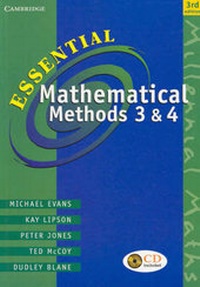
Essential Mathematical Methods 3 and 4 with CD-Rom
3rd Edition
Published on 30. September 1999
Book
Mixed media product
656 pages
978-0-521-66517-9 (ISBN)
Description
This revision of this popular text addresses the course changes and takes in requests from many teachers. It provides a consistent and comprehensive treatment of the required course and has been trialed in the classroom. The application of graphics calculators has been strengthened to include questions in all appropriate exercises that require the graphics calculator. Analysis questions are again featured in each chapter to ensure that students are thoroughly prepared for the exams.
More details
Series
Edition
3rd Revised edition
Language
English
Place of publication
Cambridge
United Kingdom
Target group
Primary & secondary/elementary & high school
Interest Age: From 14 to 16 years
Edition type
Revised edition
Illustrations
Worked examples or Exercises
Dimensions
Height: 200 mm
Width: 100 mm
Thickness: 20 mm
Weight
1040 gr
ISBN-13
978-0-521-66517-9 (9780521665179)
Copyright in bibliographic data and cover images is held by Nielsen Book Services Limited or by the publishers or by their respective licensors: all rights reserved.
Schweitzer Classification
Other editions
New editions
Michael Evans | Kay Lipson | Peter Jones
Essential Mathematical Methods 3 and 4 with CD-Rom
Book
11/2005
4th Edition
Cambridge University Press
€24.77
Article not available
Previous edition

Michael Evans | Kay Lipson | Doug Wallace
Essential Mathematical Methods 3 and 4
Book
12/1996
2nd Edition
Coghill Publishing
€47.86
Article exhausted; check for reprint
Content
Introduction; 1. Functions, 1.1. Introduction, 1.2. Set notation, 1.3. Sets of numbers, 1.4. Relations, 1.5. Functions, 1.6. Sums and products of functions, 1.7. Composite functions, 1.8. Inverse functions, 1.9. Inverse relations, 1.10. Applications; 2. Revising linear functions, 2.1. Revision of linear equations, 2.2. Linear functions, 2.3. 'Fitting' data; 3. Graphing with transformations, 3.1. Introduction, 3.2. The functions with rules f(x)=xn, where n=-1, -2, 1/2, 3.3. Composition of transformations, 3.4. Quadratic functions, 3.5. Determining the rule for a function of a graph, 3.6. Possible models for data, 3.7. Addition of ordinates, 3.8. Graphing inverse functions; 4. Polynomial functions, 4.1. Summation notation, 4.2. The Binomial Theorem, 4.3. Cubic functions of the form f: R > R, f(x)=a(x+h)3 + k, 4.4. The general cubic function, 4.5. Cubic equations, 4.6. Determining rules for graphs of cubic functions, 4.7. Quartic functions, 4.8. Graphics calculator exercise; 5. Exponential and logarithmic functions, 5.1. Exponential functions, 5.2. Exponential models, 5.3. The exponential function f(x)=ex, 5.4. Exponential equations, 5.5. Logarithmic functions, 5.6. Inverses, 5.7. Determining rules for graphs of exponential and logarithmic functions, 5.8. Solution of exponential equations and inequations with logarithms, 5.9. Graphics calculator exercise, 5.10. Applications; 6. Trigonometric functions, 6.1. Review of trigonometric functions, 6.2. Graphs of sine and cosine, 6.3. Transformations applied to graphs of y = sin x and y = cos x, 6.4. Addition of ordinates, 6.5. Determining the rule for graphs of trigonometric functions, 6.6. The function tan, 6.7. Graphics calculator exercise, 6.8. Identities, 6.9. Applications; 7. Revision of chapters 1-6, 7.1. Summary of chapters 1-6, 7.2. Short answer questions, 7.3. Multiple choice questions, 7.4. Analysis questions; 8. Differentiation of polynomials and rational functions, 8.1. The gradient of a curve at a point, 8.2. The derived function, 8.3. Differentiating xn where n is negative integer, 8.4. The Chain Rule, 8.5. Differentiating rational powers (x p/q), 8.6. Product Rule and Quotient Rule, 8.7. The graph of the gradient function, 8.8. Graphics calculator exercise, 8.9. Miscellaneous exercise; 9. Applications of differentiation, 9.1. Tangents and normals, 9.2. Angles between curves, 9.3. Linear approximation, 9.4. Stationary points, 9.5. Types of stationary points, 9.6. Maxima and minima problems, 9.7. Rates of change, 9.8. Graphics calculator exercise; 10. Differentiation of transcendental functions, 10.1. Differentiation of ex, 10.2. Differentiation of the natural logarithm function, 10.3. Derivatives of trigonometric functions, 10.4. Graphics calculator exercise, 10.5. Applications; 11. Integration, 11.1. Approximations leading to integrals, 11.2. Antidifferentiation, 11.3. Area - the definite integral, 11.4. Integration of trigonometric functions, 11.5. Integration of functions of the form f(x) = 1/ax+b, 11.6. Miscellaneous exercise, 11.7. Area of a region between two curves, 11.8. The fundamental theorem of calculus revisited, 11.9. Graphics calculator exercise, 11.10. Applications; 12. Revision of chapters 8-11, 12.1. Summary of chapters 8-11, 12.2. Short answer questions, 12.3. Multiple choice questions, 12.4. Analysis questions; 13. Discrete random variables and their probability distributions, 13.1. Review of probability, 13.2. Discrete random variables, 13.3. Discrete probability distributions, 13.4. Expectation and variance; 14. The binomial distribution, 14.1. The binomial probability distribution, 14.2. The graph of the binomial probability distribution, 14.3. Expectation and variance, 14.4. Using the graphics calculator; 15. The hypergeometric distribution, 15.1. The hypergeometric probability distribution, 15.2. Mean and variance, 15.3. The binomial and hy