

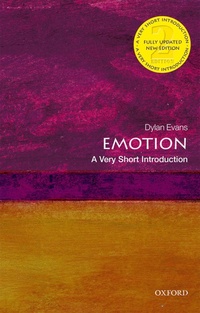
Emotion
A Very Short Introduction
2nd Edition
Published on 26. September 2019
Book
Paperback/Softback
144 pages
978-0-19-883440-3 (ISBN)
Description
Was love invented by European poets in the Middle Ages or is it part of human nature? Will winning the lottery really make you happy? Is it possible to build robots that have feelings?
In this Very Sort Introduction Dylan Evans explores these and many other intriguing questions in this guide to the latest thinking about the emotions. Drawing on a wide range of scientific research, from anthropology and psychology to neuroscience and artificial intelligence, Evans takes the reader on a fascinating journey into the human heart, discussing the evolution of emotions and their biological basis, the science of happiness, and the role that emotions play in memory and decision making. Greeted by critics as a pop science classic when it was first published in 2001, the book has now been thoroughly revised and updated to incorporate new developments in our understanding of emotions, including new sections addressing the neural basis of empathy and the emotional impact of films.
ABOUT THE SERIES: The Very Short Introductions series from Oxford University Press contains hundreds of titles in almost every subject area. These pocket-sized books are the perfect way to get ahead in a new subject quickly. Our expert authors combine facts, analysis, perspective, new ideas, and enthusiasm to make interesting and challenging topics highly readable.
In this Very Sort Introduction Dylan Evans explores these and many other intriguing questions in this guide to the latest thinking about the emotions. Drawing on a wide range of scientific research, from anthropology and psychology to neuroscience and artificial intelligence, Evans takes the reader on a fascinating journey into the human heart, discussing the evolution of emotions and their biological basis, the science of happiness, and the role that emotions play in memory and decision making. Greeted by critics as a pop science classic when it was first published in 2001, the book has now been thoroughly revised and updated to incorporate new developments in our understanding of emotions, including new sections addressing the neural basis of empathy and the emotional impact of films.
ABOUT THE SERIES: The Very Short Introductions series from Oxford University Press contains hundreds of titles in almost every subject area. These pocket-sized books are the perfect way to get ahead in a new subject quickly. Our expert authors combine facts, analysis, perspective, new ideas, and enthusiasm to make interesting and challenging topics highly readable.
More details
Series
Edition
2nd Revised edition
Language
English
Place of publication
Oxford
United Kingdom
Edition type
Revised edition
Illustrations
10-12 black and white images
Dimensions
Height: 172 mm
Width: 108 mm
Thickness: 15 mm
Weight
115 gr
ISBN-13
978-0-19-883440-3 (9780198834403)
Copyright in bibliographic data and cover images is held by Nielsen Book Services Limited or by the publishers or by their respective licensors: all rights reserved.
Schweitzer Classification
Other editions
Additional editions
E-Book
09/2019
2nd Edition
OUP eBook
€5.49
Available for download
E-Book
09/2019
2nd Edition
OUP eBook
€5.49
Available for download
Previous edition
Book
02/2003
Oxford University Press
€9.91
Article exhausted; check for reprint
Person
Dylan Evans received his PhD in Philosophy from the London School of Economics in 2000. He has taught at various universities around the world and written nine books, including The Utopia Experiment (Picador, 2015) and Atheism: All That Matters (Hodder 2014). In 2006-7 he ran the Utopia Experiment, an extended simulation of what life might be like if civilisation collapsed. He has also spent extended periods of time training horses in Guatemala, living with the Bedouins in the Sahara, and learning to play dead-goat polo in Kazakhstan.
Content
1: The universal language
2: Why Spock could never have evolved
3: Short cuts to happiness
4: The head and the heart
5: The computer that cried
Further reading
Index
2: Why Spock could never have evolved
3: Short cuts to happiness
4: The head and the heart
5: The computer that cried
Further reading
Index