

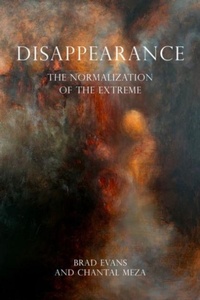
Disappearance
The Normalisation of the Extreme
Will be published approx. on 10. September 2026
Book
Paperback/Softback
256 pages
978-1-78821-916-7 (ISBN)
Description
What was once a hidden secret defining totalitarian regimes has become the defining problem of our times. Every day we encounter stories concerning the disappearance of humans, communities, cultures, and life sustaining ecosystems. Disappearance has also become a dominant theme in popular entertainment, as we have normalised the extreme. But how are we to make sense of this? This is not just about increased awareness. It now openly touches our most primal of fears - to vanish without a trace - which has been amplified in our visual landscapes that depend upon and yet weaponize the value we place on appearances.
Recognizing this state of affairs and the ways in which societies are precariously hovering over disappearance fault-lines, this book will map out in original ways the history of the phenomena to offer an urgent and timely intervention. Moving beyond old ideas concerning bodies, the authors demand new ways of seeing disappearance to inspire alternative ways of thinking and responses. Disappearance, they argue, is a form of neuroviolence that is inseparable from the invisible operations of power. Hence countering it, not only requires that we make visible those forces which continue to annihilate life, it is to look precisely at the way disappearance now structures our societies and is inseparable from any concern with power in the world.
Recognizing this state of affairs and the ways in which societies are precariously hovering over disappearance fault-lines, this book will map out in original ways the history of the phenomena to offer an urgent and timely intervention. Moving beyond old ideas concerning bodies, the authors demand new ways of seeing disappearance to inspire alternative ways of thinking and responses. Disappearance, they argue, is a form of neuroviolence that is inseparable from the invisible operations of power. Hence countering it, not only requires that we make visible those forces which continue to annihilate life, it is to look precisely at the way disappearance now structures our societies and is inseparable from any concern with power in the world.
More details
Language
English
Place of publication
United Kingdom
Publishing group
Edinburgh University Press
Target group
Professional and scholarly
Illustrations
27 colour illustrations
Dimensions
Height: 234 mm
Width: 156 mm
ISBN-13
978-1-78821-916-7 (9781788219167)
Copyright in bibliographic data and cover images is held by Nielsen Book Services Limited or by the publishers or by their respective licensors: all rights reserved.
Schweitzer Classification
Persons
Brad Evans is a Professor of Political Violence & Aesthetics and founding Director of the Centre for the Study of Violence at the University of Bath. He is the author of twenty books and edited volumes, along with over a hundred and fifty academic and international media articles. Brad has written extensively on the state of international affairs, while having made a number of telling theoretical contributions to the understanding of violence. For the past decade he has largely been working on the violence of disappearance and the importance of trans-disciplinary responses. He previously held academic positions at the Universities of Bristol and Leeds, while also teaching at Columbia University, New York. Chantal Meza is an acclaimed Mexican painter based in the UK whose work?practice focuses on the human as seen through various forms of disappearance.?Her work is held in public and private collections around the world and over the past 15 years her paintings have featured in exhibitions and biennials in prominent Museums and Galleries in Mexico, United Kingdom, Paraguay and Germany. She has delivered international lectures and workshops at reputable universities such as Harvard University, Ecole Normale Superieure, and Goethe Univeristaet, as well as being commissioned publicly and privately. Her work has received the support of grants and awards of prominent institutions in the cultural sector including a distinguished recognition in her birth province of Puebla, Mexico.
Chantal's State of Disappearance series has been exhibited in Bristol, London and is now on permanent display in the Chancellors Building at the University of Bath.
Everardo Gonzalez, a Mexican director who is considered one of the strongest voices in the documentary genre in Latin America.
Everardo's filmography includes Pulque Song (2003), The Old Thieves (2007), The Open Sky (2011), Drought (2011) and El Paso (2015), all screened and awarded at various festivals like Berlin, IDFA, Toulouse, Locarno, Montreal, BAFICI, Sarajevo, Guadalajara and Morelia.
His film Devil's Freedom (2017) was awarded the Amnesty International Film Prize at the Berlinale in 2017. In 2018, he directed A 3 Minute Hug, a Netflix Original in Latin America. He collaborated with the New York Times OpDocs with the film Children from the Narcozone, which was nominated for a News and Doc Emmy Award. His most recent film, A Wolf Pack called Ernesto (2024), has young gang members tell their chilling, occasionally poetic stories, revealing the ease with which violent organisations target young people in Mexico.
Everardo is a member of the Academy of Motion Picture Arts and Sciences and the Academia Mexicana de Artes y Ciencias Cinematograficas. He is also the founder of the Mexican Documentary Net, which looks for social, political, and cultural impact for bringing documentary filmmakers better conditions for the future.
Chantal's State of Disappearance series has been exhibited in Bristol, London and is now on permanent display in the Chancellors Building at the University of Bath.
Everardo Gonzalez, a Mexican director who is considered one of the strongest voices in the documentary genre in Latin America.
Everardo's filmography includes Pulque Song (2003), The Old Thieves (2007), The Open Sky (2011), Drought (2011) and El Paso (2015), all screened and awarded at various festivals like Berlin, IDFA, Toulouse, Locarno, Montreal, BAFICI, Sarajevo, Guadalajara and Morelia.
His film Devil's Freedom (2017) was awarded the Amnesty International Film Prize at the Berlinale in 2017. In 2018, he directed A 3 Minute Hug, a Netflix Original in Latin America. He collaborated with the New York Times OpDocs with the film Children from the Narcozone, which was nominated for a News and Doc Emmy Award. His most recent film, A Wolf Pack called Ernesto (2024), has young gang members tell their chilling, occasionally poetic stories, revealing the ease with which violent organisations target young people in Mexico.
Everardo is a member of the Academy of Motion Picture Arts and Sciences and the Academia Mexicana de Artes y Ciencias Cinematograficas. He is also the founder of the Mexican Documentary Net, which looks for social, political, and cultural impact for bringing documentary filmmakers better conditions for the future.
Content
List of Artworks by Chantal Meza
Acknowledgements
Foreword
by Everardo Gonzalez
Preface: Ways of Seeing Disappearance
1. Disappearance Fault-Lines
2. A Global Topography of Terror
3. The Rape of History
4. When Worlds Disappear
Interlude: In the Dust of New Mexico
5. Devourance
6. Surveillance & Punish
7. NeuroViolence
8. The Disappearance Horizon
Epilogue: Dreams of Disappearance
Acknowledgements
Foreword
by Everardo Gonzalez
Preface: Ways of Seeing Disappearance
1. Disappearance Fault-Lines
2. A Global Topography of Terror
3. The Rape of History
4. When Worlds Disappear
Interlude: In the Dust of New Mexico
5. Devourance
6. Surveillance & Punish
7. NeuroViolence
8. The Disappearance Horizon
Epilogue: Dreams of Disappearance