

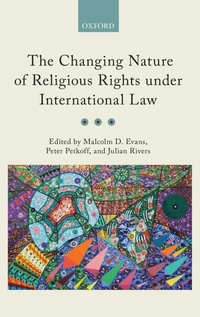
The Changing Nature of Religious Rights under International Law
Published on 19. March 2015
Book
Hardback
344 pages
978-0-19-968422-9 (ISBN)
Description
The Declaration on the Elimination of All Forms of Intolerance and of Discrimination Based on Religion or Belief, as proclaimed by the United Nations General Assembly in 1981, is the only universal human rights instrument specifically focusing on religious intolerance and discrimination. However, recent years have seen increasing controversy surrounding this right, in both political and legal contexts. The European Court of Human Rights has experienced a vast expansion in the number of cases it has had brought before it concerning religious freedom, and politically the boundaries of the right have been much disputed. This book provides a systematic analysis of the different approaches to religious rights which exist in public international law.
The book explores how particular institutional perspectives emerge in the context of these differing approaches. It examines, and challenges, these institutional perspectives. It identifies new directions for approaching religious rights through international law by examining existing legal tools, and assesses their achievements and shortcomings. It studies religious organisations' support for international human rights protection, as well as religious critique of international human rights and the development of an alternative religious 'Bills of Rights'. It investigates whether expressions of members belonging to religious minorities can be considered under the minority right to culture, rather than the right to religion, and discusses the benefits and shortcomings of such a route. It analyses the reach and limits of the provisions in the 1981 Declaration, identifies ways in which the right is being eroded as a concept, and suggests new ways in which the right can be reinforced and protected.
The book explores how particular institutional perspectives emerge in the context of these differing approaches. It examines, and challenges, these institutional perspectives. It identifies new directions for approaching religious rights through international law by examining existing legal tools, and assesses their achievements and shortcomings. It studies religious organisations' support for international human rights protection, as well as religious critique of international human rights and the development of an alternative religious 'Bills of Rights'. It investigates whether expressions of members belonging to religious minorities can be considered under the minority right to culture, rather than the right to religion, and discusses the benefits and shortcomings of such a route. It analyses the reach and limits of the provisions in the 1981 Declaration, identifies ways in which the right is being eroded as a concept, and suggests new ways in which the right can be reinforced and protected.
Reviews / Votes
An important volume for anyone who wishes to understand the issues that are at stake in the field of international law and religion. * Helge Arsheim, Nordic Journal of Human Rights *More details
Language
English
Place of publication
Oxford
United Kingdom
Target group
College/higher education
Professional and scholarly
Dimensions
Height: 240 mm
Width: 161 mm
Thickness: 23 mm
Weight
681 gr
ISBN-13
978-0-19-968422-9 (9780199684229)
Copyright in bibliographic data and cover images is held by Nielsen Book Services Limited or by the publishers or by their respective licensors: all rights reserved.
Schweitzer Classification
Other editions
Additional editions
Malcolm Evans | Peter Petkoff | Julian Rivers
The Changing Nature of Religious Rights under International Law
E-Book
03/2015
OUP eBook
€68.99
Available for download
Malcolm Evans | Peter Petkoff | Julian Rivers
The Changing Nature of Religious Rights under International Law
E-Book
03/2015
OUP eBook
€83.99
Available for download
Persons
Malcolm Evans OBE is Professor of Public International Law at the University of Bristol. He is a member of the Organisation on Security and Cooperation in Europe's Advisory Council on Freedom of Religion and Belief, and the author of many publications on international law, human rights, and religion.
Peter Petkoff is a Lecturer at Brunel University and a Fellow of the Centre for Christianity and Culture at Regent's Park College in Oxford.
Peter Petkoff is a Lecturer at Brunel University and a Fellow of the Centre for Christianity and Culture at Regent's Park College in Oxford.
Content
Forward ; Introduction ; 1. Religious Freedom in the Secular Age ; 2. Towards a Clear Conceptualization of Freedom of Religion or Belief ; 3. Freedom of Religion or Belief- New Challenges ; 4. Thirty Years 1981 Declaration as Reflected in Twenty -Five Years Mandate Practice of the United Nations Special Rapporteur on Freedom of Religion or Belief ; 5. Incitement to Hatred and the 1981 UN Declaration on Religion or Belief ; 6. A View from the United States: US Bilateral and Multilateral Promotion of Freedom of Religion or Belief ; 7. Lost Opportunities and Missed Targets: Notes on Freedom of Religion or Belief in the Organization of Security and Co-operation in Europe ; 8. Old is New: Europe and Freedom of Religion or Belief ; 9. The Contribution of the European Parliment to the Protection of Freedom of Religion or Belief through the External Relations of the European Union ; 10. Faith-Based Non-Governmental Organizations in the Public Square ; 11. Translating Across Secular and Religious Legal Cultures and Public International Law ; 12. The Holy See's Perspective on Religious Freedom ; 13. Religion, Human Rights and Foreign Policy ; 14. Corporate Religious Freedom ; 15. Freedom of Religion in Transnational Contract and Commercial Transactions