

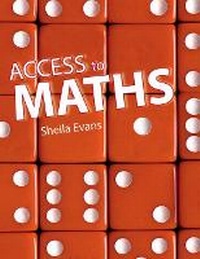
Access to Maths
Published on 9. July 2009
Book
Paperback/Softback
560 pages
978-1-4058-5961-5 (ISBN)
Description
This exciting new book is the first maths book to be written specifically for student on Access courses. The book is full of relevant real-life examples which help students see maths not as merely something which must be learned, but as a valuable tool. It presents a variety of learning methods to enable students to engage with the material and to provide them with a broader and deeper understanding of mathematics. The emphasis is on 'doing maths' and getting the students involved in the exercises, rather than simply teaching maths to the students.
It is written for students for students taking Access courses with a maths or numeracy component. It is also suitable for students on Foundation courses.
It is written for students for students taking Access courses with a maths or numeracy component. It is also suitable for students on Foundation courses.
More details
Language
English
Place of publication
Harlow
United Kingdom
Target group
College/higher education
Dimensions
Height: 245 mm
Width: 189 mm
Thickness: 26 mm
Weight
1160 gr
ISBN-13
978-1-4058-5961-5 (9781405859615)
Copyright in bibliographic data and cover images is held by Nielsen Book Services Limited or by the publishers or by their respective licensors: all rights reserved.
Schweitzer Classification
Person
Sheila Evans is a tutor at Derby University, teaching maths to access students. She has tested much of her material on her students with a good deal of success and understands the challenges presented to this unique group of learners.
Content
Preface
Chapter 1: Number Work
Introduction
1.1 Place Value
1.2 Number Types
1.3 Fractions
1.4 Working with Numbers after the Decimal Point
1.5a Approximations
1.5b Rounding to Decimal Places
1.6 Estimation
1.7 Negative Numbers
1.8 Priorities in Arithmetic
1.9 Percentages
1.10 Ratios
1.11 The Power of Numbers
1.12 Scientific Notation
1.13 Co-ordinates
1.14 Interpretation and Plotting of Graphs
1.15 Bringing it all Together
Chapter 2: Collecting, Recording and Analysing Data
Introduction
2.1 Charting Data
2.2 Frequency Polygons
2.3 Pictograms
2.4 Drawing Angles
2.5 Pie Charts
2.6 Averages
2.7 Cumulative Frequency Charts
2.8 Scatter Plots
2.9 Probability
2.10 Misleading Charts
2.11 Bringing it all Together
Chapter 3: Shape, Space and Measurement
Introduction
3.1 Polygons
3.2 Angles
3.3 Drawing Shapes
3.4 Bearings
3.5 Units of Measure and Compound Measure
3.6 Similar Shapes
3.7 Scale Drawings and Models
3.8a Area, Perimeter and Volume
3.8b 3 Dimensional Shapes and their Nets
3.8c Volume and Surface Area
3.9 Right Angled Triangles and Trigonometry
3.10 Transformations
3.11 Bringing it all Together
Chapter 4: Algebra
Introduction
4.1 Patterns in Numbers
4.2 Working with Formulae
4.3 Simplification of Algebraic Expressions
4.4 Equations
4.5 Re-arranging Formulae
4.6 Straight Line Graphs and their Equations
4.7 Simultaneous Equations
4.8
Chapter 1: Number Work
Introduction
1.1 Place Value
1.2 Number Types
1.3 Fractions
1.4 Working with Numbers after the Decimal Point
1.5a Approximations
1.5b Rounding to Decimal Places
1.6 Estimation
1.7 Negative Numbers
1.8 Priorities in Arithmetic
1.9 Percentages
1.10 Ratios
1.11 The Power of Numbers
1.12 Scientific Notation
1.13 Co-ordinates
1.14 Interpretation and Plotting of Graphs
1.15 Bringing it all Together
Chapter 2: Collecting, Recording and Analysing Data
Introduction
2.1 Charting Data
2.2 Frequency Polygons
2.3 Pictograms
2.4 Drawing Angles
2.5 Pie Charts
2.6 Averages
2.7 Cumulative Frequency Charts
2.8 Scatter Plots
2.9 Probability
2.10 Misleading Charts
2.11 Bringing it all Together
Chapter 3: Shape, Space and Measurement
Introduction
3.1 Polygons
3.2 Angles
3.3 Drawing Shapes
3.4 Bearings
3.5 Units of Measure and Compound Measure
3.6 Similar Shapes
3.7 Scale Drawings and Models
3.8a Area, Perimeter and Volume
3.8b 3 Dimensional Shapes and their Nets
3.8c Volume and Surface Area
3.9 Right Angled Triangles and Trigonometry
3.10 Transformations
3.11 Bringing it all Together
Chapter 4: Algebra
Introduction
4.1 Patterns in Numbers
4.2 Working with Formulae
4.3 Simplification of Algebraic Expressions
4.4 Equations
4.5 Re-arranging Formulae
4.6 Straight Line Graphs and their Equations
4.7 Simultaneous Equations
4.8