

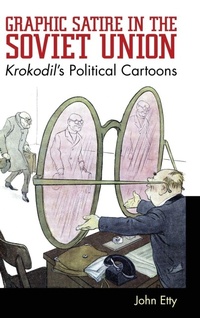
Graphic Satire in the Soviet Union
Krokodil's Political Cartoons
Published on 30. January 2019
Book
Hardback
240 pages
978-1-4968-2052-5 (ISBN)
Description
After the death of Joseph Stalin, Soviet-era Russia experienced a flourishing artistic movement due to relaxed censorship and new economic growth. In this new atmosphere of freedom, Russia's satirical magazine Krokodil (The Crocodile) became rejuvenated. John Etty explores Soviet graphic satire through Krokodil and its political cartoons. He investigates the forms, production, consumption, and functions of Krokodil, focusing on the period from 1954 to 1964.
Krokodil remained the longest-serving and most important satirical journal in the Soviet Union, unique in producing state-sanctioned graphic satirical comment on Soviet and international affairs for over seventy years. Etty's analysis of Krokodil extends and enhances our understanding of Soviet graphic satire beyond state-sponsored propaganda.
For most of its life, Krokodil consisted of a sixteen-page satirical magazine comprising a range of cartoons, photographs, and verbal texts. Authored by professional and nonprofessional contributors and published by Pravda in Moscow, it produced state-sanctioned satirical comment on Soviet and international affairs from 1922 onward. Soviet citizens and scholars of the USSR recognized Krokodil as the most significant, influential source of Soviet graphic satire. Indeed, the magazine enjoyed an international reputation, and many Americans and Western Europeans, regardless of political affiliation, found the images pointed and witty. Astoundingly, the magazine outlived the USSR but until now has received little scholarly attention.
Krokodil remained the longest-serving and most important satirical journal in the Soviet Union, unique in producing state-sanctioned graphic satirical comment on Soviet and international affairs for over seventy years. Etty's analysis of Krokodil extends and enhances our understanding of Soviet graphic satire beyond state-sponsored propaganda.
For most of its life, Krokodil consisted of a sixteen-page satirical magazine comprising a range of cartoons, photographs, and verbal texts. Authored by professional and nonprofessional contributors and published by Pravda in Moscow, it produced state-sanctioned satirical comment on Soviet and international affairs from 1922 onward. Soviet citizens and scholars of the USSR recognized Krokodil as the most significant, influential source of Soviet graphic satire. Indeed, the magazine enjoyed an international reputation, and many Americans and Western Europeans, regardless of political affiliation, found the images pointed and witty. Astoundingly, the magazine outlived the USSR but until now has received little scholarly attention.
More details
Language
English
Place of publication
Jackson
United States
Target group
Professional and scholarly
Dimensions
Height: 235 mm
Width: 157 mm
Thickness: 19 mm
Weight
554 gr
ISBN-13
978-1-4968-2052-5 (9781496820525)
Copyright in bibliographic data and cover images is held by Nielsen Book Services Limited or by the publishers or by their respective licensors: all rights reserved.
Schweitzer Classification
Other editions
Additional editions
E-Book
12/2018
Penguin Random House South Africa
€29.49
Available for download
Person
John Etty, Auckland, New Zealand, is Head of Faculty (Social Science) and Head of Department (History) at Auckland Grammar School in New Zealand. He has published in the edited volumes Russian Aviation, Space Flight and Visual Culture and Russian Culture in the Era of Globalisation, as well as in journals such as Slavic Review, History Review, the International Journal of Comic Art, and Slovo.