

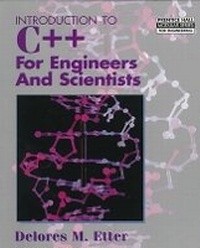
Introduction to C++ for Engineers and Scientists
Published on 10. March 1997
Book
Paperback/Softback
176 pages
978-0-13-254731-4 (ISBN)
Description
From best-selling engineering computing author Delores Etter, this book presents a consistent methodology for solving engineering problems through an introduction to the fundamental capabilities of C++, the language of choice for many practising engineers and scientists. It introduces the basics of C++ programming, and allows instructors to cover additional materials in the same class in the same semester, and allows instructors to reasonably require students to buy additional books and materials for the course. It emphasizes real-world engineering and scientific examples and problems, centered around a theme of Engineering Grand Challenges. These include: prediction of weather, climate, and global change; computerized speech understanding; mapping of the human genome; improvements in vehicle performance; and enhanced oil and gas recovery. It also introduces software engineering concepts, focusing on the design and implementation of user-friendly and reusable computer solutions; and readability and documentation in the development of all programs.
More details
Language
English
Place of publication
United States
Publishing group
Pearson Education (US)
Target group
College/higher education
Dimensions
Height: 190 mm
Width: 230 mm
Thickness: 8 mm
Weight
300 gr
ISBN-13
978-0-13-254731-4 (9780132547314)
Copyright in bibliographic data is held by Nielsen Book Services Limited or its licensors: all rights reserved.
Schweitzer Classification
Other editions
Previous edition

Book
04/1997
Pearson
€67.45
Article exhausted; check for reprint
Content
1. An Introduction to Engineering Problem-Solving.
2. Simple C++ Programs.
3. Control Structures and Data Files.
4. Modular Programming with Functions.
5. One-Dimensional Arrays.
6. Character Data.
Appendix A: ASCII Character Codes.
Complete Solutions to Practice Problems.
Index.
2. Simple C++ Programs.
3. Control Structures and Data Files.
4. Modular Programming with Functions.
5. One-Dimensional Arrays.
6. Character Data.
Appendix A: ASCII Character Codes.
Complete Solutions to Practice Problems.
Index.