

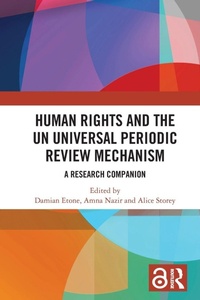
Human Rights and the UN Universal Periodic Review Mechanism
A Research Companion
1st Edition
Published on 29. September 2025
Book
Paperback/Softback
310 pages
978-1-032-54261-4 (ISBN)
Description
The Universal Periodic Review (UPR) is a peer-review mechanism, reviewing all 193 UN Member States' protection and promotion of human rights. After ten years of the existence of the UPR mechanism, this collection examines the effectiveness of the UPR, theoretical and conceptual debates about its modus operandi, and the lessons that can be drawn across different regions/states to identify possible improvements.
The book argues that despite its limitations, the UPR mechanism with its inclusive, cooperative, and collaborative framework, is an important human rights mechanism with the potential to evolve over time into an effective cooperative tool for monitoring human rights implementation. Divided into three parts, the first part focuses on exploring a variety of theoretical approaches to understanding the UPR mechanism. The second part examines specific human rights themes and the relationship between the UPR mechanism and other international mechanisms. Finally, the third part questions implementation and the ways in which states/regional groupings have engaged with the UPR mechanism and what lessons can be learned for the future.
The volume will be a valuable resource for researchers, academics, and policymakers working in the area of international human rights law, international organizations, and international relations. We would like to acknowledge the UPR Academic Network (UPRAN) for bringing together the experts on this project and the University of Stirling for providing funds to facilitate open access dissemination for parts of this output.
The Introduction and Chapter 6 of this book are freely available as a downloadable Open Access PDF at http://www.taylorfrancis.com under a Creative Commons Attribution (CC-BY) 4.0 license.
The book argues that despite its limitations, the UPR mechanism with its inclusive, cooperative, and collaborative framework, is an important human rights mechanism with the potential to evolve over time into an effective cooperative tool for monitoring human rights implementation. Divided into three parts, the first part focuses on exploring a variety of theoretical approaches to understanding the UPR mechanism. The second part examines specific human rights themes and the relationship between the UPR mechanism and other international mechanisms. Finally, the third part questions implementation and the ways in which states/regional groupings have engaged with the UPR mechanism and what lessons can be learned for the future.
The volume will be a valuable resource for researchers, academics, and policymakers working in the area of international human rights law, international organizations, and international relations. We would like to acknowledge the UPR Academic Network (UPRAN) for bringing together the experts on this project and the University of Stirling for providing funds to facilitate open access dissemination for parts of this output.
The Introduction and Chapter 6 of this book are freely available as a downloadable Open Access PDF at http://www.taylorfrancis.com under a Creative Commons Attribution (CC-BY) 4.0 license.
Reviews / Votes
'The UPR Academic Network's collection explores the UPR's evolution over three cycles, its role in strengthening democratic governance, and fostering States' accountability. A must-read for human rights advocates seeking to use this international mechanism to advance the promotion and protection of human rights for all segments of society domestically'.Mona M'ikay, Executive Director, UPR Info
'This research and academic analysis on the UPR Mechanism's effectiveness is most welcome, in order to keep improving this particular UN tool, of universal reach and general acceptance or legitimacy, which necessarily complements the national and international efforts by different stakeholders, not only the States, and the work of regional human rights systems, when available. The national integral focus of the UPR is a mobilizing force in itself, that of course needs to be matched with the good faith and political will of States, to be more effective'.
Ambassador Laura Dupuy Lasserre, Former President of the UN Human Rights Council (2011-012)
More details
Language
English
Place of publication
London
United Kingdom
Publishing group
Taylor & Francis Ltd
Target group
College/higher education
Postgraduate
Illustrations
13 s/w Tabellen, 18 s/w Zeichnungen, 1 s/w Photographie bzw. Rasterbild, 19 s/w Abbildungen
13 Tables, black and white; 18 Line drawings, black and white; 1 Halftones, black and white; 19 Illustrations, black and white
Dimensions
Height: 234 mm
Width: 156 mm
Thickness: 18 mm
Weight
506 gr
ISBN-13
978-1-032-54261-4 (9781032542614)
Copyright in bibliographic data and cover images is held by Nielsen Book Services Limited or by the publishers or by their respective licensors: all rights reserved.
Schweitzer Classification
Other editions
Additional editions
Damian Etone | Amna Nazir | Alice Storey
Human Rights and the UN Universal Periodic Review Mechanism
A Research Companion
E-Book
02/2024
1st Edition
Taylor & Francis
€52.99
Available for download
Damian Etone | Amna Nazir | Alice Storey
Human Rights and the UN Universal Periodic Review Mechanism
A Research Companion
E-Book
02/2024
1st Edition
Taylor & Francis
€52.99
Available for download
Damian Etone | Amna Nazir | Alice Storey
Human Rights and the UN Universal Periodic Review Mechanism
A Research Companion
Book
02/2024
1st Edition
Routledge
€236.70
Shipment within 10-20 days
Persons
Damian Etone is Senior Lecturer in International Human Rights Law at the University of Stirling. He is Director for the MSc Programme in Human Rights and Diplomacy run in partnership with the United Nations Institute for Training and Research (UNITAR).
Amna Nazir is Reader in International Human Rights Law and Associate Director of the Centre for Human Rights at Birmingham City University. She also serves as a trustee for the United Nations Association - UK.
Alice Storey is Senior Lecturer in Law and Associate Director of the Centre for Human Rights at Birmingham City University, where she also leads the UPR Project at BCU.
Amna Nazir is Reader in International Human Rights Law and Associate Director of the Centre for Human Rights at Birmingham City University. She also serves as a trustee for the United Nations Association - UK.
Alice Storey is Senior Lecturer in Law and Associate Director of the Centre for Human Rights at Birmingham City University, where she also leads the UPR Project at BCU.
Content
Introduction
DAMIAN ETONE, AMNA NAZIR, AND ALICE STOREY
PART I: Theoretical and Conceptual Approaches to Understanding the UPR Mechanism
1 The Universal Periodic Review as an Evolving Process: Examining the Path of Development
KATHRYN MCNEILLY
2 The Universal Periodic Review as Utopia
AMNA NAZIR, ALICE STOREY, AND JON YORKE
3 What Is the UPR? Thinking About the UPR as a Source of International Law
FREDERICK COWELL
4 Putting Down Roots: Analysis of UPR Recommendations in the First Three Cycles
EDWARD R. MCMAHON AND TOMEK BOTWICZ
PART II: The Relationship Between the UPR and Other Human Rights Mechanisms
5 Searching for Recommendation Alignment Across UN Human Rights Bodies
ELVIRA DOMINGUEZ-REDONDO AND RHONA SMITH
6 The Universal Periodic Review and Transitional Justice
DAMIAN ETONE
7 Universal Periodic Review Prospects for Promoting Support for the United Nations Declaration on the Rights of Peasants and Other People Working in Rural Areas (UNDROP)
LOUISA ASHLEY
PART III: Assessing State and Regional Engagement With the UPR Mechanism
8 Still a 'Mutual Praise Society'? The African Group at the Universal Periodic Review
EDUARD JORDAAN
9 The Significance of the UPR in the Absence of a Regional Human Rights System: The Case of the Asia Pacific
FIONA MCGAUGHEY, AMY MAGUIRE, NATALIE BAIRD, JAMES GOMEZ, AND ROMULO NAYACALEVU
10 Unpacking the Enigma of Reporting Under the Universal Periodic Review: The Case of Three Southeast Asian Countries
KAZUO FUKUDA
11 Navigating Devolution at the UPR: The Case of the United Kingdom
MICHAEL LANE
DAMIAN ETONE, AMNA NAZIR, AND ALICE STOREY
PART I: Theoretical and Conceptual Approaches to Understanding the UPR Mechanism
1 The Universal Periodic Review as an Evolving Process: Examining the Path of Development
KATHRYN MCNEILLY
2 The Universal Periodic Review as Utopia
AMNA NAZIR, ALICE STOREY, AND JON YORKE
3 What Is the UPR? Thinking About the UPR as a Source of International Law
FREDERICK COWELL
4 Putting Down Roots: Analysis of UPR Recommendations in the First Three Cycles
EDWARD R. MCMAHON AND TOMEK BOTWICZ
PART II: The Relationship Between the UPR and Other Human Rights Mechanisms
5 Searching for Recommendation Alignment Across UN Human Rights Bodies
ELVIRA DOMINGUEZ-REDONDO AND RHONA SMITH
6 The Universal Periodic Review and Transitional Justice
DAMIAN ETONE
7 Universal Periodic Review Prospects for Promoting Support for the United Nations Declaration on the Rights of Peasants and Other People Working in Rural Areas (UNDROP)
LOUISA ASHLEY
PART III: Assessing State and Regional Engagement With the UPR Mechanism
8 Still a 'Mutual Praise Society'? The African Group at the Universal Periodic Review
EDUARD JORDAAN
9 The Significance of the UPR in the Absence of a Regional Human Rights System: The Case of the Asia Pacific
FIONA MCGAUGHEY, AMY MAGUIRE, NATALIE BAIRD, JAMES GOMEZ, AND ROMULO NAYACALEVU
10 Unpacking the Enigma of Reporting Under the Universal Periodic Review: The Case of Three Southeast Asian Countries
KAZUO FUKUDA
11 Navigating Devolution at the UPR: The Case of the United Kingdom
MICHAEL LANE