

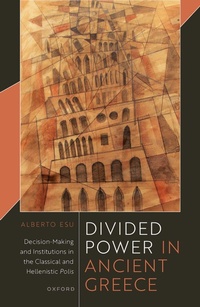
Divided Power in Ancient Greece
Decision-Making and Institutions in the Classical and Hellenistic Polis
Published on 14. March 2024
Book
Hardback
304 pages
978-0-19-888395-1 (ISBN)
Description
How did the division of power work in Ancient Greece? This groundbreaking study reveals Ancient Greek political decision-making to be a multi-layered system of delegation and legal control. Scholars have previously examined the nature and locus of sovereignty in the Classical and Hellenistic Greek poleis through institutional, rhetorical, or ideological approaches. By concentrating on the institutional design of decree-making, Alberto Esu moves beyond unitary and hierarchical understandings of sovereignty; he presents a new view of power as divided and horizontally organized between different decision-making institutions, each one with its own discourse and expertise.
Greek political decision-making is thus seen through a new institutionalist perspective that rediscovers the normative importance of political institutions as factors shaping the collective behaviour of decision-makers. Part I explores how deliberative power in decree-making was delegated in Classical Athens, Mytilene, and Hellenistic Megalopolis. Part II examines procedures of legal control and judicial review in the Classical and Hellenistic periods. Divided power proves to be a feature of both democratic and non-democratic societies across the Ancient Greek world; Esu's analysis of its institutional manifestation transforms our understanding of political life--its discourses and norms--in the Ancient Greek city-states.
Greek political decision-making is thus seen through a new institutionalist perspective that rediscovers the normative importance of political institutions as factors shaping the collective behaviour of decision-makers. Part I explores how deliberative power in decree-making was delegated in Classical Athens, Mytilene, and Hellenistic Megalopolis. Part II examines procedures of legal control and judicial review in the Classical and Hellenistic periods. Divided power proves to be a feature of both democratic and non-democratic societies across the Ancient Greek world; Esu's analysis of its institutional manifestation transforms our understanding of political life--its discourses and norms--in the Ancient Greek city-states.
Reviews / Votes
Esu focuses on two main issues of divided power: on the one hand, the delegation of power between various decision-making bodies; and, on the other, the institutions of legal control that checked the outcomes of decision-making bodies. Given the nature of the evidence, Esu relies to a significant extent on classical Athens; however, the value of the book is that it uses the evidence not in order to write an Athenocentric account, but to extend the approach to other classical andHellenistic Greek communities which offer relevant evidence: I found particularly illuminating the detailed discussions of Mytilene, Megalopolis, and Sparta. * Kostas Vlassopoulos, Greece and Rome *More details
Language
English
Place of publication
Oxford
United Kingdom
Target group
College/higher education
Product notice
sewn/stitched
Cloth over boards
Dimensions
Height: 238 mm
Width: 155 mm
Thickness: 24 mm
Weight
574 gr
ISBN-13
978-0-19-888395-1 (9780198883951)
Copyright in bibliographic data and cover images is held by Nielsen Book Services Limited or by the publishers or by their respective licensors: all rights reserved.
Schweitzer Classification
Other editions
Additional editions

Alberto Esu
Divided Power in Ancient Greece
Decision-Making and Institutions in the Classical and Hellenistic Polis
E-Book
04/2024
1st Edition
OUP eBook
€98.99
Available for download

Alberto Esu
Divided Power in Ancient Greece
Decision-Making and Institutions in the Classical and Hellenistic Polis
E-Book
02/2024
1st Edition
OUP eBook
€89.99
Available for download
Person
Alberto Esu is Postdoctoral Fellow at the University of Zurich. He studied in Italy and the UK, completing his PhD at the University of Edinburgh in 2018. He was Leverhulme Postdoctoral Fellow at the University of Mannheim from 2019 to 2022 and Assistant Professor of Ancient History at the University of Nottingham in 2022-23. He works on Greek institutional, legal, and socio-political history in the Classical and Hellenistic periods.
Content
Preface
Abbreviations
1: Introduction
Part I: Divided Power and Delegation
2: Divided Power in Athenian Decree-Making
3: Divided Power in Mytilene and Megalopolis: Delegation Practice beyond Athens
Part II: Divided Power and Control of Legality
4: Divided Power and Eunomia: Deliberative Procedures in Ancient Sparta
5: Divided Power in the Athenian Assembly: Adeia and Fifth-Century Deliberative Ideology
6: Divided Power and Judicial Review: Graph=e Paranom=on in the Decision-Making of the Greek Poleis
7: Epilogue
Bibliography
Index
Abbreviations
1: Introduction
Part I: Divided Power and Delegation
2: Divided Power in Athenian Decree-Making
3: Divided Power in Mytilene and Megalopolis: Delegation Practice beyond Athens
Part II: Divided Power and Control of Legality
4: Divided Power and Eunomia: Deliberative Procedures in Ancient Sparta
5: Divided Power in the Athenian Assembly: Adeia and Fifth-Century Deliberative Ideology
6: Divided Power and Judicial Review: Graph=e Paranom=on in the Decision-Making of the Greek Poleis
7: Epilogue
Bibliography
Index