

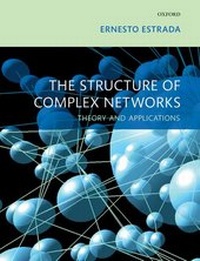
The Structure of Complex Networks
Theory and Applications
Published on 9. June 2016
Book
Paperback/Softback
478 pages
978-0-19-878380-0 (ISBN)
Description
This book deals with the analysis of the structure of complex networks by combining results from graph theory, physics, and pattern recognition. The book is divided into two parts. 11 chapters are dedicated to the development of theoretical tools for the structural analysis of networks, and 7 chapters are illustrating, in a critical way, applications of these tools to real-world scenarios. The first chapters provide detailed coverage of adjacency and metric and topological properties of networks, followed by chapters devoted to the analysis of individual fragments and fragment-based global invariants in complex networks. Chapters that analyse the concepts of communicability, centrality, bipartivity, expansibility and communities in networks follow. The second part of this book is devoted to the analysis of genetic, protein residue, protein-protein interaction, intercellular, ecological and socio-economic networks, including important breakthroughs as well as examples of the misuse of structural concepts.
Reviews / Votes
The author presents an up-to-date overview of the study of network structure that is a pleasure to read. It is a great resource for everybody working with complex networks. * Thomas Peters, Contemporary Physics *More details
Language
English
Place of publication
Oxford
United Kingdom
Target group
Professional and scholarly
Dimensions
Height: 247 mm
Width: 190 mm
Thickness: 25 mm
Weight
874 gr
ISBN-13
978-0-19-878380-0 (9780198783800)
Copyright in bibliographic data and cover images is held by Nielsen Book Services Limited or by the publishers or by their respective licensors: all rights reserved.
Schweitzer Classification
Other editions
Additional editions
Book
10/2011
Oxford University Press
€107.70
Shipment within 15-20 days
Person
Ernesto Estrada obtained a PhD in Mathematical Chemistry from the Central University of Las Villas, Cuba in 1997 and completed post-doctoral studies at the University of Valencia, Spain and the Hebrew University of Jerusalem, Israel. In 2008 he was appointed Professor and Chair in Complexity Science at the Department of Mathematics and Statistics and the Department of Physics, University of Strathclyde, Glasgow, U.K. In 2005 he was elected fellow of the International Academy of Mathematical Chemistry (IAMC) and in 2007 he received the IAMC award as Outstanding Scientist for his multidisciplinary research in the field of complex networks. Estrada has published more than 140 scientific papers and has made seminal pioneering contributions in the areas of network matrix functions, communicability, bipartivity, subgraph centrality, generalised topological indices and the so-called Estrada index of a network.
Content
1: Introduction
2: Adjacency Relationships in Networks
3: Metric and Topological Structure of Networks
4: Fragments (Subgraphs) in Complex Networks
5: Accounting for all parts (subgraphs)
6: Communicability Functions in Networks
7: Centrality Measures
8: Global Network Invariants
9: Expansion and Network Classes
10: Community Structure in Networks
11: Network Bipartivity
12: Random Models of Networks
13: Genetic Networks
14: Protein Residue Networks
15: Protein-protein Interaction Networks
16: The Structure of Reaction Networks
17: Intercellular Networks
18: Networks in Ecology
19: Socio-Economic Networks
20: Conclusions
2: Adjacency Relationships in Networks
3: Metric and Topological Structure of Networks
4: Fragments (Subgraphs) in Complex Networks
5: Accounting for all parts (subgraphs)
6: Communicability Functions in Networks
7: Centrality Measures
8: Global Network Invariants
9: Expansion and Network Classes
10: Community Structure in Networks
11: Network Bipartivity
12: Random Models of Networks
13: Genetic Networks
14: Protein Residue Networks
15: Protein-protein Interaction Networks
16: The Structure of Reaction Networks
17: Intercellular Networks
18: Networks in Ecology
19: Socio-Economic Networks
20: Conclusions