

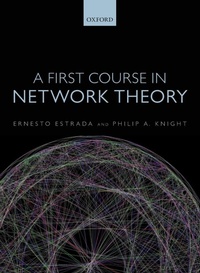
A First Course in Network Theory
Published on 26. March 2015
Book
Hardback
270 pages
978-0-19-872645-6 (ISBN)
Description
The study of network theory is a highly interdisciplinary field, which has emerged as a major topic of interest in various disciplines ranging from physics and mathematics, to biology and sociology. This book promotes the diverse nature of the study of complex networks by balancing the needs of students from very different backgrounds. It references the most commonly used concepts in network theory, provides examples of their applications in solving practical problems, and clear indications on how to analyse their results.
In the first part of the book, students and researchers will discover the quantitative and analytical tools necessary to work with complex networks, including the most basic concepts in network and graph theory, linear and matrix algebra, as well as the physical concepts most frequently used for studying networks. They will also find instruction on some key skills such as how to proof analytic results and how to manipulate empirical network data. The bulk of the text is focused on instructing readers on the most useful tools for modern practitioners of network theory. These include degree distributions, random networks, network fragments, centrality measures, clusters and communities, communicability, and local and global properties of networks. The combination of theory, example and method that are presented in this text, should ready the student to conduct their own analysis of networks with confidence and allow teachers to select appropriate examples and problems to teach this subject in the classroom.
In the first part of the book, students and researchers will discover the quantitative and analytical tools necessary to work with complex networks, including the most basic concepts in network and graph theory, linear and matrix algebra, as well as the physical concepts most frequently used for studying networks. They will also find instruction on some key skills such as how to proof analytic results and how to manipulate empirical network data. The bulk of the text is focused on instructing readers on the most useful tools for modern practitioners of network theory. These include degree distributions, random networks, network fragments, centrality measures, clusters and communities, communicability, and local and global properties of networks. The combination of theory, example and method that are presented in this text, should ready the student to conduct their own analysis of networks with confidence and allow teachers to select appropriate examples and problems to teach this subject in the classroom.
More details
Language
English
Place of publication
Oxford
United Kingdom
Target group
College/higher education
Illustrations
151 figures
Dimensions
Height: 252 mm
Width: 194 mm
Thickness: 19 mm
Weight
729 gr
ISBN-13
978-0-19-872645-6 (9780198726456)
Copyright in bibliographic data and cover images is held by Nielsen Book Services Limited or by the publishers or by their respective licensors: all rights reserved.
Schweitzer Classification
Other editions
Additional editions
Ernesto Estrada | Philip A. Knight
A First Course in Network Theory
E-Book
03/2015
1st Edition
OUP eBook
€43.49
Available for download
Ernesto Estrada | Philip A. Knight
A First Course in Network Theory
Book
03/2015
Oxford University Press
€65.10
Shipment within 15-20 days
Persons
Ernesto Estrada is a Professor in Mathematics at the University of Strathclyde, UK. He is the Chair in Complexity Science since 2008 and the 1964 Chair in Mathematics since 2014. He holds the Wolfson Research Merit Award from the Royal Society and has published more than 160 papers and 10 book chapters. He is the author of The Structure of Complex Networks: Theory and Applications, published by Oxford University Press (OUP) in 2011. Professor Estrada is also the Editor-in-Chief of the Journal of Complex Networks published by OUP. His research interests are in the mathematical analysis of networks, the use of physical analogies to study networks and applications of network theory to society, chemistry, biology, ecology and engineering.
Philip Knight is a Lecturer in Mathematics at the University of Strathclyde, UK. He obtained his PhD in Mathematics from the University of Manchester in 1993 and has spent most of his career carrying out research into matrix algebra. His interest in applications drew him inexorably towards network theory and his research interests now centre on the algebraic structure of networks as well as on the use of networks to represent other mathematical structures. More recently, Dr Knight has been involved in teaching courses on network theory in different countries and is well regarded among students for his expository abilities.
Philip Knight is a Lecturer in Mathematics at the University of Strathclyde, UK. He obtained his PhD in Mathematics from the University of Manchester in 1993 and has spent most of his career carrying out research into matrix algebra. His interest in applications drew him inexorably towards network theory and his research interests now centre on the algebraic structure of networks as well as on the use of networks to represent other mathematical structures. More recently, Dr Knight has been involved in teaching courses on network theory in different countries and is well regarded among students for his expository abilities.
Content
1. Introduction ; 2. General Concepts in Network Theory ; 3. How To Prove It? ; 4. Data Analysis ; 5. Algebraic Concepts in Network Theory ; 6. Spectra of Adjacency Matrices ; 7. The Network Laplacian ; 8. Classical Physcis Analogies ; 9. Degree Distributions ; 10. Clustering Coefficients of Networks ; 11. Random Models of Networks ; 12. Matrix Functions ; 13. Fragment Based Measures ; 14. Classical Node Centrality ; 15. Spectral Node Centrality ; 16. Quantum Physcis Analogies ; 17. Global Properties of Networks I ; 18. Global properties of networks II ; 19. Communicability in Networks ; 20. Statistical Physics Analogies ; 21. Communities in Networks