

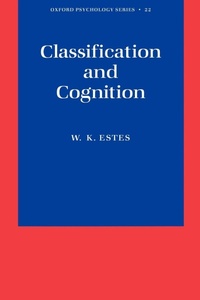
Classification and Cognition
Published on 9. January 1997
Book
Paperback/Softback
296 pages
978-0-19-510974-0 (ISBN)
Description
Understanding classification is a major challenge for formulating theories of both human cognition and artificial intelligence. Classification is a human mental activity which covers such diverse things as forming concepts, categorizing medical patients, recognising an acquaintance, or discriminating phonetic components of a language. This book considers both previous theories and new research and comes up with a new core model which it proposes as the basis of all forms of classification. Two versions of this model are developed, one based on symbol-processing, and one on connectionist architecture, and it is suggested that modules of each type of model coexist in the human cognitive system, competing for control of behavioural output.
Reviews / Votes
...astoundingly wide sphere of application. * Science *More details
Series
Language
English
Place of publication
New York
United States
Target group
Professional and scholarly
Illustrations
line figures, tables
Dimensions
Height: 234 mm
Width: 156 mm
Thickness: 16 mm
Weight
453 gr
ISBN-13
978-0-19-510974-0 (9780195109740)
Copyright in bibliographic data and cover images is held by Nielsen Book Services Limited or by the publishers or by their respective licensors: all rights reserved.
Schweitzer Classification
Other editions
Additional editions
W. K. Estes
Classification and Cognition
Book
03/1994
Oxford University Press Inc
€190.80
Shipment within 15-20 days
William K. Estes
Classification and Cognition
E-Book
01/1994
1st Edition
OUP eBook
€31.49
Available for download
Person
Content
1. Introduction and Basic Concepts ; 2. Category Structures and Categorization ; 3. Models for Category Learning ; 4. Categorization and Memory Processing ; 5. On the Storage and Retrieval of Categorical Information ; 6. Extensions and New Applications of the Exemplar-Similarity Model