

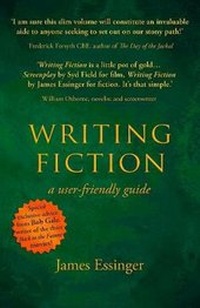
Writing Fiction - a user-friendly guide
Published on 1. August 2019
Book
Paperback/Softback
192 pages
978-1-911546-54-2 (ISBN)
Description
`I am sure this slim volume will constitute an invaluable aide to anyone seeking to set out on our stony path' - Frederick Forsyth CBE, author of 'The Day of the Jackal' and many other international bestsellers
`Writing Fiction is a little pot of gold... Screenplay by Syd Field for film, Writing Fiction by James Essinger for fiction. It's that simple.'
William Osborne, novelist and screenwriter
Writing Fiction - a user-friendly guide is a must-read if you want to write stories to a professional standard.
It draws on the author's more than thirty years of experience as a professional writer, and on the work and ideas of writers including:
* Anthony Burgess
* Joseph Conrad
* George Eliot
* Ken Follett
* Frederick Forsyth
* Dan Harmon
* Ernest Hemingway
* David Lodge
* Norman Mailer
* John Milton
* Ben Parker
* J.K. Rowling
* William Shakespeare
* Martin Cruz Smith
* J.R.R. Tolkien
The twenty-four chapters cover every important matter you need to know about, including: devising a compelling story, creating and developing characters, plotting, `plants', backstory, suspense, dialogue, `show' and `tell', and how to make your novel more real than reality.
Also featuring special guest advice from legendary screenwriter Bob Gale, who wrote the three immortal `Back to the Future' movies (1985, 1989 and 1990), and novelist and screenwriter William Osborne, whose many screen credits include the co-writing of the blockbuster `Twins' (1988), this highly entertaining book gives you all the advice and practical guidance you need to make your dream of becoming a published fiction writer come true.
`Writing Fiction is a little pot of gold... Screenplay by Syd Field for film, Writing Fiction by James Essinger for fiction. It's that simple.'
William Osborne, novelist and screenwriter
Writing Fiction - a user-friendly guide is a must-read if you want to write stories to a professional standard.
It draws on the author's more than thirty years of experience as a professional writer, and on the work and ideas of writers including:
* Anthony Burgess
* Joseph Conrad
* George Eliot
* Ken Follett
* Frederick Forsyth
* Dan Harmon
* Ernest Hemingway
* David Lodge
* Norman Mailer
* John Milton
* Ben Parker
* J.K. Rowling
* William Shakespeare
* Martin Cruz Smith
* J.R.R. Tolkien
The twenty-four chapters cover every important matter you need to know about, including: devising a compelling story, creating and developing characters, plotting, `plants', backstory, suspense, dialogue, `show' and `tell', and how to make your novel more real than reality.
Also featuring special guest advice from legendary screenwriter Bob Gale, who wrote the three immortal `Back to the Future' movies (1985, 1989 and 1990), and novelist and screenwriter William Osborne, whose many screen credits include the co-writing of the blockbuster `Twins' (1988), this highly entertaining book gives you all the advice and practical guidance you need to make your dream of becoming a published fiction writer come true.
Reviews / Votes
`I am sure this slim volume will constitute an invaluable aide to anyone seeking to set out on our stony path' - Frederick Forsyth CBE, author of The Day of the Jackal and many other international bestsellersMore details
Language
English
Place of publication
Canterbury
United Kingdom
Dimensions
Height: 198 mm
Width: 129 mm
Thickness: 14 mm
ISBN-13
978-1-911546-54-2 (9781911546542)
Copyright in bibliographic data and cover images is held by Nielsen Book Services Limited or by the publishers or by their respective licensors: all rights reserved.
Schweitzer Classification
Person
James Essinger has been a professional writer since 1988. His non-fiction books include 'Jacquard's Web' (2004), 'Ada's Algorithm' (2013), which is to be filmed by Monumental Pictures, and 'Charles and Ada: the computer's most passionate partnership' (2019). His novels include 'The Mating Game' (2016) and 'The Ada Lovelace Project' (2020).
Content
Preface
1: So what is fiction, anyway?
2: Devising a compelling story
3: Two golden rules
4: Lessons from Hollywood
5: The importance of a good outline
6: Which writers should be your model?
7: How long should your novel be?
8: Why you need to pursue everything
9: Character in your novel
10: Your novel's voice
11: Which scenes should be in your novel?
12: Backstory
13: Choosing your characters
14: Depicting villains
15: Dialogue
16: What kind of prose should you be writing?
17: Plants
18: Making your novel more real than reality
19: Language and words
20: Show and tell
21: Suspense
22: The need for your story to be logical
23: Editing and improving your novel
24: Summing up
1: So what is fiction, anyway?
2: Devising a compelling story
3: Two golden rules
4: Lessons from Hollywood
5: The importance of a good outline
6: Which writers should be your model?
7: How long should your novel be?
8: Why you need to pursue everything
9: Character in your novel
10: Your novel's voice
11: Which scenes should be in your novel?
12: Backstory
13: Choosing your characters
14: Depicting villains
15: Dialogue
16: What kind of prose should you be writing?
17: Plants
18: Making your novel more real than reality
19: Language and words
20: Show and tell
21: Suspense
22: The need for your story to be logical
23: Editing and improving your novel
24: Summing up