

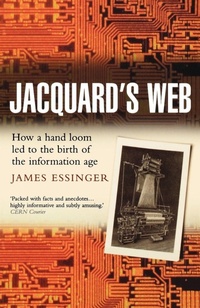
Jacquard's Web
How a hand-loom led to the birth of the information age
Published on 29. March 2007
Book
Paperback/Softback
316 pages
978-0-19-280578-2 (ISBN)
Description
Jacquard's Web is the story of some of the most ingenious inventors the world has ever known, a fascinating account of how a hand-loom invented in Napoleonic France led to the development of the modern information age. James Essinger, a master story-teller, shows through a series of remarkable and meticulously researched historical connections (spanning two centuries and never investigated before) that the Jacquard loom kick-started a process of scientific evolution which would lead directly to the development of the modern computer.
The invention of Jacquard's loom in 1804 enabled the master silk-weavers of Lyons to weave fabrics 25 times faster than had previously been possible. The device used punched cards, which stored instructions for weaving whatever pattern or design was required; it proved an outstanding success. These cards can very reasonably be described as the world's first computer programmes.
In this engaging and delightful book, James Essinger reveals a plethora of extraordinary links between the nineteenth-century world of weaving and today's computer age: to give just one example, modern computer graphics displays are based on exactly the same principles as those employed in Jacquard's special woven tableaux. Jacquard's Web also introduces some of the most colourful and interesting characters in the history of science and technology: the modest but exceptionally dedicated Jacquard himself, the brilliant but temperamental Victorian polymath Charles Babbage, who dreamt of a cogwheel computer operated using Jacquard cards, and the imaginative and perceptive Ada Lovelace, Lord Byron's only legitimate daughter.
The invention of Jacquard's loom in 1804 enabled the master silk-weavers of Lyons to weave fabrics 25 times faster than had previously been possible. The device used punched cards, which stored instructions for weaving whatever pattern or design was required; it proved an outstanding success. These cards can very reasonably be described as the world's first computer programmes.
In this engaging and delightful book, James Essinger reveals a plethora of extraordinary links between the nineteenth-century world of weaving and today's computer age: to give just one example, modern computer graphics displays are based on exactly the same principles as those employed in Jacquard's special woven tableaux. Jacquard's Web also introduces some of the most colourful and interesting characters in the history of science and technology: the modest but exceptionally dedicated Jacquard himself, the brilliant but temperamental Victorian polymath Charles Babbage, who dreamt of a cogwheel computer operated using Jacquard cards, and the imaginative and perceptive Ada Lovelace, Lord Byron's only legitimate daughter.
Reviews / Votes
Jacquard's web is a special book that explains more than the connections between loom and computer: it presents a fascinating history of talented and creative people developing and inventing the tools of progress. * Chris Arney, Mathematical Reviews *More details
Language
English
Place of publication
Oxford
United Kingdom
Target group
Professional and scholarly
Illustrations
30 halftones
Dimensions
Height: 198 mm
Width: 129 mm
Thickness: 17 mm
Weight
338 gr
ISBN-13
978-0-19-280578-2 (9780192805782)
Copyright in bibliographic data and cover images is held by Nielsen Book Services Limited or by the publishers or by their respective licensors: all rights reserved.
Schweitzer Classification
Other editions
Additional editions
E-Book
10/2004
OUP eBook
€12.99
Available for download
E-Book
10/2004
OUP eBook
€12.99
Available for download
Person
James Essinger is a writer with a particluar interest in the history of ideas that have had a practical impact on the modern world. He is currently working on a novel about Charles Babbage and Ada Lovelace and on a popular history of the written word.
Content
Acknowledgements ; 1. The engraving that wasn't ; 2. A better mouse-trap ; 3. The son of a master weaver ; 4. The emperor's new clothes ; 5. From weaving to computing ; 6. The difference engine ; 7. The analytical engine ; 8. A question of faith and funding ; 9. The lady who loved the Jacquard loom ; 10. A crisis with the American census ; 11. The first Jacquard looms that wove information ; 12. The birth of IBM ; 13. The Thomas Watson phenomenon ; 14. Howard Aiken dreams of a computer ; 15. IBM and the Harvard Mark 1 ; 16. Weaving at the speed of light ; 17. The future ; Index