

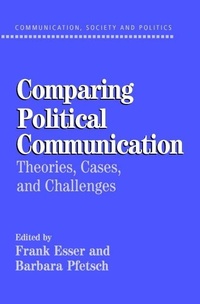
Comparing Political Communication
Theories, Cases, and Challenges
Published on 6. September 2004
Book
Paperback/Softback
438 pages
978-0-521-53540-3 (ISBN)
Description
This volume assesses comparative political communication research and considers potential ways in which it could and should develop. Twenty experts from Europe and the United States offer a unique and comprehensive discussion of the theories, cases, and challenges of comparative research in political communication. The first part discusses the fundamental themes, concepts and methods essential to analyze the effects of modernization and globalization of political communication. The second part offers a broad range of case studies that illustrate the enormous potential of cross-national approaches in many relevant fields of political communication. The third part paves the way for future research by describing the most promising concepts and pressing challenges of comparative political communication. This book is intended to introduce new students to a crucial, dynamic field as well as deepening advanced students' knowledge of its principles and perspectives.
Reviews / Votes
'This thought-provoking collection of essays not only reminds us of the richness and diversity of research in comparative political communication but it is also a convincing argument for continuing to develop such work. But the volume contains a challenge: how does one undertake comparative political communication research in the era of globalization? This is a timely intervention in such debates and should be read by everyone interested in political communication.' Ralph M. Negrine, University of Leicester 'This book tackles the very difficult job of developing a theoretical structure to compare political and media systems not only within one country, but across countries. The editors are to be commended for offering not only a current theoretical model, but also for providing other scholars with a heuristically provocative theory that will no doubt generate much theory-driven research in the future.' Pamela J. Shoemaker, Syracuse University 'A much-needed and carefully conceptualized addition to the political communication literature [that] includes contributions by some of the most eminent scholars of this field ... It is a veritable feast for those interested in the most sophisticated thinking on this subject. Congratulations to Frank Esser and Barbara Pfetsch for bringing these minds together in one volume.' David H. Weaver, Indiana UniversityMore details
Series
Language
English
Place of publication
Cambridge
United Kingdom
Target group
Professional and scholarly
College/higher education
Product notice
Paperback (trade)
Illustrations
2 Tables, unspecified
Dimensions
Height: 229 mm
Width: 152 mm
Thickness: 26 mm
Weight
707 gr
ISBN-13
978-0-521-53540-3 (9780521535403)
Copyright in bibliographic data and cover images is held by Nielsen Book Services Limited or by the publishers or by their respective licensors: all rights reserved.
Schweitzer Classification
Other editions
Additional editions
E-Book
11/2006
1st Edition
Cambridge University Press
€38.49
Available for download
Book
09/2004
Cambridge University Press
€85.20
Shipment within 15-20 days
Persons
Frank Esser is Assistant Professor in the Institut fuer Publizistik at the University of Mainz, Germany. His research centers around cross-national studies of journalism and political communication. He has written articles for various journals, including the European Journal of Communications and the Harvard International Journal of Press Politics. Barbara Pfetsch is Professor of Communication and Media Policy at the University of Hohenheim, Germany. She was a fellow at the John F. Kennedy School of Government at Harvard and at the Center for German and European Studies at Georgetown University. Her research interests focus on comparative analyses of political communication and the mediated public sphere.
Content
1. Introduction Barbara Pfetsch and Frank Esser; Part I. Theories and Methods: 2. Americanization, globalization, and secularization: understanding the convergence of media systems and political communication Daniel C. Hallin and Paolo Mancini; 3. Transnational trends in political communication: conventional views and new realities David L. Swanson; 4. Comparing mass communication systems: media formats, media contents, and media processes Hans J. Kleinsteuber; 5. Designs and methods of comparative political communication research Werner Wirth and Steffen Kolb; Part II. Cases: 6. Global political communication: good governance, human development and mass communication Pippa Norris; 7. Local political communication: media and local publics in the age of globalization Sabine Lang; 8. Strategic political communication: mobilizing public opinion in 'audience democracies' Hanspeter Kriesi; 9. Political campaign communication: conditional convergence of modern media elections Christina Holtz-Bacha; 10. Political communication and electronic democracy: American exceptionalism or global trend? Thomas Zittel; 11. Political news journalists: partisanship, professionalism, and political roles in five countries Wolfgang Donsbach and Thomas Patterson; 12. Political communication messages: pictures of our world on international television news Patrick Roessler; 13. Political communication effects: the impact of mass media and interpersonal conversations on voting Ruediger Schmitt-Beck; Part III. Perspectives and Challenges: 14. State of the art in comparative political communication research: poised for maturity? Michael Gurevitch and Jay G. Blumler; 15. From political culture to political communications culture: a theoretical approach to comparative analysis Barbara Pfetsch; 16. Problems of comparative political communication research: culture as a key variable Robert L. Stevenson; 17. Meeting the challenges of global communication and political integration: the significance of comparative research in a changing world Frank Esser and Barbara Pfetsch.