

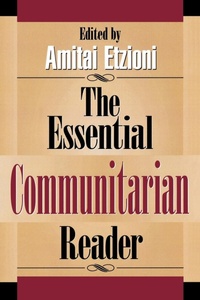
The Essential Communitarian Reader
Rowman & Littlefield Publishers
Published on 17. February 1998
Book
Paperback/Softback
364 pages
978-0-8476-8827-2 (ISBN)
Description
This outstanding new book shows why communitarian thought has had such a profound influence on contemporary American public policy, from strengthening our neighborhoods to fighting AIDS and educating our children. Edited by Amitai Etzioni, founder of the Communitarian Network and author of the best-selling books The Spirit of Community and The New Golden Rule, this comprehensive collection contains essays written by the nation's most respected thinkers. See why politicians as diverse as Vice President Al Gore and Jack Kemp view communitarian social philosophy as the most practical way of restoring America's communities and redeeming its political institutions.
Reviews / Votes
For a movement that is only a few years old, the communitarians are bursting with ideas for rebuilding what they see as the pillars of society-the family, the school, and the community. * The San Francisco Chronicle * Communitarianism promises to shape a new political era in the way progressivism reshaped our nation a century ago. -- Bill BradleyMore details
Series
Language
English
Place of publication
United States
Publishing group
Bloomsbury Publishing Plc
Target group
College/higher education
Professional and scholarly
Product notice
Paperback (trade)
Dimensions
Height: 229 mm
Width: 152 mm
Thickness: 21 mm
Weight
591 gr
ISBN-13
978-0-8476-8827-2 (9780847688272)
Copyright in bibliographic data and cover images is held by Nielsen Book Services Limited or by the publishers or by their respective licensors: all rights reserved.
Schweitzer Classification
Other editions
Additional editions
E-Book
01/1998
1st Edition
Rowman & Littlefield Publishers
€40.99
Available for download
E-Book
01/1998
1st Edition
Rowman & Littlefield Publishers
€40.99
Available for download
Persons
Amitai Etzioni is university professor at George Washington University. He is the author and editor of many influential books, including The Spirit of Community and The New Golden Rule. He resides in Washington, D.C.
Content
Chapter 1 Introduction
Chapter 2 The Responsive Communitarian Platform: Rights and Responsibilities
Part 3 Part I. Communitarian Theory
Chapter 4 Foundations of Communitarian Liberalism
Chapter 5 Community Properly Understood: A Defense of "Democratic Communitarianism"
Chapter 6 The Limits of Libertarianism
Chapter 7 A Moral Reawakening Without Puritanism
Chapter 8 The Dangers of Soft Despotism
Chapter 9 Beyond Teledemocracy: "America on the Line"
Chapter 10 Social Justice: A Communitarian Perspective
Chapter 11 A Precarious Balance: Economic Opportunity, Civil Society and Political Liberty
Part 12 Part II. Rights and Responsibilities
Chapter 13 Rights and Responsibilities
Chapter 14 "Absolute" Rights": Property and Privacy
Chapter 15 Permissible Paternalism: In Defense of the Nanny State
Chapter 16 Finding a Place for Community in the First Amendment
Chapter 17 AIDS Prevention vs. Cultural Sensitivity
Chapter 18 A Gangsta's Rights
Part 19 Part III. Communitarian Policy
Chapter 20 A Liberal-Democratic Case for the Two-Parent Family
Chapter 21 Residential Community Associations: Community or Disunity?
Chapter 22 When Redistribution and Economic Growth Fail
Chapter 23 What Makes a Good Urban Park?
Chapter 24 The Loss of Public Space
Chapter 25 Rebuilding Urban Communities
Chapter 26 The Libertarian Conundrum: Why the Market Does Not Safeguard Civil Rights
Chapter 27 Drug Abuse Control Policy: Liberatarian, Authoritarian, Liberal, and Communitarian Perspectives
Chapter 28 Inner-City Crime: What the Federal Government Should Do
Chapter 29 A Mandate For Liberty: Requiring Education-Based Community Service
Chapter 30 Social Science Finds: "Marriage Matters"
Chapter 31 Part IV. The Community of Communities
Chapter 32 Democracy and the Politics of Difference
Chapter 33 Pluralism vs. Particularism in American Education
Chapter 34 Immigration and Political Community in the United States
Chapter 35 Who Killed Modern Manners?
Chapter 36 Index
Chapter 2 The Responsive Communitarian Platform: Rights and Responsibilities
Part 3 Part I. Communitarian Theory
Chapter 4 Foundations of Communitarian Liberalism
Chapter 5 Community Properly Understood: A Defense of "Democratic Communitarianism"
Chapter 6 The Limits of Libertarianism
Chapter 7 A Moral Reawakening Without Puritanism
Chapter 8 The Dangers of Soft Despotism
Chapter 9 Beyond Teledemocracy: "America on the Line"
Chapter 10 Social Justice: A Communitarian Perspective
Chapter 11 A Precarious Balance: Economic Opportunity, Civil Society and Political Liberty
Part 12 Part II. Rights and Responsibilities
Chapter 13 Rights and Responsibilities
Chapter 14 "Absolute" Rights": Property and Privacy
Chapter 15 Permissible Paternalism: In Defense of the Nanny State
Chapter 16 Finding a Place for Community in the First Amendment
Chapter 17 AIDS Prevention vs. Cultural Sensitivity
Chapter 18 A Gangsta's Rights
Part 19 Part III. Communitarian Policy
Chapter 20 A Liberal-Democratic Case for the Two-Parent Family
Chapter 21 Residential Community Associations: Community or Disunity?
Chapter 22 When Redistribution and Economic Growth Fail
Chapter 23 What Makes a Good Urban Park?
Chapter 24 The Loss of Public Space
Chapter 25 Rebuilding Urban Communities
Chapter 26 The Libertarian Conundrum: Why the Market Does Not Safeguard Civil Rights
Chapter 27 Drug Abuse Control Policy: Liberatarian, Authoritarian, Liberal, and Communitarian Perspectives
Chapter 28 Inner-City Crime: What the Federal Government Should Do
Chapter 29 A Mandate For Liberty: Requiring Education-Based Community Service
Chapter 30 Social Science Finds: "Marriage Matters"
Chapter 31 Part IV. The Community of Communities
Chapter 32 Democracy and the Politics of Difference
Chapter 33 Pluralism vs. Particularism in American Education
Chapter 34 Immigration and Political Community in the United States
Chapter 35 Who Killed Modern Manners?
Chapter 36 Index