

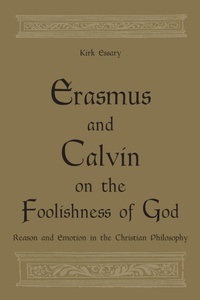
Erasmus and Calvin on the Foolishness of God
Reason and Emotion in the Christian Philosophy
Published on 7. April 2017
Book
Hardback
304 pages
978-1-4875-0188-4 (ISBN)
Description
What did Paul mean when he wrote that the foolishness of God is wiser than human wisdom? Through close analysis of the sixteenth-century reception of Paul's discourses of folly, this book examines the role of the New Testament in the development of what Erasmus and John Calvin refer to as the "Christian philosophy."
Erasmus and Calvin on the Foolishness of God reveals the importance of Pauline rhetoric in the development of humanist critiques of scholasticism while charting the formation of a specifically affective approach to religious epistemology and theological method. As the first book-length examination of Calvin's indebtedness to Erasmus, which also considers the participation of Bullinger, Pellikan, and Melanchthon in an Erasmian exegetical milieu, it is a case study in the complicated cross-confessional exchange of ideas in the sixteenth century. Kirk Essary examines assumptions about the very nature of theology in the sixteenth century, how it was understood by leading humanist reformers, and how ideas about philosophy and rhetoric were received, appropriated, and shared in a complex intellectual and religious context.
Erasmus and Calvin on the Foolishness of God reveals the importance of Pauline rhetoric in the development of humanist critiques of scholasticism while charting the formation of a specifically affective approach to religious epistemology and theological method. As the first book-length examination of Calvin's indebtedness to Erasmus, which also considers the participation of Bullinger, Pellikan, and Melanchthon in an Erasmian exegetical milieu, it is a case study in the complicated cross-confessional exchange of ideas in the sixteenth century. Kirk Essary examines assumptions about the very nature of theology in the sixteenth century, how it was understood by leading humanist reformers, and how ideas about philosophy and rhetoric were received, appropriated, and shared in a complex intellectual and religious context.
Reviews / Votes
'Essary's book offers much that will intrigue curious general readers as well as scholars. Excellent notes and bibliography.'- P.A. Streveler (Choice Magazine vol 55:03:2017) "This is an admirable study that reflects extensive scholarship in early modern and patristic sources."
- William P. Weaver, Baylor University (Erasmus Studies, vol 39)
More details
Series
Language
English
Place of publication
Toronto
Canada
Target group
College/higher education
Professional and scholarly
Product notice
sewn/stitched
Cloth over boards
With dust jacket
Dimensions
Height: 239 mm
Width: 166 mm
Thickness: 27 mm
Weight
597 gr
ISBN-13
978-1-4875-0188-4 (9781487501884)
Copyright in bibliographic data and cover images is held by Nielsen Book Services Limited or by the publishers or by their respective licensors: all rights reserved.
Schweitzer Classification
Other editions
Additional editions
Kirk Essary
Erasmus and Calvin on the Foolishness of God
Reason and Emotion in the Christian Philosophy
E-Book
04/2017
1st Edition
University of Toronto Press
€71.95
Available for download
Person
Kirk Essary is Lecturer in History and Classics at the University of Western Australia.
Content
Preface
Chapter One
Calvin's Erasmus, Theologia Rhetorica, and Pauline Folly
Chapter Two
Foolishness as Religious Knowledge
Chapter Three
Hidden Wisdom and the Revelation of the Spirit
Chapter Four
Milk for Babes: A Pauline Eloquence
Chapter Five
Blaming Philosophy, Praising Folly
Chapter Six
The Affective Christian Philosophy
Conclusion
Notes
Bibliography
Chapter One
Calvin's Erasmus, Theologia Rhetorica, and Pauline Folly
Chapter Two
Foolishness as Religious Knowledge
Chapter Three
Hidden Wisdom and the Revelation of the Spirit
Chapter Four
Milk for Babes: A Pauline Eloquence
Chapter Five
Blaming Philosophy, Praising Folly
Chapter Six
The Affective Christian Philosophy
Conclusion
Notes
Bibliography