

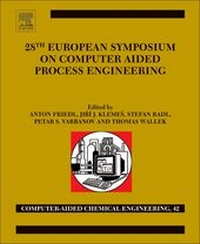
27th European Symposium on Computer Aided Process Engineering: Volume 40
Published on 22. September 2017
Book
3042 pages
978-0-444-63965-3 (ISBN)
Description
27th European Symposium on Computer Aided Process Engineering, Volume 40 contains the papers presented at the 27th European Society of Computer-Aided Process Engineering (ESCAPE) event held in Barcelona, October 1-5, 2017. It is a valuable resource for chemical engineers, chemical process engineers, researchers in industry and academia, students, and consultants for chemical industries.
More details
Series
Language
English
Place of publication
Oxford
United Kingdom
Publishing group
Elsevier Science & Technology
Target group
Professional and scholarly
College/higher education
Chemical engineers, chemical process engineers, researchers in industry and academia, students, and consultants for chemical industries
Dimensions
Height: 235 mm
Width: 191 mm
Weight
6670 gr
ISBN-13
978-0-444-63965-3 (9780444639653)
Copyright in bibliographic data and cover images is held by Nielsen Book Services Limited or by the publishers or by their respective licensors: all rights reserved.
Schweitzer Classification
Other editions
Additional editions
E-Book
09/2017
Elsevier
€530.00
Available for download
Person
Antonio Espuna is Professor of Chemical Engineering at the Universitat Politecnica de Catalunya (UPC).
His research experience includes the participation as researcher and technical responsible in more than 30 research and development projects in the area of management of chemical processes (modeling, design, optimization and control), funded by local, national and international administrations (EU, NATO, etc.) and also by private entities. Since 1986 he has been responsible for more than 20 different topics at university graduate and master levels, mainly in the area of chemical engineering and environmental engineering.
Professor Espuna has co-authored more than 90 papers in technical and scientific journals indexed in the JCR and has made more than 160 contributions to international congresses in the areas of Environmental Engineering, Chemical Engineering and Process Control. He is currently member of the "Association of Industrial Engineers of Catalonia?; Spanish Delegate in the "Working Party: Computer Application in Process Engineering? of the European Federation of Chemical Engineering (EFChE); and Member of the Executive Committee of EURECHA (European Committee for Computers in Chemical Engineering Education).
His research experience includes the participation as researcher and technical responsible in more than 30 research and development projects in the area of management of chemical processes (modeling, design, optimization and control), funded by local, national and international administrations (EU, NATO, etc.) and also by private entities. Since 1986 he has been responsible for more than 20 different topics at university graduate and master levels, mainly in the area of chemical engineering and environmental engineering.
Professor Espuna has co-authored more than 90 papers in technical and scientific journals indexed in the JCR and has made more than 160 contributions to international congresses in the areas of Environmental Engineering, Chemical Engineering and Process Control. He is currently member of the "Association of Industrial Engineers of Catalonia?; Spanish Delegate in the "Working Party: Computer Application in Process Engineering? of the European Federation of Chemical Engineering (EFChE); and Member of the Executive Committee of EURECHA (European Committee for Computers in Chemical Engineering Education).
Content
1. Scientific organization
2. Plenary lectures
3. Modelling and simulation
4. Synthesis and Design
5. Planning and scheduling
6. Process monitoring and control
7. Integrated and holistic approaches for decision support
8. CAPE concepts, methods and tools
9. CAPE applications addressing global grand challenges
10. CAPE/PSE education and training
2. Plenary lectures
3. Modelling and simulation
4. Synthesis and Design
5. Planning and scheduling
6. Process monitoring and control
7. Integrated and holistic approaches for decision support
8. CAPE concepts, methods and tools
9. CAPE applications addressing global grand challenges
10. CAPE/PSE education and training