

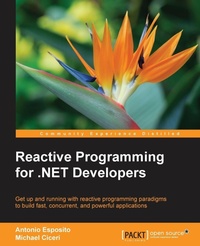
Reactive Programming for .NET Developers
Get up and running with reactive programming paradigms to build fast, concurrent, and powerful applications
Published on 29. July 2016
Book
Paperback/Softback
276 pages
978-1-78588-288-3 (ISBN)
Description
Get up and running with reactive programming paradigms to build fast, concurrent, and powerful applications
Key Features
[*] Get to grips with the core design principles of reactive programming
[*] Learn about Reactive Extensions for .NET through real-world examples
[*] Improve your problem-solving ability by applying functional programming
Book DescriptionReactive programming is an innovative programming paradigm focused on time-based problem solving. It makes your programs better-performing, easier to scale, and more reliable.
Want to create fast-running applications to handle complex logics and huge datasets for financial and big-data challenges? Then you have picked up the right book!
Starting with the principles of reactive programming and unveiling the power of the pull-programming world, this book is your one-stop solution to get a deep practical understanding of reactive programming techniques. You will gradually learn all about reactive extensions, programming, testing, and debugging observable sequence, and integrating events from CLR data-at-rest or events. Finally, you will dive into advanced techniques such as manipulating time in data-flow, customizing operators and providers, and exploring functional reactive programming.
By the end of the book, you'll know how to apply reactive programming to solve complex problems and build efficient programs with reactive user interfaces.
What you will learn
[*] Create, manipulate, and aggregate sequences in a functional-way
[*] Query observable data streams using standard LINQ query operators
[*] Program reactive observers and observable collections with C#
[*] Write concurrent programs with ease, scheduling actions on various workers
[*] Debug, analyze, and instrument Rx functions
[*] Integrate Rx with CLR events and custom scheduling
[*] Learn Functional Reactive Programming with F#
Who this book is forIf you are a .NET developer who wants to implement all the reactive programming paradigm techniques to create better and more efficient code, then this is the book for you. No prior knowledge of reactive programming is expected.
Key Features
[*] Get to grips with the core design principles of reactive programming
[*] Learn about Reactive Extensions for .NET through real-world examples
[*] Improve your problem-solving ability by applying functional programming
Book DescriptionReactive programming is an innovative programming paradigm focused on time-based problem solving. It makes your programs better-performing, easier to scale, and more reliable.
Want to create fast-running applications to handle complex logics and huge datasets for financial and big-data challenges? Then you have picked up the right book!
Starting with the principles of reactive programming and unveiling the power of the pull-programming world, this book is your one-stop solution to get a deep practical understanding of reactive programming techniques. You will gradually learn all about reactive extensions, programming, testing, and debugging observable sequence, and integrating events from CLR data-at-rest or events. Finally, you will dive into advanced techniques such as manipulating time in data-flow, customizing operators and providers, and exploring functional reactive programming.
By the end of the book, you'll know how to apply reactive programming to solve complex problems and build efficient programs with reactive user interfaces.
What you will learn
[*] Create, manipulate, and aggregate sequences in a functional-way
[*] Query observable data streams using standard LINQ query operators
[*] Program reactive observers and observable collections with C#
[*] Write concurrent programs with ease, scheduling actions on various workers
[*] Debug, analyze, and instrument Rx functions
[*] Integrate Rx with CLR events and custom scheduling
[*] Learn Functional Reactive Programming with F#
Who this book is forIf you are a .NET developer who wants to implement all the reactive programming paradigm techniques to create better and more efficient code, then this is the book for you. No prior knowledge of reactive programming is expected.
More details
Language
English
Place of publication
Birmingham
United Kingdom
Target group
Professional and scholarly
US School Grade: College Graduate Student
Dimensions
Height: 235 mm
Width: 191 mm
Thickness: 16 mm
Weight
521 gr
ISBN-13
978-1-78588-288-3 (9781785882883)
Copyright in bibliographic data and cover images is held by Nielsen Book Services Limited or by the publishers or by their respective licensors: all rights reserved.
Schweitzer Classification
Other editions
Additional editions
Antonio Esposito | Michael Ciceri
Reactive Programming for .NET Developers
Get up and running with reactive programming paradigms to build fast, concurrent, and powerful applications
E-Book
01/2025
Packt Publishing
from
€37.19
Available for download
Persons
Antonio Esposito is a Microsoft Certified Trainer, software architect, father, son, and lover of cooking and eating. He has been addicted to computer programming from age 8, a developer since 2002, and a speaker from 2010. He has moved across Europe in the last fifteen years working as freelance consultant or speaker for companies such as UniCredit Bank, Ferrari F1 Racing Team, Microsoft Italy, IBM, and many others. He actively attends as a speaker at a lot of conferences, such as MCT Summit and WPC Italy. He is already an author for Packt with Learning .NET High Performance Programming in 2014. Michael Ciceri is a technology consultant in .NET Framework and Microsoft. He is a functional programming, mathematics, technology, psychology, and science enthusiast. He started as an autodidact and passionately became an analyst and software developer in several areas, such as image processing, banking ATM services security, intranet back end, app monetizing. Recently, he has been working on the analysis and development of functions in the core application to solve problems or improve capabilities.
Content
Table of Contents
First steps in Reactive programming
Reactive programming with C#
Reactive Extensions programming
Observable Sequence programming
Testing and debugging observable sequences
CLR Integration and event scheduling
Advanced techniques
F# and Functional Reactive Programming
Advanced FRP and best practices
First steps in Reactive programming
Reactive programming with C#
Reactive Extensions programming
Observable Sequence programming
Testing and debugging observable sequences
CLR Integration and event scheduling
Advanced techniques
F# and Functional Reactive Programming
Advanced FRP and best practices