

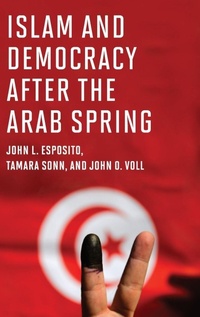
Islam and Democracy after the Arab Spring
Published on 28. January 2016
Book
Hardback
320 pages
978-0-19-514798-8 (ISBN)
Description
In late 2010, the wave of civil resistance known as the Arab Spring stunned the world as dictatorships in Tunisia, Egypt, and Libya were overthrown, while the regimes of Bahrain, Syria, and Yemen brutally suppressed their own revolutions. The Islamic political parties of Tunisia and Egypt have gained particular attention for their success in the national elections following the overthrow of their regimes, and similar electoral success has been seen in Morocco and is predicted throughout the Arab world and beyond in the broader Middle East and in Southeast Asia.
While the opposition movements of the Arab Spring are distinctive, each has raised questions regarding equality, economic justice, democratic participation, and the relationship between Islam and democracy in their respective countries, such as: does democracy require a secular political regime? And are religious movements the most effective opponents of authoritarian secularist regimes? The argument that that Islamic political groups' participation in democratic processes is only a ruse to actually impose an anti-democratic theocracy once in power continues to be made, often by former political and economic elites and secularists who would prefer a secularist autocracy to a democracy in which religious parties might control the government.
In Islam and Democracy after the Arab Spring, renowned Islamic Studies and History scholars John Esposito, Tamara Sonn, and John Voll examine these uprisings and the democratic process in the Muslim world, while also analyzing the larger relationship between religion and politics. Expanding upon issues initially raised by Esposito and Voll in the mid-1990s with Islam and Democracy, Islam and Democracy after the Arab Spring applies a twenty-first century perspective to the question of whether or not Islam is "compatible" with democracy by redirecting the conversation towards a new politic of democracy that transcends both secular authoritarianism and Political Islam.
While the opposition movements of the Arab Spring are distinctive, each has raised questions regarding equality, economic justice, democratic participation, and the relationship between Islam and democracy in their respective countries, such as: does democracy require a secular political regime? And are religious movements the most effective opponents of authoritarian secularist regimes? The argument that that Islamic political groups' participation in democratic processes is only a ruse to actually impose an anti-democratic theocracy once in power continues to be made, often by former political and economic elites and secularists who would prefer a secularist autocracy to a democracy in which religious parties might control the government.
In Islam and Democracy after the Arab Spring, renowned Islamic Studies and History scholars John Esposito, Tamara Sonn, and John Voll examine these uprisings and the democratic process in the Muslim world, while also analyzing the larger relationship between religion and politics. Expanding upon issues initially raised by Esposito and Voll in the mid-1990s with Islam and Democracy, Islam and Democracy after the Arab Spring applies a twenty-first century perspective to the question of whether or not Islam is "compatible" with democracy by redirecting the conversation towards a new politic of democracy that transcends both secular authoritarianism and Political Islam.
Reviews / Votes
This valuable book is highly recommended for understanding the contemporary dilemma of Muslin states caught, as they are, between modernity, tradition and certain ideologies. * The Muslim World Book Review Vol.38.2 * Democracy can take many forms, and the struggle of Muslim majority countries to find a democracy suited to their distinct cultural and political experiences is, as outlined in Islam and Democracy after the Arab Spring, an epoch-making experiment. Countering the 'clash of civilizations' and 'end of history' prophecies, Esposito, Sonn, and Voll show how pre- and post-Arab spring political developments in Muslim majority countries are marathon battles to end authoritarian practices in politics, religion, culture and statecraft. A must-read for those wishing to gain a nuanced understanding of the volatile and complex developments tied to Muslim efforts to make democracy a reality. * Ebrahim Moosa, Professor of Islamic Studies, Keough School of Global Affairs, University of Notre Dame * This is a very timely book. At a time where many observers are questioning the possibility of a true democratic process within Muslim majority countries, this series of essays shows, from Turkey to Iran, Senegal to Indonesia, that the political experiences are multiple and the way toward democratization is complex, yet open. The authors invite the reader to avoid simplistic conclusions about Islam and democracy. A critical achievement. * Tariq Ramadan, Professor of Contemporary Islamic Studies at the University of Oxford * For those who see in the apparent failure of the 'Arab spring' proof of the incompatibility of Islam and democratization, Esposito, Sonn, and Voll's new book offers a nuanced and brilliant rejoinder. No work that I know succeeds better at explaining the logic of the political struggles underway in the modern Muslim world. None more fully deserves to be read by scholars and the general reader alike. * Robert W. Hefner, author of Civil Islam: Muslims and Democratization in Indonesia *More details
Language
English
Place of publication
New York
United States
Target group
College/higher education
Professional and scholarly
Dimensions
Height: 240 mm
Width: 161 mm
Thickness: 22 mm
Weight
646 gr
ISBN-13
978-0-19-514798-8 (9780195147988)
Copyright in bibliographic data and cover images is held by Nielsen Book Services Limited or by the publishers or by their respective licensors: all rights reserved.
Schweitzer Classification
Other editions
Additional editions
John L. Esposito | Tamara Sonn | John O. Voll
Islam and Democracy after the Arab Spring
E-Book
10/2015
1st Edition
OUP eBook
€32.49
Available for download
John L. Esposito | Tamara Sonn | John O. Voll
Islam and Democracy after the Arab Spring
E-Book
10/2015
1st Edition
OUP eBook
€32.49
Available for download
Persons
John L. Esposito is University Professor, Professor of Religion & International Affairs and of Islamic Studies and Founding Director of the Alwaleed Center for Muslim-Christian Understanding at the Walsh School of Foreign Service at Georgetown University.
Tamara Sonn is the Hamad Bin Khalifa Al-Thani Professor in the History of Islam in the Alwaleed Center for Muslim-Christian Understanding at the Edmund A. Walsh School of Foreign Service at Georgetown University.
John O. Voll is Professor Emeritus of Islamic History and past Associate Director of the Alwaleed bin Talal Center for Muslim-Christian Understanding at Georgetown University.
Tamara Sonn is the Hamad Bin Khalifa Al-Thani Professor in the History of Islam in the Alwaleed Center for Muslim-Christian Understanding at the Edmund A. Walsh School of Foreign Service at Georgetown University.
John O. Voll is Professor Emeritus of Islamic History and past Associate Director of the Alwaleed bin Talal Center for Muslim-Christian Understanding at Georgetown University.
Author
University Professor and Professor of Religion & International Affairs and of Islamic StudiesUniversity Professor and Professor of Religion & International Affairs and of Islamic Studies, Georgetown University, Washington, DC
Hamad Bin Khalifa Al-Thani Professor in the History of Islam at the Edmund A. Walsh School of Foreign ServiceHamad Bin Khalifa Al-Thani Professor in the History of Islam at the Edmund A. Walsh School of Foreign Service, Georgetown University, Washington, DC
Professor Emeritus of Islamic History at the Center for Muslim-Christian UnderstandingProfessor Emeritus of Islamic History at the Center for Muslim-Christian Understanding, Georgetown University, Washington, DC
Content
Chapter 1: Introduction ; Chapter 2: Islam, Democracy and Turkey's Secular State ; Chapter 3: Iran: Classical Themes and Contemporary Challenges ; Chapter 4: Pakistan: A Work in Progress ; Chapter 5: Indonesia: From Military Rule to Democracy ; Chapter 6: Senegal: Democracy and the Post-Colonial State ; Chapter 7: Tunisia: From Revolution to Republic ; Chapter 8: Egypt: From Democratization to the Restoration of Authoritarianism ; Chapter 9: Conclusion ; Notes ; Index