

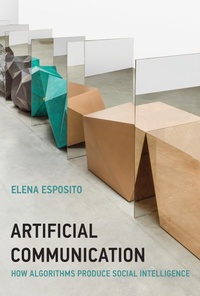
Artificial Communication
How Algorithms Produce Social Intelligence
Published on 24. May 2022
Book
Hardback
160 pages
978-0-262-04666-4 (ISBN)
Description
A proposal that we think about digital technologies such as machine learning not in terms of artificial intelligence but as artificial communication.
Algorithms that work with deep learning and big data are getting so much better at doing so many things that it makes us uncomfortable. How can a device know what our favorite songs are, or what we should write in an email? Have machines become too smart? In Artificial Communication, Elena Esposito argues that drawing this sort of analogy between algorithms and human intelligence is misleading. If machines contribute to social intelligence, it will not be because they have learned how to think like us but because we have learned how to communicate with them. Esposito proposes that we think of “smart” machines not in terms of artificial intelligence but in terms of artificial communication.
To do this, we need a concept of communication that can take into account the possibility that a communication partner may be not a human being but an algorithm—which is not random and is completely controlled, although not by the processes of the human mind. Esposito investigates this by examining the use of algorithms in different areas of social life. She explores the proliferation of lists (and lists of lists) online, explaining that the web works on the basis of lists to produce further lists; the use of visualization; digital profiling and algorithmic individualization, which personalize a mass medium with playlists and recommendations; and the implications of the “right to be forgotten.” Finally, she considers how photographs today seem to be used to escape the present rather than to preserve a memory.
Algorithms that work with deep learning and big data are getting so much better at doing so many things that it makes us uncomfortable. How can a device know what our favorite songs are, or what we should write in an email? Have machines become too smart? In Artificial Communication, Elena Esposito argues that drawing this sort of analogy between algorithms and human intelligence is misleading. If machines contribute to social intelligence, it will not be because they have learned how to think like us but because we have learned how to communicate with them. Esposito proposes that we think of “smart” machines not in terms of artificial intelligence but in terms of artificial communication.
To do this, we need a concept of communication that can take into account the possibility that a communication partner may be not a human being but an algorithm—which is not random and is completely controlled, although not by the processes of the human mind. Esposito investigates this by examining the use of algorithms in different areas of social life. She explores the proliferation of lists (and lists of lists) online, explaining that the web works on the basis of lists to produce further lists; the use of visualization; digital profiling and algorithmic individualization, which personalize a mass medium with playlists and recommendations; and the implications of the “right to be forgotten.” Finally, she considers how photographs today seem to be used to escape the present rather than to preserve a memory.
More details
Series
Language
English
Place of publication
Cambridge (Massachusetts)
United States
Publishing group
MIT Press Ltd
Illustrations
1 black and white photo
Dimensions
Height: 233 mm
Width: 160 mm
Thickness: 27 mm
Weight
452 gr
ISBN-13
978-0-262-04666-4 (9780262046664)
Copyright in bibliographic data and cover images is held by Nielsen Book Services Limited or by the publishers or by their respective licensors: all rights reserved.
Schweitzer Classification
Other editions
Additional editions

E-Book
05/2022
MIT Press
€27.49
Available for download
Person
Elena Esposito is Professor of Sociology at the University Bielefeld and the University of Bologna.
Content
Introduction IX
1 Artificial Communication? Algorithms as Interaction Partners 1
2 Organizing without Understanding: Lists in Ancient and Digital Cultures 19
3 Reading Images: Visualization and Interpretation in Digital Text Analysis 31
4 Getting Personal with Algorithms 47
5 Algorithmic Memory and the Right to be Forgotten 65
6 Forgetting Pictures 79
7 The Future of Prediction: From Statistical Uncertainty to Algorithmic Forecasts 87
Conclusion 107
Acknowledgments 113
Notes 115
Bibliography 147
Index 181
1 Artificial Communication? Algorithms as Interaction Partners 1
2 Organizing without Understanding: Lists in Ancient and Digital Cultures 19
3 Reading Images: Visualization and Interpretation in Digital Text Analysis 31
4 Getting Personal with Algorithms 47
5 Algorithmic Memory and the Right to be Forgotten 65
6 Forgetting Pictures 79
7 The Future of Prediction: From Statistical Uncertainty to Algorithmic Forecasts 87
Conclusion 107
Acknowledgments 113
Notes 115
Bibliography 147
Index 181