

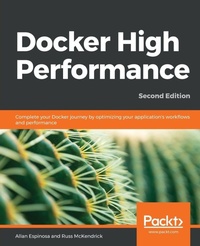
Docker High Performance
Complete your Docker journey by optimizing your application's work?ows and performance
2nd Edition
Published on 30. April 2019
Book
Paperback/Softback
174 pages
978-1-78980-721-9 (ISBN)
Description
Leverage Docker to unlock efficient and rapid container deployments for improving your development workflow
Key Features
Reconfigure Docker hosts to create a logging system with the ElasticSearch-Logstash-Kibana (ELK) stack
Tackle the challenges of large-scale container deployment with this fast-paced guide
Benchmark the performance of your Docker containers using Apache JMeter
Book DescriptionDocker is an enterprise-grade container platform that allows you to build and deploy your apps. Its portable format lets you run your code right from your desktop workstations to popular cloud computing providers. This comprehensive guide will improve your Docker work?ows and ensure your application's production environment runs smoothly.
This book starts with a refresher on setting up and running Docker and details the basic setup for creating a Docker Swarm cluster. You will then learn how to automate this cluster by using the Chef server and cookbooks. After that, you will run the Docker monitoring system with Prometheus and Grafana, and deploy the ELK stack. You will also learn best practices for optimizing Docker images.
After deploying containers with the help of Jenkins, you will then move on to a tutorial on using Apache JMeter to analyze your application's performance. You will learn how to use Docker Swarm and NGINX to load-balance your application, and how common debugging tools in Linux can be used to troubleshoot Docker containers.
By the end of this book, you will be able to integrate all the optimizations that you have learned and put everything into practice in your applications.
What you will learn
Automate provisioning and setting up nodes in a Docker Swarm cluster
Configure a monitoring system with Prometheus and Grafana
Use Apache JMeter to create workloads for benchmarking the performance of Docker containers
Understand how to load-balance an application with Docker Swarm and Nginx
Deploy strace, tcdump, blktrace, and other Linux debugging tools to troubleshoot containers
Integrate Docker optimizations for DevOps, Site Reliability Engineering, CI, and CD
Who this book is forIf you are a software developer with a good understanding of managing Docker services and the Linux filesystem and are looking for ways to optimize working with Docker containers, then this is the book for you. Developers fascinated with containers and workflow automation with benefit from this book.
Key Features
Reconfigure Docker hosts to create a logging system with the ElasticSearch-Logstash-Kibana (ELK) stack
Tackle the challenges of large-scale container deployment with this fast-paced guide
Benchmark the performance of your Docker containers using Apache JMeter
Book DescriptionDocker is an enterprise-grade container platform that allows you to build and deploy your apps. Its portable format lets you run your code right from your desktop workstations to popular cloud computing providers. This comprehensive guide will improve your Docker work?ows and ensure your application's production environment runs smoothly.
This book starts with a refresher on setting up and running Docker and details the basic setup for creating a Docker Swarm cluster. You will then learn how to automate this cluster by using the Chef server and cookbooks. After that, you will run the Docker monitoring system with Prometheus and Grafana, and deploy the ELK stack. You will also learn best practices for optimizing Docker images.
After deploying containers with the help of Jenkins, you will then move on to a tutorial on using Apache JMeter to analyze your application's performance. You will learn how to use Docker Swarm and NGINX to load-balance your application, and how common debugging tools in Linux can be used to troubleshoot Docker containers.
By the end of this book, you will be able to integrate all the optimizations that you have learned and put everything into practice in your applications.
What you will learn
Automate provisioning and setting up nodes in a Docker Swarm cluster
Configure a monitoring system with Prometheus and Grafana
Use Apache JMeter to create workloads for benchmarking the performance of Docker containers
Understand how to load-balance an application with Docker Swarm and Nginx
Deploy strace, tcdump, blktrace, and other Linux debugging tools to troubleshoot containers
Integrate Docker optimizations for DevOps, Site Reliability Engineering, CI, and CD
Who this book is forIf you are a software developer with a good understanding of managing Docker services and the Linux filesystem and are looking for ways to optimize working with Docker containers, then this is the book for you. Developers fascinated with containers and workflow automation with benefit from this book.
More details
Edition
2nd Revised edition
Language
English
Place of publication
Birmingham
United Kingdom
Target group
Professional and scholarly
US School Grade: College Graduate Student
Edition type
Revised edition
Dimensions
Height: 235 mm
Width: 191 mm
Thickness: 10 mm
Weight
338 gr
ISBN-13
978-1-78980-721-9 (9781789807219)
Copyright in bibliographic data and cover images is held by Nielsen Book Services Limited or by the publishers or by their respective licensors: all rights reserved.
Schweitzer Classification
Other editions
Additional editions
Allan Espinosa | Russ McKendrick
Docker High Performance
Complete your Docker journey by optimizing your application's work?ows and performance
E-Book
09/2024
2nd Edition
Packt Publishing
€19.99
Available for download
Persons
Allan Espinosa is a DevOps practitioner and an active open source contributor to various distributed system tools, such as Docker and Chef. Allan maintains several Docker images for popular open source software that were popular even before their official release from the upstream open source groups. Throughout his career, Allan has worked on large distributed systems containing hundreds to thousands of servers in production. He has built scalable applications on various platforms, ranging from large supercomputing centers to production clusters in the enterprise. He is currently managing distributed systems at scale for Bloomberg, where he oversees the company's Hadoop infrastructure. Allan can be contacted through his Twitter handle, @AllanEspinosa. Russ McKendrick is an experienced DevOps practitioner and system administrator with a passion for automation and containers. He has been working in IT and related industries for the better part of 30 years. During his career, he has had responsibilities in many different sectors, including first-line, second-line, and senior support in client-facing and internal teams for small and large organizations.
He works almost exclusively with Linux, using open source systems and tools across dedicated hardware and virtual machines hosted in public and private clouds at Node4, where he holds the title of practice manager (SRE and DevOps). He also buys way too many records!
He works almost exclusively with Linux, using open source systems and tools across dedicated hardware and virtual machines hosted in public and private clouds at Node4, where he holds the title of practice manager (SRE and DevOps). He also buys way too many records!
Content
Table of Contents
Preparing Docker Hosts
Configuring Docker with Chef
Monitoring Docker
Optimizing Docker Images
Deploying Containers
Benchmarking
Load Balancing
Troubleshooting Containers
Onto Production
Preparing Docker Hosts
Configuring Docker with Chef
Monitoring Docker
Optimizing Docker Images
Deploying Containers
Benchmarking
Load Balancing
Troubleshooting Containers
Onto Production