

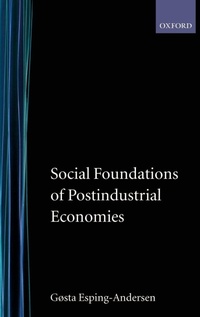
Social Foundations of Postindustrial Economies
Published on 25. February 1999
Book
Hardback
218 pages
978-0-19-874201-2 (ISBN)
Description
The Golden Age of postwar capitalism has been eclipsed, and with it seemingly also the possibility of harmonizing equality and welfare with efficiency and jobs. Most analyses believe that the emerging postindustrial society is overdetermined by massive, convergent forces, such as tertiarization, new technologies, or globalization, all conspiring to make welfare states unsustainable in the future.
Social Foundations of Postindustrial Economies takes a second, more sociological and more institutional, look at the driving forces of economic transformation. What, as a result, stands out is postindustrial diversity, not convergence. Macroscopic, global trends are undoubtedly powerful, yet their influence is easily rivalled by domestic institutional traditions, by the kind of welfare regime that, some generations ago, was put in place. It is, however, especially the family economy that hold the key as to what kind of postindustrial model will emerge, and to how evolving tradeoffs will be managed.
Twentieth-century economic analysis depended on a set of sociological assumptions that, now, are invalid. Hence, to better grasp what drives today's economy, we must begin with its social foundations.
Social Foundations of Postindustrial Economies takes a second, more sociological and more institutional, look at the driving forces of economic transformation. What, as a result, stands out is postindustrial diversity, not convergence. Macroscopic, global trends are undoubtedly powerful, yet their influence is easily rivalled by domestic institutional traditions, by the kind of welfare regime that, some generations ago, was put in place. It is, however, especially the family economy that hold the key as to what kind of postindustrial model will emerge, and to how evolving tradeoffs will be managed.
Twentieth-century economic analysis depended on a set of sociological assumptions that, now, are invalid. Hence, to better grasp what drives today's economy, we must begin with its social foundations.
Reviews / Votes
well worth reading as a highly informative analysis of the diversity of the social foundations of postindustrial economies. * Andrew Sayer, Progress in Human Geography 24,3. * The book provides a wealth of interesting statistical information and analysis. * Andrew Sayer, Progress in Human Geography 24,3. *More details
Language
English
Place of publication
Oxford
United Kingdom
Target group
Professional and scholarly
Illustrations
tables
Dimensions
Height: 240 mm
Width: 161 mm
Thickness: 17 mm
Weight
499 gr
ISBN-13
978-0-19-874201-2 (9780198742012)
Copyright in bibliographic data and cover images is held by Nielsen Book Services Limited or by the publishers or by their respective licensors: all rights reserved.
Schweitzer Classification
Other editions
Additional editions
GA2sta Esping-Andersen
Social Foundations of Postindustrial Economies
E-Book
02/1999
1st Edition
Oxford University Press
€188.14
Available for download

Gosta Esping-Andersen
Social Foundations of Postindustrial Economies
Book
02/1999
Oxford University Press
€72.00
Shipment within 15-20 days
Person
Gosta Esping-Andersen is Professor of Comparative Social Systems at the University of Trento, Italy
Content
1. Introduction ; PART ONE: VARIETIES OF WELFARE CAPITALISM ; 2. The Democratic Class Struggle Revisited ; 3. Social Risks and Wefare States ; 4. The Household Economy ; 5. Comparative Welfare Regimes Re-examined ; PART TWO: THE NEW POLITICAL ECONOMY ; 6. The Structural Bases of Postindustrial Employment ; 7. Managing Divergent Employment Dilemmas ; PART THREE: WELFARE CAPITALISM RECAST? ; 8. New Social Risks in Old Welfare States ; 9. Recasting Wefare Regimes for a Postindustrial Era ; Bibliography