

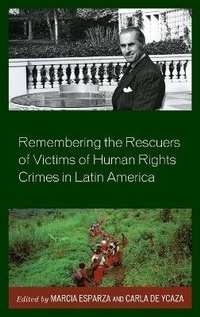
Remembering the Rescuers of Victims of Human Rights Crimes in Latin America
Published on 20. December 2016
Book
Hardback
218 pages
978-1-4985-3326-3 (ISBN)
Description
This book explores the significance of remembering the rescuers denouncing human rights crimes as well as protecting and sheltering targeted victims-including the dead-during the Cold War state violence in Latin America. In light of newly unearthed archival evidence, testimonial memories, and the continued mobilization of human rights groups to preserve Cold War memory, this timely book moves beyond the victim-perpetrator dichotomy and its discursive studies to focus on those whose moral courage and righteous acts were beacons of hope in the midst of extreme violence. Remembering Latin American "righteousness," a term used in Holocaust literature, is important in recognizing that those who resisted human rights violations and protected victims yesterday are those who often keep the collective memory of that past alive today.
Reviews / Votes
The least noticed aspect of genocide is the courageous resistance that is often put up to save the victims. This collection shows how victims were helped during Cold War violence in Latin American countries including Guatemala, El Salvador, Argentina, Chile and Colombia. The rich exploration of historical cases enhances our general understanding of "rescue", showing that it is not just a matter of bystander intervention but of solidarity among victims. This is an important collection that deserves a wide readership. -- Martin Shaw, emeritus, University of Sussex A much-needed and relevant collection of essays on a rarely studied topic-rescuers of human rights violations in Cold War Latin America. Who were the rescuers and how and why did they risk their lives to save others? By examining cases arising in a number of national contexts, the volume provides a valuable contribution to previous discussions about the figure of the "rescuer" and the political and moral duty to remember that have long characterized Holocaust studies. It explores the tension between a historically and geographically broader reading of acts of humanity on one hand, and concrete historical contexts on the other, delivering hopeful and inspiring insights. -- Nina Schneider, Global South Study Center (GSSC), University of CologneMore details
Language
English
Place of publication
United States
Publishing group
Bloomsbury Publishing Plc
Target group
Professional and scholarly
Illustrations
5 BW Illustrations, 5 BW Photos, 6 Tables
Dimensions
Height: 240 mm
Width: 159 mm
Thickness: 18 mm
Weight
454 gr
ISBN-13
978-1-4985-3326-3 (9781498533263)
Copyright in bibliographic data and cover images is held by Nielsen Book Services Limited or by the publishers or by their respective licensors: all rights reserved.
Schweitzer Classification
Other editions
Additional editions
E-Book
12/2016
1st Edition
Lexington Books
€91.49
Available for download
E-Book
12/2016
1st Edition
Lexington Books
€91.49
Available for download
Persons
Marcia Esparza is sociologist and associate professor in the Department of Criminal Justice at John Jay College of Criminal Justice, CUNY. She is the Founder and Co-Director of the Historical Memory Project (HMP).
Carla De Ycaza teaches at the Center for Global Affairs at New York University and serves as editor of Dialogues on Historical Justice and Memory Network at Columbia University.
Carla De Ycaza teaches at the Center for Global Affairs at New York University and serves as editor of Dialogues on Historical Justice and Memory Network at Columbia University.
Content
Acknowledgments
Introduction: Why Remember the Rescuers in Latin America?
Marcia Esparza and Zachary McKiernan
Chapter 1: Rescued From Fear: The Sebastian Acevedo Movement Against Torture in Chile
Christopher Ney
Chapter 2: Bending the Rules: An Ambassador's Quest to Save Lives
Pascale Bonnefoy
Chapter 3: The Santo Tomas Chichicastenango's Municipal Firefighters: "Green Pines Covering the Dead Bodies"
Marcia Esparza, Stephanie Alfaro and Kristy Sanandres
Chapter 4: Strategic Rescue Responses to Genocide: The Guatemalan Case
Roddy Brett
Chapter 5: Between Memory and Oblivion: The Cases of Eureka and Afadem
Isabel de Leon Olivares, Maribel Rivas-Vasconcelos and Miriam Rodriguez
Chapter 6: From Rescue to Solidarity: (Re) Humanizing Relationships for Social Transformation
Jenny Escobar and Angie Tamayo
Chapter 7: Argentine Rescuers: A Study on the "Banality of Good"
Jessica Casiro
Conclusion: On the Moral Value of Rescue and Remembering Rescuers: Conceptualizing Rescue in the Latin American Context
Jeffrey Blustein
About the Contributors and Editors
Introduction: Why Remember the Rescuers in Latin America?
Marcia Esparza and Zachary McKiernan
Chapter 1: Rescued From Fear: The Sebastian Acevedo Movement Against Torture in Chile
Christopher Ney
Chapter 2: Bending the Rules: An Ambassador's Quest to Save Lives
Pascale Bonnefoy
Chapter 3: The Santo Tomas Chichicastenango's Municipal Firefighters: "Green Pines Covering the Dead Bodies"
Marcia Esparza, Stephanie Alfaro and Kristy Sanandres
Chapter 4: Strategic Rescue Responses to Genocide: The Guatemalan Case
Roddy Brett
Chapter 5: Between Memory and Oblivion: The Cases of Eureka and Afadem
Isabel de Leon Olivares, Maribel Rivas-Vasconcelos and Miriam Rodriguez
Chapter 6: From Rescue to Solidarity: (Re) Humanizing Relationships for Social Transformation
Jenny Escobar and Angie Tamayo
Chapter 7: Argentine Rescuers: A Study on the "Banality of Good"
Jessica Casiro
Conclusion: On the Moral Value of Rescue and Remembering Rescuers: Conceptualizing Rescue in the Latin American Context
Jeffrey Blustein
About the Contributors and Editors