

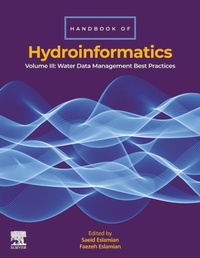
Handbook of HydroInformatics
Volume III: Water Data Management Best Practices
Published on 15. December 2022
Book
Paperback/Softback
420 pages
978-0-12-821962-1 (ISBN)
Description
Handbook of HydroInformatics Volume III: Water Data Management Best Practices presents the latest and most updated data processing techniques that are fundamental to Water Science and Engineering disciplines. These include a wide range of the new methods that are used in hydro-modeling such as Atmospheric Teleconnection Pattern, CONUS-Scale Hydrologic Modeling, Copula Function, Decision Support System, Downscaling Methods, Dynamic System Modeling, Economic Impacts and Models, Geostatistics and Geospatial Frameworks, Hydrologic Similarity Indices, Hydropower/Renewable Energy Models, Sediment Transport Dynamics Advanced Models, Social Data Mining, and Wavelet Transforms.
This volume is an example of true interdisciplinary work. The audience includes postgraduates and above interested in Water Science, Geotechnical Engineering, Soil Science, Civil Engineering, Chemical Engineering, Computer Engineering, Engineering, Applied Science, Earth and Geoscience, Atmospheric Science, Geography, Environment Science, Natural Resources, Mathematical Science, and Social Sciences. It is a fully comprehensive handbook which provides all the information needed related to the best practices for managing water data.
This volume is an example of true interdisciplinary work. The audience includes postgraduates and above interested in Water Science, Geotechnical Engineering, Soil Science, Civil Engineering, Chemical Engineering, Computer Engineering, Engineering, Applied Science, Earth and Geoscience, Atmospheric Science, Geography, Environment Science, Natural Resources, Mathematical Science, and Social Sciences. It is a fully comprehensive handbook which provides all the information needed related to the best practices for managing water data.
More details
Language
English
Place of publication
United States
Target group
Professional and scholarly
Product notice
Paperback (trade)
Illustrations
100 illustrations (20 in full color); Illustrations
Dimensions
Height: 279 mm
Width: 216 mm
Thickness: 22 mm
Weight
974 gr
ISBN-13
978-0-12-821962-1 (9780128219621)
Copyright in bibliographic data and cover images is held by Nielsen Book Services Limited or by the publishers or by their respective licensors: all rights reserved.
Schweitzer Classification
Other editions
Additional editions
Saeid Eslamian | Cep Eslamian
Handbook of HydroInformatics
Volume III: Water Data Management Best Practices
E-Book
12/2022
Elsevier
€160.00
Available for download
Persons
Saeid Eslamian received his PhD in Civil and Environmental Engineering from University of New South Wales, Australia in 1998. Saeid was Visiting Professor in Princeton University and ETH Zurich in 2005 and 2008 respectively. He has contributed to more than 1K publications in journals, conferences, books. Eslamian has been appointed as 2-Percent Top Researcher by Stanford University for several years. Currently, he is full professor of Hydrology and Water Resources and Director of Excellence Center in Risk Management and Natural Hazards. Isfahan University of Technology, His scientific interests are Floods, Droughts, Water Reuse, Climate Change Adaptation, Sustainability and Resilience
Faezeh Eslamian is a PhD holder of bioresource engineering from McGill University. Her research focuses on the development of a novel lime-based product to mitigate phosphorus loss from agricultural fields. Faezeh completed her bachelor's and master's degrees in civil and environmental engineering from Isfahan University of Technology, Iran, where she evaluated natural and low-cost absorb bents for the removal of pollutants such as textile dyes and heavy metals. Furthermore, she has conducted research on the worldwide water quality standards and wastewater reuse guidelines. Faezeh is an experienced multidisciplinary researcher with research interests in soil and water quality, environmental remediation, water reuse, and drought management.
Faezeh Eslamian is a PhD holder of bioresource engineering from McGill University. Her research focuses on the development of a novel lime-based product to mitigate phosphorus loss from agricultural fields. Faezeh completed her bachelor's and master's degrees in civil and environmental engineering from Isfahan University of Technology, Iran, where she evaluated natural and low-cost absorb bents for the removal of pollutants such as textile dyes and heavy metals. Furthermore, she has conducted research on the worldwide water quality standards and wastewater reuse guidelines. Faezeh is an experienced multidisciplinary researcher with research interests in soil and water quality, environmental remediation, water reuse, and drought management.
Content
69. Atmospheric Teleconnection Pattern
70. Bathymetry and Roughness Acquisition
71. CFD Models
72. Cluster and Discriminant Analysis
73. CONUS-Scale Hydrologic Modeling
74. Copula Function
75. Cyberinfrastructure for Water Science
76. Decision Support System
77. Downscaling Methods
78. Drone Technology in River/Lake/Estuarine
79. Dynamic System Modeling
80. Ecohydrology Nature Based Solutions Quantification of Processes
81. Ecohydraulic Modeling and Experimentation
82. Economic Impacts and Models
83. Emergency Management
84. Geostatistics and Geospatial Frameworks
85. Hydrological modeling in a "Big Data" era
86. Hydrologic Similarity Indices
87. Hydrologic Model Training and Validation
88. Hydropower/Renewable Energy Models
89. Hydrothermal Systems Generation
90. Multi-Variate Linear Moments
91. Online Education in Hydroinformatics
92. Radar Application
93. Real-time Sensor Management
94. Remote Sensing
95. Sediment Transport Dynamics Advanced Models
96. Smart Cities and Hydroinformatic Data
97. Social Data Mining in Hydrosystems
98. Spectrum Water Technology
99. Vegetal Drag Modelling
100. Water Data Standards
101. Water Performance Metrics
102. Wavelet Transforms
70. Bathymetry and Roughness Acquisition
71. CFD Models
72. Cluster and Discriminant Analysis
73. CONUS-Scale Hydrologic Modeling
74. Copula Function
75. Cyberinfrastructure for Water Science
76. Decision Support System
77. Downscaling Methods
78. Drone Technology in River/Lake/Estuarine
79. Dynamic System Modeling
80. Ecohydrology Nature Based Solutions Quantification of Processes
81. Ecohydraulic Modeling and Experimentation
82. Economic Impacts and Models
83. Emergency Management
84. Geostatistics and Geospatial Frameworks
85. Hydrological modeling in a "Big Data" era
86. Hydrologic Similarity Indices
87. Hydrologic Model Training and Validation
88. Hydropower/Renewable Energy Models
89. Hydrothermal Systems Generation
90. Multi-Variate Linear Moments
91. Online Education in Hydroinformatics
92. Radar Application
93. Real-time Sensor Management
94. Remote Sensing
95. Sediment Transport Dynamics Advanced Models
96. Smart Cities and Hydroinformatic Data
97. Social Data Mining in Hydrosystems
98. Spectrum Water Technology
99. Vegetal Drag Modelling
100. Water Data Standards
101. Water Performance Metrics
102. Wavelet Transforms