

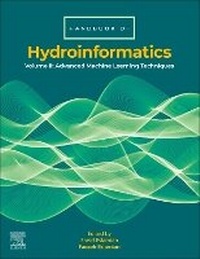
Handbook of HydroInformatics
Volume II: Advanced Machine Learning Techniques
Published on 9. December 2022
Book
Paperback/Softback
418 pages
978-0-12-821961-4 (ISBN)
Description
Advanced Machine Learning Techniques includes the theoretical foundations of modern machine learning, as well as advanced methods and frameworks used in modern machine learning. Handbook of HydroInformatics, Volume II: Advanced Machine Learning Techniques presents both the art of designing good learning algorithms, as well as the science of analyzing an algorithm's computational and statistical properties and performance guarantees. The global contributors cover theoretical foundational topics such as computational and statistical convergence rates, minimax estimation, and concentration of measure as well as advanced machine learning methods, such as nonparametric density estimation, nonparametric regression, and Bayesian estimation; additionally, advanced frameworks such as privacy, causality, and stochastic learning algorithms are also included. Lastly, the volume presents Cloud and Cluster Computing, Data Fusion Techniques, Empirical Orthogonal Functions and Teleconnection, Internet of Things, Kernel-Based Modeling, Large Eddy Simulation, Patter Recognition, Uncertainty-Based Resiliency Evaluation, and Volume-Based Inverse Mode.
This is an interdisciplinary book, and the audience includes postgraduates and early-career researchers interested in: Computer Science, Mathematical Science, Applied Science, Earth and Geoscience, Geography, Civil Engineering, Engineering, Water Science, Atmospheric Science, Social Science, Environment Science, Natural Resources, Chemical Engineering.
This is an interdisciplinary book, and the audience includes postgraduates and early-career researchers interested in: Computer Science, Mathematical Science, Applied Science, Earth and Geoscience, Geography, Civil Engineering, Engineering, Water Science, Atmospheric Science, Social Science, Environment Science, Natural Resources, Chemical Engineering.
More details
Language
English
Place of publication
United States
Target group
Professional and scholarly
Illustrations
100 illustrations (20 in full color); Illustrations
Dimensions
Height: 276 mm
Width: 216 mm
Weight
450 gr
ISBN-13
978-0-12-821961-4 (9780128219614)
Copyright in bibliographic data and cover images is held by Nielsen Book Services Limited or by the publishers or by their respective licensors: all rights reserved.
Schweitzer Classification
Other editions
Additional editions
Saeid Eslamian | Cep Eslamian
Handbook of HydroInformatics
Volume II: Advanced Machine Learning Techniques
E-Book
12/2022
Elsevier
€160.00
Available for download
Persons
Saeid Eslamian received his PhD in Civil and Environmental Engineering from University of New South Wales, Australia in 1998. Saeid was Visiting Professor in Princeton University and ETH Zurich in 2005 and 2008 respectively. He has contributed to more than 1K publications in journals, conferences, books. Eslamian has been appointed as 2-Percent Top Researcher by Stanford University for several years. Currently, he is full professor of Hydrology and Water Resources and Director of Excellence Center in Risk Management and Natural Hazards. Isfahan University of Technology, His scientific interests are Floods, Droughts, Water Reuse, Climate Change Adaptation, Sustainability and Resilience
Faezeh Eslamian is a PhD holder of bioresource engineering from McGill University. Her research focuses on the development of a novel lime-based product to mitigate phosphorus loss from agricultural fields. Faezeh completed her bachelor's and master's degrees in civil and environmental engineering from Isfahan University of Technology, Iran, where she evaluated natural and low-cost absorb bents for the removal of pollutants such as textile dyes and heavy metals. Furthermore, she has conducted research on the worldwide water quality standards and wastewater reuse guidelines. Faezeh is an experienced multidisciplinary researcher with research interests in soil and water quality, environmental remediation, water reuse, and drought management.
Faezeh Eslamian is a PhD holder of bioresource engineering from McGill University. Her research focuses on the development of a novel lime-based product to mitigate phosphorus loss from agricultural fields. Faezeh completed her bachelor's and master's degrees in civil and environmental engineering from Isfahan University of Technology, Iran, where she evaluated natural and low-cost absorb bents for the removal of pollutants such as textile dyes and heavy metals. Furthermore, she has conducted research on the worldwide water quality standards and wastewater reuse guidelines. Faezeh is an experienced multidisciplinary researcher with research interests in soil and water quality, environmental remediation, water reuse, and drought management.
Content
35. Bayesian Estimation
36. Cloud and Cluster Computing
37. Computational and Statistical Convergence Rates
38. Concentration of Measure
39. Cross Validation
40. Data Assimilation
41. Data Fusion Techniques
42. Deep Learning
43. Empirical Orthogonal Functions
44. Empirical Orthogonal Teleconnection
45. Error Modeling
46. GARCH Time Series Analysis
47. Gradient-Based Optimization
48. Internet-Based Methods
49. Internet of Things
50. Kernel-Based Modeling
51. Large Eddy Simulation
52. Markov Chain Monte Carlo Methods
53. Minimax Estimation
54. Model Fusion Approach
55. Monitoring Quality Sensors
56. Nested Reinforcement Learning
57. Nested Stochastic Dynamic Programming
58. Nonparametric Density estimation
59. Nonparametric Regressions
60. Operational Real-Time Forecasting
61. Patter Recognition
62. Self-Adaptive Evolutionary Extreme Learning Machine
63. Stochastic Learning Algorithms
64. Supercomputing Methods (Parallelization/GPU)
65. Transient-Based Time-Frequency Analysis
66. Uncertainty-Based Resiliency Evaluation
67. Volume-Based Inverse Mode
68. WebGIS
36. Cloud and Cluster Computing
37. Computational and Statistical Convergence Rates
38. Concentration of Measure
39. Cross Validation
40. Data Assimilation
41. Data Fusion Techniques
42. Deep Learning
43. Empirical Orthogonal Functions
44. Empirical Orthogonal Teleconnection
45. Error Modeling
46. GARCH Time Series Analysis
47. Gradient-Based Optimization
48. Internet-Based Methods
49. Internet of Things
50. Kernel-Based Modeling
51. Large Eddy Simulation
52. Markov Chain Monte Carlo Methods
53. Minimax Estimation
54. Model Fusion Approach
55. Monitoring Quality Sensors
56. Nested Reinforcement Learning
57. Nested Stochastic Dynamic Programming
58. Nonparametric Density estimation
59. Nonparametric Regressions
60. Operational Real-Time Forecasting
61. Patter Recognition
62. Self-Adaptive Evolutionary Extreme Learning Machine
63. Stochastic Learning Algorithms
64. Supercomputing Methods (Parallelization/GPU)
65. Transient-Based Time-Frequency Analysis
66. Uncertainty-Based Resiliency Evaluation
67. Volume-Based Inverse Mode
68. WebGIS