

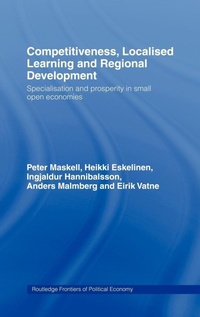
Competitiveness, Localised Learning and Regional Development
Specialization and Prosperity in Small Open Economies
1st Edition
Published on 25. December 1997
Book
Hardback
272 pages
978-0-415-15428-4 (ISBN)
Description
Drawing on a rich literature and case study material from selected industries, and elaborating on key concepts such as firms and competencies, industries and industrial systems, and competitiveness and prosperity, this book sets out to answer three broad research questions:
* What is competition about in today's economy?
* Why do geographical areas (local milieus, cities, regions, countries) specialize in particular types of economic activity, and why do patterns of specialization, once in place tend to be so tremendously durable?
* How can high-cost regions in general and small industrialized countries in particular sustain competitiveness and prosperity in an increasingly globally integrated world economy?
This book points the way out of a dilemma created by recent industrial theory and policy: is it possible for countries which are not destined to be leading high-tech powers to take advantage of the current conjuncture of increasingly open-markets.
* What is competition about in today's economy?
* Why do geographical areas (local milieus, cities, regions, countries) specialize in particular types of economic activity, and why do patterns of specialization, once in place tend to be so tremendously durable?
* How can high-cost regions in general and small industrialized countries in particular sustain competitiveness and prosperity in an increasingly globally integrated world economy?
This book points the way out of a dilemma created by recent industrial theory and policy: is it possible for countries which are not destined to be leading high-tech powers to take advantage of the current conjuncture of increasingly open-markets.
More details
Series
Language
English
Place of publication
London
United Kingdom
Publishing group
Taylor & Francis Ltd
Target group
College/higher education
Professional and scholarly
Dimensions
Height: 240 mm
Width: 161 mm
Thickness: 19 mm
Weight
581 gr
ISBN-13
978-0-415-15428-4 (9780415154284)
Copyright in bibliographic data and cover images is held by Nielsen Book Services Limited or by the publishers or by their respective licensors: all rights reserved.
Schweitzer Classification
Other editions
Additional editions
Heikki Eskelinen | Ingjaldur Hannibalsson | Anders Malmberg
Competitiveness, Localised Learning and Regional Development
Specialization and Prosperity in Small Open Economies
E-Book
03/2002
Routledge
€60.49
Available for download
Heikki Eskelinen | Ingjaldur Hannibalsson | Anders Malmberg
Competitiveness, Localised Learning and Regional Development
Specialization and Prosperity in Small Open Economies
E-Book
03/2002
Routledge
€60.49
Available for download
Persons
Peter Maskell is Professor in Regional Economics at Copenhagen Business School, Denmark. Heikki Eskelinen is an economist and Head of the Social Science Department at the Karelian Institute, University of Joensuu, Finland. Ingjaldur Hannibalsson is Associate Professor in Operations Management in the Faculty of Economics and Business Administration at the University of Iceland. Anders Malmberg is Associate Professor at the Department of Social and Economic Geography, Uppsala University, Sweden. Eirik Vatne is Professor in Economic Geography at the Norwegian School of Economics and Business Administration, Bergen, Norway.
Content
Preface 1 Regional specialisation and localised learning-An introduction PART I Ubiquitification, knowledge and localised capabilites 2 Sustainable patterns of specialisation in a globalised economy 3 Firm competitiveness through knowledge creation 4 Localised capabilities and the competitiveness of regions and countries PART II Small countries, localised learning and lack of learning: the cases of furniture, fish and phones 5 Small nations: how to sustain prosperity in open, low-tech economies 6 Comfort and competitiveness: the wooden furniture industry 7 Natural resources and the institutional endowment: the fishing industry 8 Footloose communications: the mobile phone industry PART III Conclusions and policy implications 9 Towards a learning-based industrial and regional policy