

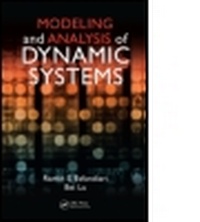
Modeling and Analysis of Dynamic Systems
1st Edition
Published on 16. March 2010
Book
Hardback
454 pages
978-1-4398-0845-0 (ISBN)
Description
Using MATLAB (R) and Simulink (R) to perform symbolic, graphical, numerical, and simulation tasks, Modeling and Analysis of Dynamic Systems provides a thorough understanding of the mathematical modeling and analysis of dynamic systems. It meticulously covers techniques for modeling dynamic systems, methods of response analysis, and vibration and control systems.
After introducing the software and essential mathematical background, the text discusses linearization and different forms of system model representation, such as state-space form and input-output equation. It then explores translational, rotational, mixed mechanical, electrical, electromechanical, pneumatic, liquid-level, and thermal systems. The authors also analyze the time and frequency domains of dynamic systems and describe free and forced vibrations of single and multiple degree-of-freedom systems, vibration suppression, modal analysis, and vibration testing. The final chapter examines aspects of control system analysis, including stability analysis, types of control, root locus analysis, Bode plot, and full-state feedback.
With much of the material rigorously classroom tested, this textbook enables undergraduate students to acquire a solid comprehension of the subject. It provides at least one example of each topic, along with multiple worked-out examples for more complex topics. The text also includes many exercises in each chapter to help students learn firsthand how a combination of ideas can be used to analyze a problem.
After introducing the software and essential mathematical background, the text discusses linearization and different forms of system model representation, such as state-space form and input-output equation. It then explores translational, rotational, mixed mechanical, electrical, electromechanical, pneumatic, liquid-level, and thermal systems. The authors also analyze the time and frequency domains of dynamic systems and describe free and forced vibrations of single and multiple degree-of-freedom systems, vibration suppression, modal analysis, and vibration testing. The final chapter examines aspects of control system analysis, including stability analysis, types of control, root locus analysis, Bode plot, and full-state feedback.
With much of the material rigorously classroom tested, this textbook enables undergraduate students to acquire a solid comprehension of the subject. It provides at least one example of each topic, along with multiple worked-out examples for more complex topics. The text also includes many exercises in each chapter to help students learn firsthand how a combination of ideas can be used to analyze a problem.
More details
Language
English
Place of publication
Bosa Roca
United States
Publishing group
Taylor & Francis Inc
Target group
College/higher education
Undergraduate students in mechanical and aerospace engineering; professional engineers.
Product notice
Paper over boards
Illustrations
9 s/w Tabellen, 732 s/w Abbildungen
483 Equations; 9 Tables, black and white; 732 Illustrations, black and white
Dimensions
Height: 254 mm
Width: 178 mm
Weight
975 gr
ISBN-13
978-1-4398-0845-0 (9781439808450)
Copyright in bibliographic data and cover images is held by Nielsen Book Services Limited or by the publishers or by their respective licensors: all rights reserved.
Schweitzer Classification
Other editions
New editions
Ramin S. Esfandiari | Bei Lu
Modeling and Analysis of Dynamic Systems, Second Edition
Book
04/2014
2nd Edition
CRC Press
€170.84
Article exhausted; check for reprint
Persons
Ramin Esfandiari is a professor of mechanical and aerospace engineering at California State University, Long Beach.
Bei Lu is an assistant professor of mechanical and aerospace engineering at California State University, Long Beach.
Bei Lu is an assistant professor of mechanical and aerospace engineering at California State University, Long Beach.
Content
Introduction to MATLAB and Simulink
MATLAB Command Window and Command Prompt
User-Defined Functions
Defining and Evaluating Functions
Iterative Calculations
Matrices and Vectors
Differentiation and Integration
Plotting in MATLAB
Simulink
Complex Analysis, Differential Equations and Laplace Transformation
Complex Analysis
Differential Equations
Laplace Transformation
Matrix Analysis
Matrices
Matrix Eigenvalue Problem
System Model Representation
Configuration Form
State-Space Form
Input-Output Equation, Transfer Function
Relations between State-Space Form, Input-Output Equation, and Transfer Function
Block Diagram Representation
Linearization
Mechanical Systems
Mechanical Elements
Translational Systems
Rotational Systems
Mixed Systems: Translational and Rotational
Gear-Train Systems
Electrical, Electronic, and Electromechanical Systems
Electrical Elements
Electric Circuits
Operational Amplifiers
Electromechanical Systems
Impedance Methods
Fluid and Thermal Systems
Pneumatic Systems
Liquid-Level Systems
Thermal Systems
System Response
Transient Response of First-Order Systems
Transient Response of Second-Order Systems
Frequency Response
Solving the State Equation
Response of Nonlinear Systems
Introduction to Vibrations
Free Vibration
Forced Vibration
Vibration Suppressions
Modal Analysis
Vibration Measurement and Analysis
Introduction to Feedback Control Systems
Basic Concepts and Terminologies
Stability and Performance
Benefits of Feedback Control
Proportional-Integral-Derivative Control
Root Locus
Bode Plot
Full-State Feedback
Appendix A
Appendix B
Index
A Summary appears at the end of each chapter.
MATLAB Command Window and Command Prompt
User-Defined Functions
Defining and Evaluating Functions
Iterative Calculations
Matrices and Vectors
Differentiation and Integration
Plotting in MATLAB
Simulink
Complex Analysis, Differential Equations and Laplace Transformation
Complex Analysis
Differential Equations
Laplace Transformation
Matrix Analysis
Matrices
Matrix Eigenvalue Problem
System Model Representation
Configuration Form
State-Space Form
Input-Output Equation, Transfer Function
Relations between State-Space Form, Input-Output Equation, and Transfer Function
Block Diagram Representation
Linearization
Mechanical Systems
Mechanical Elements
Translational Systems
Rotational Systems
Mixed Systems: Translational and Rotational
Gear-Train Systems
Electrical, Electronic, and Electromechanical Systems
Electrical Elements
Electric Circuits
Operational Amplifiers
Electromechanical Systems
Impedance Methods
Fluid and Thermal Systems
Pneumatic Systems
Liquid-Level Systems
Thermal Systems
System Response
Transient Response of First-Order Systems
Transient Response of Second-Order Systems
Frequency Response
Solving the State Equation
Response of Nonlinear Systems
Introduction to Vibrations
Free Vibration
Forced Vibration
Vibration Suppressions
Modal Analysis
Vibration Measurement and Analysis
Introduction to Feedback Control Systems
Basic Concepts and Terminologies
Stability and Performance
Benefits of Feedback Control
Proportional-Integral-Derivative Control
Root Locus
Bode Plot
Full-State Feedback
Appendix A
Appendix B
Index
A Summary appears at the end of each chapter.