

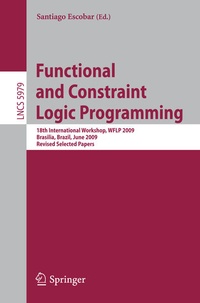
Functional and Constraint Logic Programming
18th International Workshop, WFLP 2009, Brasilia, Brazil, June 28, 2009, Revised Selected Papers
1st Edition
Published on 1. April 2010
Book
Paperback/Softback
IX, 179 pages
978-3-642-11998-9 (ISBN)
Description
Thisvolumecontainsaselectionofthepaperspresentedatthe18thInternational Workshop on Functional and (Constraint) Logic Programming (WFLP 2009), held on June 28, 2009 in Bras' ?lia, Brazil. Previous WFLP meetings were held in Siena (2008), Paris (2007), Madrid (2006), Tallinn (2005), Aachen (2004), Valencia (2003),Grado(2002),Kiel(2001),Benicassim(2000),Grenoble(1999), Bad Honnef (1998), Schwarzenberg (1997, 1995, and 1994), Marburg (1996), Rattenberg (1993), and Karlsruhe (1992). The aim of the WFLP series is to bring together researchers interested in functional programming, (constraint) logic programming, as well as the integ- tion of the two paradigms. It promotes the cross-fertilizing exchange of ideas and experiences among researchers and students from the di?erent commu- ties interested in the foundations, applications, and combinations of high-level, declarative programming languages and related areas. WFLP 2009 solicited papers in all areas of functional and (constraint) logic programming, including but not limited to: - Foundations:formalsemantics,rewritingandnarrowing,non-monotonicr- soning, dynamics, and type theory.
- Language Design: modules and type systems, multi-paradigm languages, concurrency and distribution, and objects. - Implementation: abstract machines, parallelism, compile-time and run-time optimizations, and interfacing with external languages. - Transformation and Analysis: abstract interpretation, specialization, partial evaluation, program transformation, and meta-programming. - Software Engineering: design patterns, speci?cation, veri?cation and vali- tion, debugging, and test generation. - IntegrationofParadigms:integrationofdeclarativeprogrammingwithother paradigms such as imperative, object-oriented, concurrent, and real-time programming. - Applications: declarative programming in education and industry, doma- speci?c languages, visual/graphical user interfaces, embedded systems, WWW applications, knowledge representation and machine learning, - ductive databases, advanced programming environments and tools.
- Language Design: modules and type systems, multi-paradigm languages, concurrency and distribution, and objects. - Implementation: abstract machines, parallelism, compile-time and run-time optimizations, and interfacing with external languages. - Transformation and Analysis: abstract interpretation, specialization, partial evaluation, program transformation, and meta-programming. - Software Engineering: design patterns, speci?cation, veri?cation and vali- tion, debugging, and test generation. - IntegrationofParadigms:integrationofdeclarativeprogrammingwithother paradigms such as imperative, object-oriented, concurrent, and real-time programming. - Applications: declarative programming in education and industry, doma- speci?c languages, visual/graphical user interfaces, embedded systems, WWW applications, knowledge representation and machine learning, - ductive databases, advanced programming environments and tools.
More details
Series
Language
English
Place of publication
Berlin
Germany
Publishing group
Springer Berlin
Target group
Professional and scholarly
Professional/practitioner
Illustrations
35 s/w Abbildungen
IX, 179 p. 35 illus.
Dimensions
Height: 235 mm
Width: 155 mm
Thickness: 11 mm
Weight
300 gr
ISBN-13
978-3-642-11998-9 (9783642119989)
DOI
10.1007/978-3-642-11999-6
Schweitzer Classification
Other editions
Additional editions
Santiago Escobar
Functional and Constraint Logic Programming
18th International Workshop, WFLP 2009, Brasilia, Brazil, June 28, 2009, Revised Selected Papers
E-Book
03/2010
Springer
€53.49
Available for download
Content
Invited Papers.- Programming with Multiple Paradigms in Lua.- Constraint Based Strategies.- Contributed Papers.- Integrating ILOG CP Technology into .- Termination of Context-Sensitive Rewriting with Built-In Numbers and Collection Data Structures.- Semantic Labelling for Proving Termination of Combinatory Reduction Systems.- A Taxonomy of Some Right-to-Left String-Matching Algorithms.- Type Checking and Inference Are Equivalent in Lambda Calculi with Existential Types.- Fast and Accurate Strong Termination Analysis with an Application to Partial Evaluation.- New Results on Type Systems for Functional Logic Programming.- A Simple Region Inference Algorithm for a First-Order Functional Language.- A Theoretical Framework for the Declarative Debugging of Functional Logic Programs with Lambda Abstractions.