

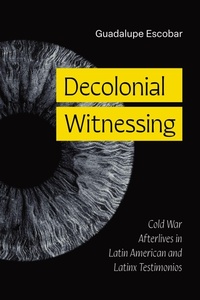
Decolonial Witnessing
Cold War Afterlives in Latin American and Latinx Testimonios
Published on 12. May 2026
Book
Hardback
248 pages
978-1-4773-3371-6 (ISBN)
Description
Examining the power of testimonios in illuminating political injustice in Latin America from the Cold War to the present.
During the Cold War, testimonio emerged as a powerful genre of political nonfiction in Latin America. Artists created first-person narratives of censorship and state violence, highlighting broader circumstances of oppression carried out by local right-wing oligarchies in collusion with the US empire. Decolonial Witnessing explores the continuing vitality of testimonio in the twenty-first century, as it has evolved into narratives contesting neoliberal dispossession and dispoasability.
Considering the cultural work of Ana Castillo, Regina JosE Galindo, Jayro Bustamante, Alberto Ledesma, Javier Zamora, Lila Downs, and others, Guadalupe Escobar shows how artists, authors, musicians, and filmmakers are using testimonial narratives to identify and resist the architecture of post-Cold War militarized democracy. Contemporary testimonios center migrant children, torture abolitionists, Indigenous land defenders-figures whose perspectives and, indeed, presence disrupt dominant paradigms of citizenship. Cast against the law, their stories-their memories-constitute a critical optic on the construction of belonging. In these acts of bearing witness, Escobar locates the possibility of a new, counterhegemonic political imagination.
During the Cold War, testimonio emerged as a powerful genre of political nonfiction in Latin America. Artists created first-person narratives of censorship and state violence, highlighting broader circumstances of oppression carried out by local right-wing oligarchies in collusion with the US empire. Decolonial Witnessing explores the continuing vitality of testimonio in the twenty-first century, as it has evolved into narratives contesting neoliberal dispossession and dispoasability.
Considering the cultural work of Ana Castillo, Regina JosE Galindo, Jayro Bustamante, Alberto Ledesma, Javier Zamora, Lila Downs, and others, Guadalupe Escobar shows how artists, authors, musicians, and filmmakers are using testimonial narratives to identify and resist the architecture of post-Cold War militarized democracy. Contemporary testimonios center migrant children, torture abolitionists, Indigenous land defenders-figures whose perspectives and, indeed, presence disrupt dominant paradigms of citizenship. Cast against the law, their stories-their memories-constitute a critical optic on the construction of belonging. In these acts of bearing witness, Escobar locates the possibility of a new, counterhegemonic political imagination.
Reviews / Votes
"Tightly argued, tender, provocative, and meticulously researched, Decolonial Witnessing offers a significant new analysis that ties together the seemingly unending afterlives of both the Cold War and the War on Terror to an ever denser and more violent deportation machinery. Escobar's eloquent study illustrates the complex reparative work of witnessing as a process of refusing violent hierarchies and redefining the human and the rights to be human while also teaching us how to read and learn from a broad array of cultural texts." - Mary Pat Brady, Cornell University, author of Scales of Captivity: Racial Capitalism and the Latinx Child"Decolonial Witnessing is a powerful and necessary intervention that revitalizes our understanding of testimonio for the twenty-first century. Escobar's incisive readings show how contemporary artists and writers transform witnessing into a decolonial practice that foregrounds gender, youth, and migration with extraordinary nuance. The book's transnational vision is one of its greatest strengths, revealing the reach of US power while honoring the creativity and resilience of Latin American and Latinx communities. Bold, interdisciplinary, and ethically attuned, Decolonial Witnessing demonstrates why testimonio remains an indispensable human rights genre-and why its afterlives matter now more than ever." - Veronica Garibotto, University of North Carolina at Chapel Hill, author of Rethinking Testimonial Cinema in Postdictatorship Argentina: Beyond Memory Fatigue
More details
Series
Language
English
Place of publication
Austin, TX
United States
Target group
Professional and scholarly
Product notice
sewn/stitched
Cloth over boards
Illustrations
28 b&w illus.
Dimensions
Height: 229 mm
Width: 152 mm
Weight
454 gr
ISBN-13
978-1-4773-3371-6 (9781477333716)
Copyright in bibliographic data and cover images is held by Nielsen Book Services Limited or by the publishers or by their respective licensors: all rights reserved.
Schweitzer Classification
Person
Guadalupe Escobar is an assistant professor in the Department of English and the Department of Gender, Race, and Identity at the University of Nevada, Reno.
Content
List of Illustrations
Introduction. Shifting Paradigms of Perception
Chapter 1. Reappearing Acts
Chapter 2. The Prosecutor's Gaze
Chapter 3. The Child Refugee as Witness
Chapter 4. Reluctant DREAMers
Coda. Witnessing Otherwise
Acknowledgments
Notes
Bibliography
Index
Introduction. Shifting Paradigms of Perception
Chapter 1. Reappearing Acts
Chapter 2. The Prosecutor's Gaze
Chapter 3. The Child Refugee as Witness
Chapter 4. Reluctant DREAMers
Coda. Witnessing Otherwise
Acknowledgments
Notes
Bibliography
Index