

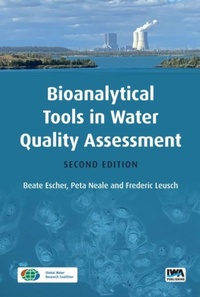
Bioanalytical Tools in Water Quality Assessment
2nd Edition
Published on 15. June 2021
Book
Paperback/Softback
462 pages
978-1-78906-197-0 (ISBN)
Description
The first edition of Bioanalytical Tools in Water Quality Assessment was released in 2012. The field has exploded since and the second edition updates and reviews the application of bioanalytical tools for water quality assessment including surveillance monitoring. The book focuses on applications to water quality assessment ranging from wastewater to drinking water, including recycled water, as well as treatment processes and advanced water treatment. Emerging applications for other environmental matrices are also included. Bioanalytical Tools in Water Quality Assessment, Second Edition not only demonstrates applications but also fills in the background knowledge in toxicology/ecotoxicology needed to appreciate these applications. Each chapter summarises fundamental material in a targeted way so that information can be applied to better understand the use of bioanalytical tools in water quality assessment.
The book can be used by lecturers teaching academic and professional courses and also by risk assessors, regulators, experts, consultants, researchers and managers working in the water sector. It can also be a reference manual for environmental engineers, analytical chemists and toxicologists.
Detailed descriptions of dose-response assessment, data reporting, mixture modelling and quality assurance/quality control are complemented by a series of online resources and tools to apply some of the principles and data methods explained in this book. This supplementary information is available at www.ufz.de/bioanalytical-tools.
The book can be used by lecturers teaching academic and professional courses and also by risk assessors, regulators, experts, consultants, researchers and managers working in the water sector. It can also be a reference manual for environmental engineers, analytical chemists and toxicologists.
Detailed descriptions of dose-response assessment, data reporting, mixture modelling and quality assurance/quality control are complemented by a series of online resources and tools to apply some of the principles and data methods explained in this book. This supplementary information is available at www.ufz.de/bioanalytical-tools.
More details
Edition
2nd edition
Language
English
Place of publication
London
United Kingdom
Target group
College/higher education
Professional and scholarly
Dimensions
Height: 232 mm
Width: 157 mm
Thickness: 30 mm
Weight
698 gr
ISBN-13
978-1-78906-197-0 (9781789061970)
Copyright in bibliographic data and cover images is held by Nielsen Book Services Limited or by the publishers or by their respective licensors: all rights reserved.
Schweitzer Classification
Content
About the Authors
Preface
Foreword
Acknowledgements (First Edition 2012)
Acknowledgements (Second Edition 2021)
Chapter 1 - Introduction to bioanalytical tools in water quality assessment
Chapter 2 - Risk assessment of chemicals
Chapter 3 - Water quality assessment and whole effluent toxicity testing
Chapter 4 - Modes of action and toxicity pathways
Chapter 5 - Toxicity pathways of chemicals in humans
Chapter 6 - Adverse outcome pathways of chemicals in aquatic organisms
Chapter 7 - Dose-response assessment
Chapter 8 - Mixtures
Chapter 9 - In vitro assays for the risk assessment of chemicals
Chapter 10 - Current bioanalytical tools for water quality assessment
Chapter 11 - Quality assurance and quality control (QA/QC)
Chapter 12 - Sampling, sample preparation and dosing
Chapter 13 - Design of test batteries and interpretation of bioassay results
Chapter 14 - Case studies
Chapter 15 - Application of bioanalytical tools beyond water: Sediment and biota
Chapter 16 - A promising future for bioanalytical tools
Glossary
References
Index
Preface
Foreword
Acknowledgements (First Edition 2012)
Acknowledgements (Second Edition 2021)
Chapter 1 - Introduction to bioanalytical tools in water quality assessment
Chapter 2 - Risk assessment of chemicals
Chapter 3 - Water quality assessment and whole effluent toxicity testing
Chapter 4 - Modes of action and toxicity pathways
Chapter 5 - Toxicity pathways of chemicals in humans
Chapter 6 - Adverse outcome pathways of chemicals in aquatic organisms
Chapter 7 - Dose-response assessment
Chapter 8 - Mixtures
Chapter 9 - In vitro assays for the risk assessment of chemicals
Chapter 10 - Current bioanalytical tools for water quality assessment
Chapter 11 - Quality assurance and quality control (QA/QC)
Chapter 12 - Sampling, sample preparation and dosing
Chapter 13 - Design of test batteries and interpretation of bioassay results
Chapter 14 - Case studies
Chapter 15 - Application of bioanalytical tools beyond water: Sediment and biota
Chapter 16 - A promising future for bioanalytical tools
Glossary
References
Index