

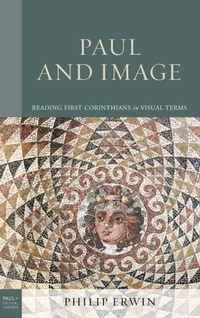
Paul and Image
Reading First Corinthians in Visual Terms
Published on 29. September 2020
Book
Hardback
270 pages
978-1-9787-1071-9 (ISBN)
Description
In Paul and Image, Philip Erwin challenges conventional interpretations of 1 Corinthians that tend to overlook the significance of ancient Roman visual culture in framing and posing exegetical questions. He argues that in 1 Corinthians Paul engaged in a long-standing philosophical discussion of visual representation, with consequential implications for how he and his Corinthian addressees interacted with the imagery around them. By situating Paul's letter in the context of the critical discourse on visual representation from Plato to Philo to the Second Sophistic, Erwin redefines Paul's critique of human wisdom, treatment of idols, and resurrection discourse in visual terms.
Reviews / Votes
the book succeeds in challenging a dominant bias in Pauline scholarship: the tendency to prioritize philosophical or rhetorical analysis while neglecting the significance of visual and archaeological material. By bringing these dimensions to the forefront, it inspires scholars to adopt a more interdisciplinary approach to Paul's letters. Ultimately, this study demonstrates how archaeological insights can enrich textual analysis, offering a fresh and compelling perspective on the visual orientation of 1 Corinthians. * Review of Biblical Literature * Philip Erwin convincingly demonstrates that Paul's first letter to the Corinthians engages a pervasive critical-philosophical discourse on images and the visual arts. By showing how this discourse is at the same time conceptual and interactive, as confirmed by its engagement with actual works of art at Corinth, Erwin has set a new paradigm for Pauline studies. -- John R. Clarke, University of Texas at Austin In this seminal and ground-breaking monograph, Philip Erwin argues that Paul's theological and pastoral arguments in 1 Corinthians would (paradoxically) have been seen as much as heard by his original auditors in first-century Roman Corinth. Erwin rides with absolute expertise the new wave of Visual Exegesis Studies, pioneered by scholars such as David Balch, Annette Weissenrieder, Harry Maier, and Rosemary Canavan in the last decade. In this incisive contribution to Pauline exegesis, Erwin turns to the material evidence of the imperial statuary of Augustus and his adopted sons, Gaius and Lucius, at Corinth, as well as to the statuary of the Olympic deities in chthonic garb, in order to understand better 1 Corinthians 1-2, 8, 10, and 15. This is prefaced by an authoritative discussion of Plato's philosophical discourse on the visual media and the later critical reaction of Philo, Dio Chrysostom, and Lucian to Plato's dismissal of the visual arts. The philosophically and visually attuned Corinthian converts would have been tantalized by Paul's deep engagement with the visual evidence of his culture, including its debates, in presenting the central image of his gospel: Christ crucified and risen. This is an outstanding and highly original contribution to Pauline studies that deserves a very wide readership amongst New Testament scholars and their students. -- James R. Harrison, Sydney College of Divinity Hundreds of books have been published on 1 Corinthians; this one is indeed a paradigm change, pivoting to a focus on the visual world. Reading Plato's critique of poets (Homer) and of the visual nature of writing and the arts of sculpture and painting (chap. 1) may surprise, but it has stunning dividends in later chapters. Erwin examines Paul's vocabulary and also displays statues and reliefs of emperors and Olympian god(desse)s that first-century Corinthians would actually have seen in the forum and in their temples. For example, Erwin interprets 1 Cor 8 not primarily as concerned with food laws but as addressing both philosophical and practical, everyday concerns. Is the deity actually visually "imitated" or represented by Greco-Roman statues? Is the deity present or absent in those visual representations? Phil Erwin gives readers a radically new perception of Paul's visual world and of this letter. -- David L. Balch, Pacific Lutheran Theological Seminary, emeritus In this far-reaching, illuminating, and impressive book, Philip Erwin brings the visual turn in New Testament exegesis to 1 Corinthians and in so doing moves beyond current debates concerning the relationship of the letter to the doctrines of philosophical schools and the conventions of rhetoric. He elegantly relates ancient philosophical considerations of objects and their images to Paul's treatment of the relation of speech to divine revelation, the signifying truth of idols, and the resurrection bodies of believers. The images that accompany the discussion richly illustrate Paul's embeddedness in his visual imperial world and help to reveal an apostle fully immersed in philosophical and religious consideration of the divine and the possibilities of its representation. This is an important book for anyone seeking a nuanced account of Paul's relation to ancient visual culture and the religious and political iconography of Corinth and the Empire more generally. -- Harry O. Maier, Vancouver School of Theology In Paul and Image, Philip Erwin reframes the scholarly conversation on image-text relations in 1 Corinthians. Erwin's close attention to Paul's visual concepts and context open our eyes to the Corinthian situation anew. Through bringing together philosophical discourse, rhetorical analysis, and critical engagement with visual representation, innovative questions about the promises, pitfalls, and potentialities of Paul's rhetoric and its reception emerge. Readers and interpreters of Paul's letters should be energized by this contribution. -- Davina C. Lopez, Eckerd CollegeMore details
Series
Language
English
Place of publication
United States
Publishing group
Bloomsbury Publishing Plc
Target group
Professional and scholarly
Illustrations
15 b/w photos;
Dimensions
Height: 235 mm
Width: 157 mm
Thickness: 19 mm
Weight
546 gr
ISBN-13
978-1-9787-1071-9 (9781978710719)
Copyright in bibliographic data and cover images is held by Nielsen Book Services Limited or by the publishers or by their respective licensors: all rights reserved.
Schweitzer Classification
Other editions
Additional editions
E-Book
09/2020
1st Edition
Lexington Books/Fortress Academic
€107.99
Available for download
E-Book
09/2020
1st Edition
Bloomsbury eBooks US
€107.99
Available for download
Person
Philip Erwin (Ph.D, Graduate Theological Union) is a scholar of the New Testament whose research focuses on the relationship between the letters of Paul and the material and discursive elements of ancient Greco-Roman visual culture.
Content
Chapter One Plato's Critique of Art and the Phenomenon of Mimesis: the Beginning of a Philosophical Dialogue
Chapter Two Art in Dialogue (with Plato): Occasions of Appropriation and Rejoinder in Philo of Alexandria, Dio Chrysostom, and Lucian of Samosata
Chapter Three Paul on Speech and Image in 1 Cor 1-2: Entering a Dialogue
Chapter Four Paul on the Power of Images in 1 Cor 8 and 10: Externalizing the Dialogue
Chapter Five Paul on the Death and Resurrection of the Image in 1 Cor 15: Toward an End of the Dialogue
Chapter Two Art in Dialogue (with Plato): Occasions of Appropriation and Rejoinder in Philo of Alexandria, Dio Chrysostom, and Lucian of Samosata
Chapter Three Paul on Speech and Image in 1 Cor 1-2: Entering a Dialogue
Chapter Four Paul on the Power of Images in 1 Cor 8 and 10: Externalizing the Dialogue
Chapter Five Paul on the Death and Resurrection of the Image in 1 Cor 15: Toward an End of the Dialogue