

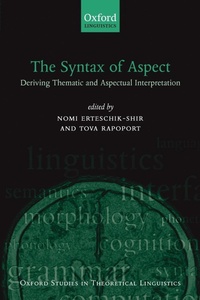
The Syntax of Aspect
Deriving Thematic and Aspectual Interpretation
Published on 26. May 2005
Book
Paperback/Softback
332 pages
978-0-19-928044-5 (ISBN)
Description
This book investigates the way grammar deals with the representation of aspectual (aktionsart) concepts, focussing on issues of the lexicon-syntax interface. The authors' innovative analyses of this interface significantly advance our understanding of the role that syntax plays in determining verbal meaning, aspectual interpretation, and thematic information.
Various theories are developed in this collection, including those that take as their starting point the lexical-syntactic framework of Hale and Keyser, prominent among which is the chapter by Hale and Keyser themselves.
By examining different phenomena in a cross-linguistic perspective, this book develops insights into the general theoretical question of universal grammar and acquisition as well as into the specific nature of the lexicon-syntax interface. It is a major contribution to modern syntactic theory.
Various theories are developed in this collection, including those that take as their starting point the lexical-syntactic framework of Hale and Keyser, prominent among which is the chapter by Hale and Keyser themselves.
By examining different phenomena in a cross-linguistic perspective, this book develops insights into the general theoretical question of universal grammar and acquisition as well as into the specific nature of the lexicon-syntax interface. It is a major contribution to modern syntactic theory.
Reviews / Votes
important contribution to the literature on aspect, argument mapping and interpretation, and the interface between the lexicon and the syntax. * Karen Zagona, Journal of Linguistics * an important contribution to the literature on aspect, argument mapping and interpretation, and the interface between the lexicon and the syntax ... this volume offers important insights into the structural and semantic underpinnings of the temporal and thematic properties of predicates, which take into account and are founded on a wealth of data from a range of languages. * Karen Zagona, Journal of Linguistics *More details
Series
Language
English
Place of publication
Oxford
United Kingdom
Target group
Professional and scholarly
Illustrations
2 tables, numerous line drawings
Dimensions
Height: 234 mm
Width: 156 mm
Thickness: 18 mm
Weight
503 gr
ISBN-13
978-0-19-928044-5 (9780199280445)
Copyright in bibliographic data and cover images is held by Nielsen Book Services Limited or by the publishers or by their respective licensors: all rights reserved.
Schweitzer Classification
Other editions
Additional editions
Nomi Erteschik-Shir | Tova Rapoport
The Syntax of Aspect
Deriving Thematic and Aspectual Interpretation
Book
05/2005
Oxford University Press
€108.94
Shipment within 15-20 days
Persons
Nomi Erteschik-Shir is Associate Professor in the Department of Foreign Literatures and Linguistics at Ben-Gurion University, Israel. Her publications include The Dynamics of Focus Structure (1997). She is writing The Syntax-Discourse Interface: Information Structure (forthcoming in Oxford Surveys in Syntax and Morphology).
Tova Rapoport is Senior Lecturer in the Department of Foreign Literatures and Linguistics at Ben-Gurion University, Israel. She is currently working on a theory of syntax-driven interpretation, including a book with Nomi Erteschik-Shir on the lexicon-syntax interface, The Atoms of Meaning.
Tova Rapoport is Senior Lecturer in the Department of Foreign Literatures and Linguistics at Ben-Gurion University, Israel. She is currently working on a theory of syntax-driven interpretation, including a book with Nomi Erteschik-Shir on the lexicon-syntax interface, The Atoms of Meaning.
Content
1 FROM LEXICAL ROOTS TO SYNTAX ; 1. Introduction ; 2. Aspect and the Syntax of Argument Structure ; 3. How do Verbs Get their Names? Denominal Verbs, Manner Incorporation and the Ontology of Verb Roots in English ; 4. Path Predicates ; 2 EVENT STRUCTURE AND FEATURE PROJECTIONS ; 5. Tense, Person, and Transitivity ; 6. Complex Aspectual Structure in Hindi/Urdu ; 7. The Aspect of Agency ; 8. Agents and Causes in Malagasy and Tagalog ; 9. Event Structure and Morphosyntax in Navajo ; 3 LEXICAL RESTRICTIONS ON SYNTAX ; 10. Constructions, Lexical Semantics and the Correspondence Principle: Accounting for Generalizations and Subregularities in the Realization of Arguments ; 11. Unspecified Arguments in Episodic and Habitual Sentences ; 12. Resultatives under the 'Event-Argument Homomorphism' Model of Telicity ; 13. Change of State Verbs: Implications for Theories of Argument Projection ; References