

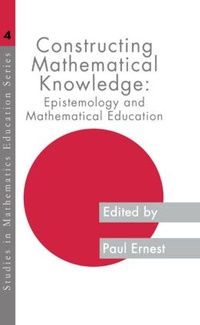
Constructing Mathematical Knowledge
Epistemology and Mathematical Education
1st Edition
Published on 31. October 1994
Book
Hardback
300 pages
978-0-7507-0354-3 (ISBN)
Description
First published in 1994. This book and its companion volume, Mathematics, Education and Philosophy: An International Perspective are edited collections. Instead of the sharply focused concerns of the research monograph, the books offer a panorama of complementary and forward-looking perspectives. They illustrate the breadth of theoretical and philosophical perspectives that can fruitfully be brough to bear on the mathematics and education. The empathise of this book is on epistemological issues, encompassing multiple perspectives on the learning of mathematics, as well as broader philosophical reflections on the genesis of knowledge. It explores constructivist and social theories of learning and discusses the rile of the computer in light of these theories.
More details
Language
English
Place of publication
London
United Kingdom
Publishing group
Taylor & Francis Ltd
Target group
Professional and scholarly
Dimensions
Height: 234 mm
Width: 156 mm
Weight
720 gr
ISBN-13
978-0-7507-0354-3 (9780750703543)
Copyright in bibliographic data and cover images is held by Nielsen Book Services Limited or by the publishers or by their respective licensors: all rights reserved.
Schweitzer Classification
Other editions
Additional editions
Book
06/2016
1st Edition
Routledge
€75.70
Article exhausted; check different version

E-Book
10/2012
1st Edition
Routledge
€47.49
Available for download

E-Book
10/2012
1st Edition
Routledge
€47.49
Available for download
Person
Paul Ernest is Reader in Mathematics Education in the School of Education at the University of Exeter.
Content
Introduction Part 1 Constructivism and the Learning of Mathematics Chapter 1 A Radical Constructivist View of Basic Mathematical Concepts Chapter 2 Interaction and Children's Mathematics 8 Chapter 3 Radical Constructive Criticisms of von Glasersfe1d's Radical Constructivism Chapter 4 Articulating Theories of Mathematics Learning Chapter 5 Is Radical Constructivism Coherent? Chapter 6 Social Constructivism and the Psychology of Mathematics Education Chapter 7 Mathematics, Computers and People: Individual and Social Perspectives Chapter 8 The Context of Cognition: The Challenge of Technology Part 2 Psychology, Epistemology and Hermeneutics Chapter 9 Another Psychology of Mathematics Education Chapter 10 On Interpretation Chapter 11 Potential Space and Mathematical Reality Chapter 12 Towards a Hermeneutical Understanding of Mathematics and Mathematical Learning Chapter 13 The Myth of Mathematics Part 3 Enquiry in Mathematics Education Chapter 14 The Problem of the Problem and Curriculum Fallacies Chapter 15 Enquiry in Mathematics and in Mathematics Education Chapter 16 Demystifying Mathematics Education through Inquiry Chapter 17 Reading to Learn Mathematics in the Primary Age Range Part 4 History, Mathematics and Education Chapter 18 The Idea of 'Revolution' As an Instrument for the Study of the Development of Mathematics and Its Application to Education Chapter 19 Mathematical Practices, Anomalies and Classroom Communication Problems